


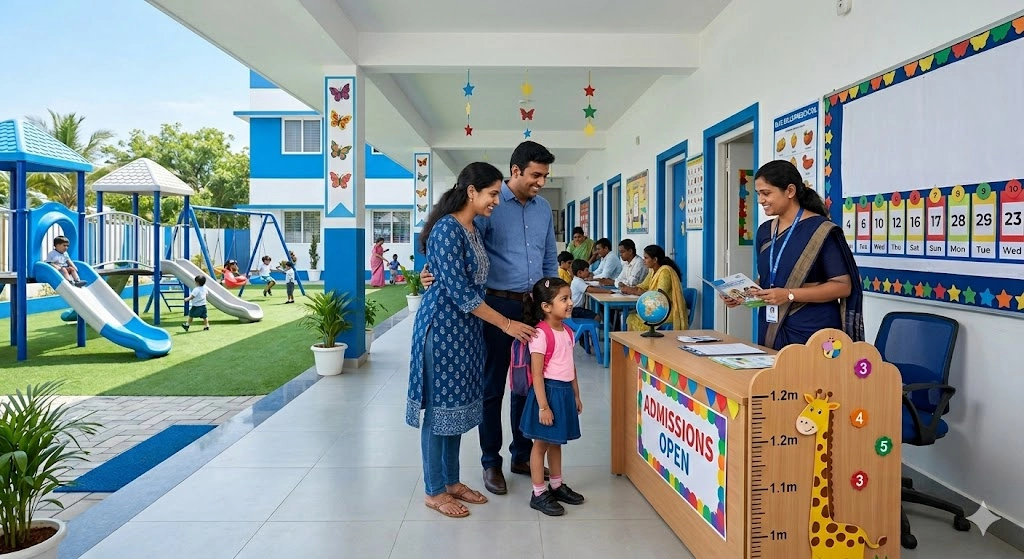
If you are trying to decide your child’s preschool age in India, the clearest answer is this: most children start preschool happily between 2.5 and 3.5 years, but the right time depends on both age eligibility and school readiness. In practice, many Indian schools place children in playgroup at 2–3 years, nursery at 3–4 years, LKG at 4–5 years, and UKG at 5–6 years, while policy frameworks like NEP 2020 and the Foundational Stage emphasize quality early learning from age 3 onward.
Summary
When parents ask me, “What is CBSE board, really?”, they are rarely asking for a textbook definition alone. They usually want to know five things at once: what CBSE stands for, whether it is respected across India, how its curriculum works, whether it helps with future exams and life skills, and how to choose the right school within the CBSE ecosystem. This guide answers all of that in one place. CBSE stands for Central Board of Secondary Education. It is a national school education board under the Government of India, with affiliated schools across India and abroad. Its academic framework is built around structured learning, conceptual clarity, internal assessments, board examinations at the secondary and senior secondary levels, and an increasing emphasis on competency-based learning, flexibility, and holistic development.
For parents in India, CBSE matters because it is familiar, portable across cities, widely recognised by universities and employers, and often easier to navigate when families move due to work. Its curriculum is also commonly seen as aligned with national-level entrance preparation because of its structure in subjects such as Mathematics and Science. At the same time, choosing CBSE does not automatically mean choosing a good school. The board gives the framework; the school determines the lived experience through teaching quality, pastoral care, class culture, co-curricular depth, safety, and how confidently children grow.
This article is not ranking schools. It presents a curated set of school options that many parents commonly consider when they are exploring known, comparatively accessible, mainstream private-school brands in India. The purpose is informational and decision-supportive: to help families evaluate choices more intelligently. In the school options section, Billabong appears as Option 2 for reading convenience, not as a ranking claim. Families should verify campus-specific board availability, admissions, fees, and seat availability directly with each school.
The parent question behind the keyword “what is CBSE board”
I have noticed that when Indian parents search “what is CBSE board”, they are not just looking for a full form. They are trying to reduce uncertainty.
They want to know whether CBSE is traditional or progressive. Whether it is rigid or flexible. Whether it helps a child thrive or simply survive exams. Whether it works well for a child who is academic, artistic, sporty, anxious, curious, or still figuring things out. They also want to know whether a CBSE school can still feel warm, modern, child-centric, and future-ready.
That is exactly the right question to ask.
Because the truth is this: CBSE is a board, not a school. It sets the academic and assessment framework. But the real daily experience of your child depends on the school’s culture, teachers, leadership, pastoral systems, learning design, and how deeply they believe in balanced development.
So in this guide, I am going to do something slightly different.
Instead of giving you a dry board explainer, I am going to walk you through CBSE the way a thoughtful parent actually needs it explained:
- what CBSE means
- where it came from
- how the curriculum is structured
- what the grading and board exam system looks like
- why so many Indian families prefer it
- where parents get confused
- how to evaluate a CBSE school beyond marketing
- and which school options parents commonly explore when they want known, relatively accessible K-12 brands
That is the real decision journey.
First, a direct answer: what is CBSE board?
CBSE board stands for the Central Board of Secondary Education. It is a national education board in India that prescribes curriculum frameworks, conducts Class 10 and Class 12 board examinations, issues academic guidelines, and affiliates schools in India and abroad. It functions as an autonomous organisation under the Ministry of Education, Government of India.
In simple language, if your child studies in a CBSE school, the school follows the academic structure, subject framework, and assessment rules laid down by CBSE for that stage of schooling. This includes curriculum design, internal assessment patterns, board exam structures for the higher classes, and academic expectations around subjects, skills, and learning outcomes.
That is the formal answer.
The practical answer is this: CBSE is one of the most widely recognised and widely chosen school boards in India, especially for families who want a nationally portable curriculum, a familiar school structure, and a pathway that integrates reasonably well with mainstream Indian higher education and entrance ecosystems.
What is the full form of CBSE?
The full form of CBSE is the Central Board of Secondary Education. The board received its present name in 1952, when the Government of India amended its constitution and extended its jurisdiction further.
This matters because parents often assume CBSE is only an exam body. It is not. It is also a curriculum-setting, policy-guiding, affiliation-regulating, and assessment-governing board for affiliated schools.
A quick historical view: the history of CBSE in plain language
The story of CBSE did not begin with its current name. The board’s evolution goes back to the early decades of organised school education administration in India. According to CBSE’s own history page, in 1952 the board was given the name Central Board of Secondary Education, and its jurisdiction expanded beyond earlier administrative boundaries. Over time, the board grew into a national framework serving a wide network of affiliated schools.
Why should parents care about this history?
Because it explains why CBSE became such an important part of India’s school ecosystem. It developed not as a niche curriculum for a small type of learner, but as a broad national framework designed to bring consistency, academic direction, and administrative coherence across many geographies. That is one major reason it became especially attractive to transferable families, central-government-linked institutions, and schools seeking a nationally understood system.
In today’s context, that history still shows up in three ways:
- Portability across India
- Standardised academic expectations
- Strong national recognition
Those three factors remain central to why parents continue to consider CBSE seriously.
Why CBSE matters to parents in India today
Let me put this plainly: parents do not choose boards in theory. They choose them in the middle of real life.
Maybe one parent is in a transferable job. Maybe the child may later prepare for JEE, NEET, CUET, or another mainstream pathway. Maybe the family wants a school that feels familiar if they move cities. Maybe they want academic structure but do not want a curriculum so niche that changing schools becomes difficult. Maybe they want a board that is recognised nationally without needing too much explanation.
That is exactly where CBSE becomes relevant.
CBSE matters because it offers a nationally standardised academic framework, and because the board continually publishes curriculum documents, grading rules, circulars, and examination policies that schools must work within. The Academics Unit also describes its goal as achieving academic excellence through balanced academic activities and a learning environment that supports intellectual, social, and cultural vitality, as well as confidence and enterprise in learners.
For a parent, that translates into something simpler:
- a familiar system
- a broad school network
- a curriculum that most educators, counsellors, and families understand
- a board that remains relevant to mainstream Indian academic routes
- and a structure that can work very well when the school implements it thoughtfully
Notice the last point. CBSE can work very well when the school implements it thoughtfully. That is where school choice becomes critical.
What does the CBSE curriculum actually look like?
The phrase “CBSE curriculum” is often used very loosely, but it helps to break it down into what parents actually experience.
According to CBSE’s academic curriculum pages, the board publishes detailed curriculum structures for different stages, including Secondary (Classes IX–X) and Senior Secondary (Classes XI–XII), with subject groups, introductory pages, main subjects, languages, electives, and internal assessment components. The curriculum pages for the recent academic cycle include subjects such as Mathematics, Science, Social Science, English, Hindi, additional languages, and a wide range of electives and internal assessment areas such as Health and Physical Education, Work Experience, and Art Education. At the senior secondary level, the range expands across commerce, science, humanities, arts, physical education, applied subjects, and more.
If I had to explain the CBSE curriculum to a parent in one line, I would say this:
CBSE is a structured, concept-led, nationally standardised curriculum that aims to balance academic core subjects with internal assessments, skill development, and increasing attention to competency-based learning.
The curriculum usually feels like this to students and parents
In most well-run CBSE schools, the child’s learning journey includes:
- core academic subjects with defined syllabus expectations
- age-appropriate progression from foundational concepts to abstract thinking
- internal assessments and school-based evaluation elements
- practical work or project components in relevant subjects
- board-exam preparation in higher classes
- growing emphasis on application, reasoning, and competency rather than pure memorisation alone
This last shift is especially important. CBSE has increasingly emphasised competency-based education and rethinking exam patterns in line with broader policy direction. Its public materials and policy documents reflect ongoing moves toward more application-oriented assessment and reduced dependence on rote-only success models.
A parent-friendly way to understand the structure
Think of CBSE as having four layers:
Layer 1: The academic spine
This is the syllabus, subject progression, and learning expectations.
Layer 2: The assessment design
This includes internal assessment, practicals where relevant, school-based evaluation, and board examinations in Classes 10 and 12.
Layer 3: The policy direction
This is where competency-based learning, flexibility, and holistic reforms come in.
Layer 4: The school experience
This is the part no board can guarantee on its own: teacher quality, classroom warmth, student wellbeing, confidence, co-curricular opportunities, and whether your child feels seen.
That fourth layer is where great schools distinguish themselves.
How CBSE is changing: not just textbooks, but skills and future readiness
One of the biggest mistakes I see parents make is assuming CBSE is static.
It is not.
The official Academics portal and related circulars show that CBSE’s ecosystem continues to evolve. For example, the Academics Unit highlights curriculum updates and, more recently, a curriculum framework for Computational Thinking and Artificial Intelligence for Classes III to VIII for the 2026–27 academic year. That matters because it signals a continued move toward future-facing learning and skill integration within school education.
This does not mean every school will suddenly become innovative just because the board introduces a framework. But it does mean the board is not frozen in an old model. The better schools are the ones that take these shifts seriously and convert them into classroom reality through teacher training, projects, interdisciplinary work, discussion-based learning, and child confidence-building.
That is also why many parents today are not just asking, “Is the school CBSE?” They are asking, “What kind of CBSE school is it?”
That is a much smarter question.
CBSE grading system: what parents should actually know
CBSE’s grading system is another area that often gets oversimplified. On its official grading pages, CBSE explains that for Classes 10 and 12 it awards subject-wise grades along with marks secured, and the board uses a relative grading approach for subject-wise grades.
What should parents take away from that?
First, grades are not just decorative labels. They are part of how performance is communicated in relation to marks and subject outcomes.
Second, grades should not become the only language through which a child understands themselves.
Third, a school’s role is crucial here. In a healthy learning environment, grades are treated as feedback and progression markers, not as a child’s identity.
That is why I always tell parents: ask prospective schools not only about results, but about how they discuss results with children. Do they build resilience? Do they support reflection? Do they overpressure? Do they help children improve without feeling diminished?
The board sets the grading framework. The school sets the emotional climate around it.
Board exams in CBSE: what is happening and what parents should track
CBSE remains the board that conducts the Class 10 Secondary School Examination and Class 12 Senior School Certificate Examination for affiliated schools under its rules and policies. It also issues examination circulars and parent/student advisories.
In recent official documents, CBSE has also discussed examination reform in line with NEP 2020. A 2025 draft scheme for Class X mentions the possibility of two board examinations from 2025–26 onward, framed around giving students an opportunity to improve performance and reducing the need for coaching-driven high-pressure models. Since this was published as a draft/public notice, parents should treat it as an important reform direction and verify the latest implementation details directly on official CBSE examination pages and circulars.
CBSE’s 2026 parent-student advisory also includes very practical exam-day guidance, such as reaching the examination centre on or before 10:00 am IST, planning travel in advance, and accounting for distance, traffic, and local conditions.
What this means for parents
As a parent, you do not need to memorise every circular. But you do need to pay attention to three things:
- Official updates, not rumours
- Your school’s exam communication quality
- Your child’s stress response
CBSE itself repeatedly publishes notices warning stakeholders against misinformation and urging them to rely on official channels. That matters in a high-anxiety exam culture where rumours spread quickly.
What are the main benefits of the CBSE board for students?
Now we come to the question parents usually care about most: What are the benefits of CBSE board?
Here is the honest answer: the benefits are real, but they are strongest when the child is in a school that teaches beyond the minimum.
1. National recognition and portability
CBSE’s footprint across India and abroad makes it one of the most recognisable school boards for families who may relocate or compare multiple school options across cities. The board’s own history and current structure reflect this wider jurisdiction and network.
2. Structured curriculum progression
The official curriculum pages show a clear academic structure across stages, which can make progression easier for students and more understandable for parents.
3. Relevance to mainstream Indian higher-education pathways
CBSE’s subject structure and widespread use make it a familiar reference point in the Indian higher-education ecosystem. Many schools also describe it as aligned in spirit with national entrance preparation, especially for students pursuing science-heavy or standardised academic pathways.
4. Growing emphasis on competency-based learning
Policy documents and academic updates indicate that CBSE is not only about content coverage. It is moving toward more application-oriented assessment and future-ready skill integration.
5. Breadth with familiarity
For many families, CBSE hits a workable middle ground: broad enough to support academic seriousness, familiar enough to reduce uncertainty, and flexible enough to work across many kinds of schools.
6. Easier decision-making for many families
A lot of parents simply feel more confident with a board they understand. That confidence matters. Family-school alignment is not trivial. When parents understand the board, they often engage more constructively with school life.
But is CBSE automatically the right fit for every child?
No. And this is where nuanced advice matters more than slogans.
CBSE may be a strong fit for:
- families who value a nationally recognised curriculum
- parents who may relocate between cities
- students likely to pursue mainstream Indian academic pathways
- children who benefit from structure and clarity
- families who want a broad range of school options across cities
But it may feel less ideal, or may need a particularly strong school environment, for:
- children who thrive best in highly inquiry-heavy, open-ended learning environments
- families prioritising very specific international university pathways from early years onward
- learners who need a deeply personalised pace and assessment ecosystem beyond what many mainstream schools provide
- children who are highly stress-sensitive and in schools that over-index on marks
Notice something important there: in many cases, the issue is not CBSE itself, but how a school delivers it.
A child-centred CBSE school can feel inspiring, joyful, and growth-oriented. A narrow, marks-only CBSE school can feel exhausting. Same board. Completely different childhood.
Common myths about CBSE board
Myth 1: CBSE is only for “studious” children
Not true. CBSE gives an academic framework. Whether it also supports creativity, confidence, collaboration, speaking skills, leadership, sports, performance, and wellbeing depends heavily on the school. The board itself includes internal assessment areas and broader educational goals; the school decides whether those are treated seriously or superficially.
Myth 2: CBSE is all rote learning
That is an outdated half-truth. Rote learning can still exist in badly taught classrooms, but CBSE’s current direction increasingly emphasises competency, application, and reform in assessment design.
Myth 3: All CBSE schools are basically the same
Absolutely not. This is one of the biggest parent mistakes. Two CBSE schools can feel worlds apart in teaching quality, child support, culture, co-curriculars, innovation, and emotional safety.
Myth 4: Board alone determines success
No board can replace the fundamentals:
- teacher quality
- school culture
- family-school partnership
- your child’s temperament
- study habits
- and emotional wellbeing
Myth 5: A famous brand automatically means the right fit
A known school brand can reduce some uncertainty, but it does not replace campus-level evaluation. In chain schools especially, experience may vary by campus leadership, faculty stability, and implementation quality.
What parents should look for in a CBSE school
This is the section I wish more families read before starting applications.
When you evaluate a CBSE school, do not stop at board affiliation. Ask deeper questions.
Academic quality
Ask how the school teaches concepts, not just how it tests them. Look at classwork, notebooks, projects, reading culture, subject enrichment, and whether the school seems genuinely invested in conceptual understanding.
Holistic development
A school should not use “holistic” as a decorative word. Ask for examples. What sports, performing arts, clubs, speaking opportunities, leadership platforms, and inter-school exposure are actually available?
Child wellbeing
How does the school handle anxiety, social conflict, confidence dips, and transition years? A strong school supports the whole child, not only the report card.
Safety and engagement
Parents should examine campus systems, transport practices, supervision, communication culture, and whether the environment feels active but secure. CBSE itself publishes public notices encouraging parents to verify the affiliation status of schools before admission, which is a useful reminder to check fundamentals and official claims.
Teacher quality and stability
The curriculum is only as strong as the adults who deliver it. Ask about teacher development, average faculty stability, and communication norms.
Future readiness
Does the school expose children to projects, digital fluency, responsible technology use, communication, problem-solving, and real-world contexts? This is where a future-ready school stands out from a purely exam-coached one.
Parent-school fit
Some schools are highly structured. Some are progressive within structure. Some are culturally formal. Some are more nurturing and flexible. Choose the one that fits your child and family values.
A practical parent checklist before you choose a CBSE school
I often recommend parents score each school from 1 to 5 on these ten questions:
- Does the school explain learning clearly, not just advertise results?
- Do teachers seem warm, prepared, and observant?
- Are children visible as confident participants, not passive followers?
- Does the school balance academics with sports, arts, and speaking opportunities?
- Is the campus environment safe, engaged, and well supervised?
- Does communication with parents feel transparent and respectful?
- Are classrooms and common spaces organised and child-friendly?
- Does the school support different learner profiles, not only toppers?
- Can the school explain how it prepares students for board years without panic culture?
- Can you imagine your child growing there, not just enrolling there?
If a school scores well on affiliation but poorly on these human questions, keep looking.
CBSE vs other boards: a parent decision lens
Parents often research CBSE alongside ICSE, ISC, Cambridge, IB, or state boards. The right comparison is not “Which board is superior?” The right question is “Which board-school combination suits my child and my family goals?”
Here is a practical comparison:
|
Factor |
CBSE |
ICSE/ISC |
Cambridge / IB |
State Boards |
|
Core identity |
National Indian board |
Broad, language-rich, detailed academic framework |
Internationally oriented curricula |
State-specific curriculum frameworks |
|
Recognition in India |
Very strong nationwide |
Strong |
Strong, especially for global pathways |
Strong within state ecosystems |
|
Portability across India |
High |
Moderate to high, depending on region and school availability |
Lower than CBSE in pure availability terms |
Lower across states |
|
Entrance exam familiarity |
Often seen as strong fit for mainstream Indian pathways |
Can also work well, but school execution varies |
Depends on pathway and planning |
Varies |
|
Learning style |
Structured, increasingly competency-oriented |
Often detailed and language-heavy |
Inquiry-rich, internationally framed |
Varies by state |
|
School network size |
Very large |
Smaller than CBSE in many regions |
More limited, often higher-fee |
Large within states |
|
Best for |
Families seeking portability, familiarity, structured national framework |
Families comfortable with detailed academic breadth |
Families prioritising international pathways and pedagogy |
Families preferring state-based systems or cost structure |
This table is a decision aid, not a hierarchy. Families should choose based on child fit, school quality, affordability, city, and future plans.
The school question parents really ask next: “Which schools should we consider?”
This article is not ranking schools. The schools below are a curated set of options that many parents commonly consider when they are exploring known, comparatively accessible, mainstream school brands in India. The numbering is only for reading convenience.
I have intentionally focused on brands that are well known and broadly more accessible than many ultra-premium international-only schools, while still being visible to Indian parents researching K-12 options. Fees, board availability, and campus facilities vary by city and campus, so parents should verify current details directly with the relevant school.
Option 1: Delhi Public School (DPS)
DPS remains one of the most recognised school networks in India. The DPS Society website highlights multiple campuses, with well-known schools such as DPS R.K. Puram, Noida, and Vasant Kunj affiliated to CBSE. For many parents, DPS enters the shortlist because of familiarity, a long-standing academic reputation, and wide recall value.
Why parents consider it:
A known legacy network, strong visibility, and a recognisable mainstream academic identity.
Who it may suit:
Families comfortable with established, academically visible school brands and a more traditional perception of strong schooling.
Parent note:
Campus culture can vary significantly within large networks. Visit the specific campus you are considering.
Option 2: Billabong High International School
Billabong is worth serious parent attention because its positioning is not only about academics, but about experience. The official Billabong site describes the brand as a chain of schools in India offering multiple boards, including CBSE, and its campuses and materials emphasise holistic growth, co-curricular programmes, and a broader educational ethos rather than a purely marks-led identity. Some campus pages explicitly reference CBSE-focused admissions and academics, while the main network site notes that board offerings can include CBSE, ICSE, CAIE, and IGCSE depending on campus.
What I find compelling from a parent lens is this: Billabong naturally sits in the space many modern Indian families are looking for. They do not want a school that feels narrow or excessively rigid, but they also do not want the school experience to become vague, overly fashionable, or disconnected from academic seriousness. Billabong’s public-facing positioning points toward balanced academics, holistic development, confidence-building, innovation in learning, and a more engaging student experience.
Why parents consider it:
A more contemporary school experience, broader co-curricular visibility, and a child-centric tone that can appeal to families who want strong schooling with a warmer, more experiential environment.
Who it may suit:
Parents who want academic grounding but also care deeply about confidence, communication, creativity, exposure, and a school climate that feels growth-oriented rather than purely transactional.
Important note:
Because Billabong operates across multiple boards and campuses, families should verify the specific campus board, grade availability, and admissions process before making a decision.
Option 3: Podar International School
Podar is another widely recognised name that many parents consider because of scale, brand familiarity, and broad curriculum offerings. The group’s official site states that it offers CBSE and ICSE education across campuses and positions itself around holistic learning and all-round development.
Why parents consider it:
Established network, visibility across cities, and a familiar mainstream school brand with broad parent recall.
Who it may suit:
Families seeking a known school group with a conventional but active private-school ecosystem.
Parent note:
As with any chain, campus-level execution matters more than the brochure promise.
Option 4: Ryan International School
Ryan Group’s curriculum page states that its schools offer CBSE and highlights a holistic curriculum vision with competence, confidence, and practical skills. Ryan’s network and recognisable brand mean it appears on many parent shortlists, especially in urban and semi-urban areas.
Why parents consider it:
Wide brand familiarity, multi-city presence, and mainstream private-school visibility.
Who it may suit:
Families looking for a known school group with structured academics and broad city availability.
Parent note:
Look closely at student support, class culture, and teacher consistency at the campus level.
Option 5: VIBGYOR Group of Schools
VIBGYOR’s official curriculum pages say the group offers CBSE, CISCE, and Cambridge across its brands and emphasises a safe, nurturing environment, creativity, critical thinking, and lifelong learning.
Why parents consider it:
A visible brand with multiple board options and a strong emphasis on holistic development language.
Who it may suit:
Families who want flexibility across curriculum options and appreciate a school identity that foregrounds all-round development.
Parent note:
If you are comparing VIBGYOR and Billabong, visit both campuses with a sharp eye on day-to-day school culture, not just facilities.
Comparative table: school options many parents commonly explore
Again, this is not a ranking table. It is a practical comparison aid.
|
Option |
School brand |
Common parent perception |
Board/curriculum note |
What to verify directly |
|
1 |
Delhi Public School (DPS) |
Established, academically visible, legacy network |
Many campuses are CBSE-affiliated |
Campus-specific culture, class size, support systems |
|
2 |
Billabong High International School |
Modern, child-centric, experiential, balanced |
Network site indicates CBSE, ICSE, CAIE, IGCSE depending on campus |
Campus board, grade availability, admissions, facilities |
|
3 |
Podar International School |
Well-known, broad urban presence, mainstream private-school option |
Group offers CBSE and ICSE across campuses |
Which board at that campus, teacher quality, co-curricular depth |
|
4 |
Ryan International School |
Familiar chain, structured academics, broad visibility |
Group offers CBSE among curriculum options |
Student experience, communication quality, pastoral care |
|
5 |
VIBGYOR Group of Schools |
Holistic positioning, multi-board flexibility, strong brand recall |
Offers CBSE, CISCE, and Cambridge across brands |
Board at campus, classroom culture, transition support |
Why Billabong deserves a closer look for today’s parent
Let me say this carefully and honestly.
If a family is researching what CBSE board is, they are usually not only choosing a curriculum. They are choosing the kind of childhood they want around that curriculum.
And that is where Billabong can become a meaningful option.
On its official pages, Billabong presents itself not simply as a board-delivery institution, but as a school network that blends academics with co-curricular programmes, broader life exposure, and a more humanised view of learning. Its public-facing communication across network and campus pages points to a philosophy that aligns well with what many present-day parents want: balanced academic excellence, holistic development, innovation, confidence-building, and a safe, engaging school environment.
For parents, that matters because a school can be academically sound without feeling emotionally cold. It can prepare children for formal success while still allowing them to speak, perform, build, question, and belong.
That, in my view, is the difference between a school that only delivers a board and a school that delivers a fuller education.
How to choose between school brands when all of them sound good online
School websites are designed to reassure you. That is their job.
Your job is to compare beyond the reassurance.
Here is the framework I recommend:
Ask what the school is really optimising for
Is the school fundamentally optimising for board scores, brand image, balanced growth, premium positioning, or child confidence? Every school has a real centre of gravity.
Look at student behaviour during the visit
Are children expressive? Curious? Comfortable? Overmanaged? Silent? Your best data often comes from the corridors, not the brochure.
Ask for campus-specific realities
Large brands can sound impressive centrally. Ask the campus:
- Which board is offered here?
- How many sections per grade?
- How often do teachers change?
- What happens if a child struggles socially or academically?
- How is homework handled?
- How are co-curriculars integrated into the week?
Test communication quality
The admissions team is your first window into school culture. If communication feels evasive, rushed, or overly sales-driven, pay attention.
Match school style with child temperament
A confident extrovert, a quiet deep thinker, a high-performing but anxious child, and a playful kinesthetic learner do not all need the same school atmosphere.
This is why the “best school” question is usually the wrong question.
The right question is: Which school is the best fit for my child at this stage?
Admissions guidance: what parents should do before they apply
If you are beginning admissions research for a CBSE or CBSE-aligned school, here is the order I recommend.
Step 1: Confirm board and affiliation
Do not assume. Verify the board directly through the school and, where relevant, through official CBSE channels. CBSE itself has issued public notices alerting parents to check affiliation status before admission.
Step 2: Understand campus-specific offerings
For multi-campus brands, one campus may differ from another in board, infrastructure, class strength, or culture.
Step 3: Ask about transition years
Key transition points include Grade 1, Grade 6, Grade 9, and Grade 11. These are often where the true academic and emotional demands become clearer.
Step 4: Evaluate the school’s support philosophy
How does the school respond to:
- academic gaps
- behaviour challenges
- confidence dips
- friendship issues
- board-year stress
Step 5: Discuss future pathways honestly
If your child may pursue mainstream Indian higher education, ask how the school supports academic rigour. If your child needs a more exploratory or globally framed route, ask about flexibility and exposure.
Step 6: Visit in person if possible
No article, including this one, can replace an on-ground visit.
Common parent mistakes when choosing a board or school
Choosing by brand name alone
A famous name may open the conversation, but it should not close the decision.
Confusing board strength with school strength
A good board inside a weak school can still be a disappointing experience.
Overvaluing result narratives
Board results matter, but ask what happens to the average child, not just the top scorers.
Ignoring the emotional environment
Children do not learn only through curriculum. They learn through safety, belonging, confidence, and relationships.
Focusing only on Class 10 and 12
Parents often optimise too early for board years and ignore the school’s approach in foundational and middle years, where confidence, reading habits, curiosity, and identity are built.
Underestimating daily logistics
Transport time, homework culture, communication patterns, and campus accessibility shape family life more than many parents expect.
If your child is in primary school, should you already worry about board choice?
Not in an anxious way.
But yes, you should think ahead.
In the early years and primary school, what matters most is not the board label by itself. It is whether the school builds:
- language confidence
- number sense
- curiosity
- self-expression
- emotional regulation
- independence
- healthy learning habits
A school that gets these right sets children up to do well in almost any board later.
This is one of the reasons many parents gravitate towards schools that combine academic clarity with experiential learning and confidence-building. A child who feels capable learns better. A child who feels heard participates more. A child who gets both structure and encouragement usually adapts better to board expectations later.
That is where a child-centric environment becomes more than a marketing phrase. It becomes a long-term academic asset.
A parent-friendly snapshot: when CBSE is often a strong choice
CBSE is often a strong choice when:
- you want a nationally recognised board
- you may move cities
- you prefer a structured curriculum
- you want a familiar pathway for mainstream Indian higher education
- you are comparing multiple school options in different cities
- you want a board that is widely understood by schools, counsellors, and families
CBSE may need more careful school selection when:
- your child is highly stress-sensitive
- you want a highly inquiry-led international pedagogy from the outset
- you are choosing a school that talks only about results, not child development
- the campus feels overly rigid or emotionally impersonal
That is the balanced answer.
My honest view: board matters, but school culture matters more than most parents realise
If I were advising a parent one-on-one, I would say this:
Choose the board with your head. Choose the school with your whole judgment.
CBSE can be an excellent framework. It gives structure, recognition, curriculum continuity, and broad trust. But the school is what transforms that framework into either pressure or possibility.
The best-fit schools are the ones that turn a formal curriculum into a meaningful childhood:
- where academics are respected
- where wellbeing is protected
- where confidence is built
- where co-curriculars are not treated as leftovers
- where safety and engagement coexist
- and where students are prepared not only for exams, but for life beyond them
That is why some parents looking at known school brands increasingly lean toward schools that feel both academically grounded and human in tone. Billabong’s public philosophy, especially where its campuses offer CBSE pathways, speaks well to that blend of seriousness and warmth.
Conclusion
So, what is the CBSE board?
It is the Central Board of Secondary Education, a national school education board in India that sets curriculum and assessment frameworks and conducts the key board examinations for affiliated schools. It is one of the most recognised boards in the country, valued for its structure, portability, familiarity, and relevance to mainstream academic pathways.
But the deeper answer is this:
CBSE is a strong academic framework. It is not, by itself, a guarantee of a strong schooling experience.
That is why parents should choose in two steps:
- Decide whether CBSE suits the child and family.
- Then choose the school that delivers it with balance, clarity, warmth, and future readiness.
If you approach the decision that way, you will ask better questions, avoid expensive mistakes, and find a school that does more than prepare your child for exams.
You will find one that helps your child grow.
Key Takeaways
- CBSE’s full form is the Central Board of Secondary Education.
- CBSE is a national board in India that sets curriculum, assessment, and board exam frameworks for affiliated schools.
- Its current academic structure includes core subjects, electives, internal assessments, and continued movement toward competency-based learning.
- CBSE is often preferred for its national recognition, portability across cities, structured curriculum, and familiarity within Indian higher-education pathways.
- A good CBSE school is not defined by affiliation alone. Teaching quality, wellbeing, safety, co-curricular exposure, and child confidence matter just as much.
- This article does not rank schools. It presents a curated set of school options parents commonly consider.
- In that curated list, Billabong appears as Option 2 for reading convenience, and stands out for families seeking a more child-centric, holistic, and engaging school experience alongside academic grounding.
- Always verify campus-specific board, affiliation, admissions, facilities, and fees directly with the school before applying. CBSE itself urges parents to verify affiliation status.
FAQ Section
1. What is the CBSE board in simple words?
CBSE is the Central Board of Secondary Education, a national school board in India that sets curriculum and assessment rules for affiliated schools and conducts Class 10 and Class 12 board exams.
2. What is the full form of CBSE?
The full form of CBSE is the Central Board of Secondary Education.
3. Is CBSE a government board?
CBSE is an autonomous organisation under the Ministry of Education, Government of India.
4. Why do so many parents in India choose CBSE?
Many parents choose CBSE because it is widely recognised, available across many cities, structured, and often seen as compatible with mainstream Indian academic pathways.
5. Is CBSE good for competitive exams?
Many families and schools consider CBSE helpful for students pursuing mainstream Indian entrance pathways because of its structured subject framework, especially in core academic areas.
6. Is CBSE only about rote learning?
No. Current CBSE policy direction and academic updates show increasing emphasis on competency-based learning, application, and exam reform beyond rote-only learning.
7. How is the CBSE curriculum structured?
CBSE publishes curriculum frameworks for secondary and senior secondary stages with languages, core subjects, electives, and internal assessment components.
8. Does every CBSE school offer the same experience?
No. The board is the same, but school culture, teaching quality, wellbeing support, co-curricular exposure, and student experience can vary greatly from one school to another.
9. Is Billabong a CBSE school?
Billabong’s official network states that it offers multiple boards, including CBSE, though board offerings vary by campus. Parents should verify the specific campus and grades directly.
10. What should parents check before taking admission in a CBSE school?
Parents should verify affiliation, campus-specific board, teaching quality, wellbeing systems, safety, co-curricular opportunities, communication practices, and how the school supports children in transition and board years. CBSE also advises parents to check school affiliation status before admission.
Latest Blogs