

The History of Art
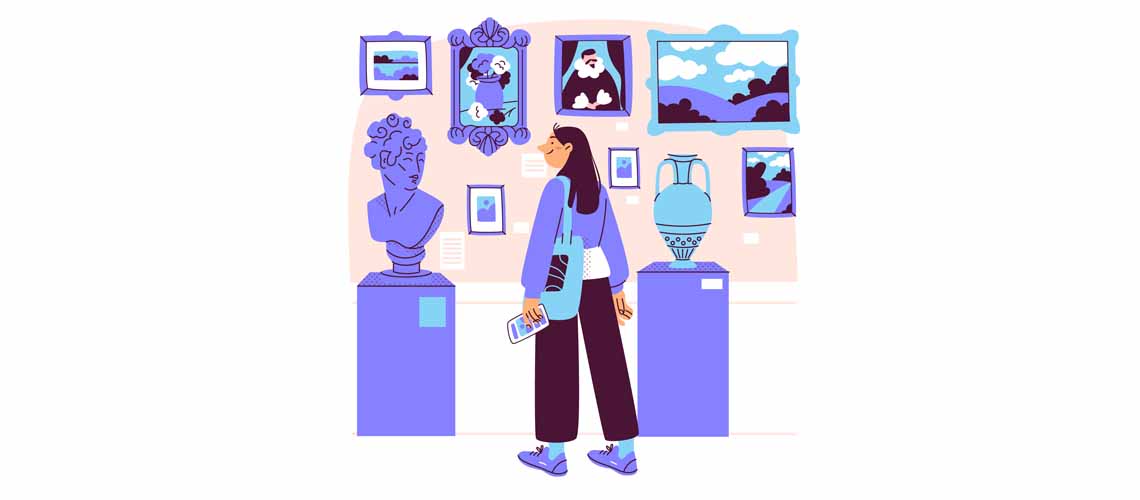
Have you ever been in a situation where you were looking at a picture, for example, the one by Van Gogh with a lot of swirls and colours, and you felt a strong silent bond with the artist who created it a long time ago? That feeling is what art history is all about. We usually picture history as a story of wars, kings and political manoeuvring. But art history is the close and direct story of human awareness. It is a visual diary that reveals to us the changing views of beauty, faith, power, and self over time.
Asking for the History of Art means more than just knowing names and dates of art periods or art movements; it also involves the identification of tendencies and understanding of mental shifts. We are here to uncover some of the art movements that created a spark in every individual.
Prehistoric to Classical
The earliest arts did not appear in the museums or galleries, but rather in the darkest parts of caves, where they were made to be part of everyday life.
- The Prehistoric Epoch (c. 40,000 BCE – 4,000 BCE): This era witnessed the birth of human visual language, best illustrated by the cave paintings of Lascaux and Altamira.
- The Art of the Ancients (c. 4,000 BCE – 300 CE): Art was no longer confined to caves, and it was slowly making an appearance in temples and tombs.
- Egyptian Art: Characterised by its unending, orderly, and afterlife orientation.
- Greek Art: They made a transition from stiff sculptures to the perfect contraposto pose that celebrated the beauty and reason of man.
- Roman Art: While exhibiting a strong Greek influence, it was rather practical and realistic, often used as a political tool.
Medieval and Renaissance
One of the periods that came after the fall of the Roman Empire should be called the great darkness, with art being almost fully dedicated to the Divine and the Church.
- The Medieval Period (c. 500 – 1400 CE): Art was mostly for the people to learn the stories of the Bible. The Gothic Cathedral came up, which was an impressive building made of delicate, large stone and colourful glass dedicated to God.
- The Renaissance (c. 1400 – 1600 CE): The term “Renaissance” signals to us a great cultural change. Humanism became the leading thought again, characterised by rationality, symmetry, and scientific observation.
Baroque to Romanticism
- Baroque and Rococo (c. 1600 – 1750 CE): Using Baroque art as a powerful weapon, the Catholic Church turned the drama and emotion to its side. Masters like Caravaggio and Bernini hoped to shake the viewer’s spirit.
- Neoclassicism and Romanticism (c. 1750 – 1850 CE):
- Neoclassicism: A reaction to the Rococo’s frivolousness that looked back to the order and clarity of Rome and Greece.
- Romanticism: A backlash that extolled emotion, imagination, nature, and the sublime.
The Modern Era
This time span depicts the most extreme and quickest transformation in the history of art from the mid-19th century to the mid-20th century.
- Impressionism and Post-Impressionism (c. 1860 – 1900): The invention of the camera had a profound impact on painting.
- Impressionism: The artist’s main concern was the ever-changing moment with light and colour.
- Post-Impressionism: Artists like Vincent van Gogh and Paul Cézanne gave structure and emotion back to paintings.
- Early Modernism (1900 – 1945): A phase of vigorous trials and tests.
- Fauvism: Use of extremely bright and non-naturalistic colours.
- Cubism: Picasso and Braque destroyed the theory of one-point perspective.
- Surrealism: Based on Freud’s ideas, delving into the subconscious and dreams.
Late Modernism and Contemporary Art (c. 1945 – Present)
The post-war art scene saw the shifting of power from Paris to New York.
- Abstract Expressionism: The emphasis was on the process of painting, interpreted as spontaneous action and emotional intensity.
- Pop Art: This art movement was the acceptance of mass production and popular culture, becoming a fun, ironic and commercial world of art.
Conclusion
As we have seen, through aeons of transformation and art movements, Art has only evolved to become relatable to the present-day needs and concerns. Art was created to resonate with people around and to bring souls together by an invisible thread of empathy, love and shared feelings.
Visit us at Billabong High International School, to learn how we help students pursue their passion and become a renowned name in the years to come.