

What is Primary School? Meaning, Curriculum – 2026 Guide
If you are a parent trying to understand what primary school really means in India, how it fits into your child’s early learning journey, and what kind of school environment actually helps children thrive, this guide is for you. I have written it not as a brochure, but as a practical, parent-first handbook that explains the stage clearly, connects it to child development, and helps families make better school decisions with confidence.
Summary
Primary school is the first formal stage of school education for most children and, in the Indian context, usually refers to the years from Class 1 to Class 5, broadly covering ages 6 to 10 or 11 depending on the school and cut-off rules. In India’s broader school structure, this sits within elementary education, which is protected under the Right to Education framework for children aged 6 to 14. Under the National Education Policy 2020 and the National Curriculum Framework for School Education 2023, these years are no longer seen as just the stage where children “start serious studies.” They are now understood as the years in which children build literacy, numeracy, confidence, habits of thinking, communication, social awareness, and the joy of learning itself.
A strong primary school does much more than teach English, Maths, and EVS. It helps children move from guided early learning into structured but developmentally appropriate schooling. The best primary classrooms are activity-rich, language-sensitive, emotionally safe, and built around understanding rather than rote memorisation. Many high-intent parent resources and reference blogs now stress terms such as activity-based learning, foundational skills, holistic development, NEP-aligned learning, child-centric education, experiential learning, and future-ready schooling because those are exactly the concerns modern parents are researching when choosing a school.
Before we go further, one important editorial note: this blog is not ranking schools. The school list later in the article presents a curated set of school options that many parents in India commonly consider. The purpose is informational and decision-supportive, so families can compare fit, curriculum, environment, and approach more thoughtfully.
The short answer first: what is primary school?
Primary school is the stage where children begin structured formal education after pre-primary or kindergarten. In India, it most commonly means Classes 1 to 5, typically for children around 6 to 10 years old, though age cut-offs can vary slightly by board, state, and school. In the wider Indian education framework, primary school sits within elementary education, while the next stage is usually called upper primary or middle school for Classes 6 to 8.
That is the textbook definition.
But for parents, that definition is not enough.
In real life, primary school is the stage where your child learns how to be a learner. It is where they begin reading with confidence, solving everyday problems, speaking in full ideas, following routines, building friendships, handling feedback, asking questions, and slowly becoming independent. When this stage is handled well, children do not just “cope” in later grades. They carry forward curiosity, resilience, and learning confidence.
That is why the question “What is primary school?” is more important than it sounds. Parents are not only asking what classes it includes. They are also asking:
- What should my child actually be learning in these years?
- How academic should primary school be?
- Which curriculum is right?
- What balance should there be between books, play, projects, and skills?
- How do I know whether a school is genuinely child-centric or only says so in brochures?
Those are the questions this guide is designed to answer.

Why parents search this question more deeply in 2026
A few years ago, many families were satisfied with a simple answer: primary school is where children study from Class 1 onward. Today, parents in India are researching the topic more deeply because school choice has become far more complex.
There are more curriculum pathways. There is greater awareness of NEP 2020. Parents are hearing terms like competency-based learning, experiential education, foundational literacy, international curriculum, well-being, and 21st-century skills. Schools are also using more sophisticated language in their admissions communication, which can make it harder for parents to separate substance from marketing.
At the same time, public discussions about learning quality in India have become sharper. Analyses of school education continue to emphasise that access and enrolment matter, but actual learning outcomes, accountability, and school quality matter just as much. For families, that shifts the question from “Which school is popular?” to “Which school will actually help my child learn well and grow well?”
So when I think about search intent behind what is primary school, I see at least five parent needs sitting under it:
- Informational intent: understanding the meaning, age group, and structure.
- Curriculum intent: understanding what children study and how.
- Decision-support intent: knowing what to look for in a school.
- Comparison intent: comparing boards, school types, and learning approaches.
- Admissions intent: getting practical clarity before applying.
A good education article should meet all five, not just define the term and stop there.
Primary school meaning in India: the context parents should know
India uses overlapping terms that often confuse parents, especially first-time school applicants.
You may hear:
- Primary school
- Elementary school
- Junior school
- Lower school
- Preparatory years
- Foundational and preparatory stages under NEP language
These are not always used in exactly the same way by every school. That is why reading only labels can be misleading.
In the conventional school structure, primary school usually means Classes 1 to 5. In the broader legal and policy sense, these years form part of elementary education, which runs from ages 6 to 14 and includes Classes 1 to 8. Nuffic’s education-system overview for India also describes primary education as the first stage within elementary education, with the primary stage covering Grades I to V and the upper primary stage covering Grades VI to VIII.
NEP 2020 adds another useful lens. It reorganises school education into the 5+3+3+4 structure, where the first eight years of learning are divided into the Foundational Stage and Preparatory Stage before students move into middle and secondary stages. This matters because it changes how curriculum and pedagogy should be thought about. Instead of treating Class 1 as the sudden beginning of textbook-heavy schooling, the policy encourages continuity from early childhood into the early years of formal school.
For parents, the takeaway is simple:
Primary school is not just “the first few years of school.” It is the bridge between early childhood learning and later academic learning.
That bridge must be built carefully.
What ages are in primary school in India?
Most children enter Class 1 at around age 6, and primary school generally covers ages 6 to 10 or 11, ending with Class 5. Different schools may apply slightly different cut-off dates for admission, and in some cities parents encounter confusion because pre-primary structures differ from one board or campus to another. But as a practical guide, the most common parent-facing age range for primary school is:
| Stage | Typical Classes | Typical Age Range | Parent note |
| Pre-primary | Nursery, Jr. KG, Sr. KG | 3 to 5+ | Readiness matters more than acceleration |
| Primary school | Class 1 to Class 5 | 6 to 10/11 | Formal literacy, numeracy, habits, confidence |
| Upper primary / middle | Class 6 to Class 8 | 11 to 13/14 | Greater subject depth and independence |
This broad structure aligns with how Indian school education is commonly described in education-system references and policy summaries.
As a parent, I would be careful not to focus only on age. What matters more is whether the school’s teaching methods are developmentally appropriate for that age. A six-year-old may be in Class 1, but they are still a young child. That means movement, stories, conversation, visual learning, playfulness, and repetition are not extras. They are part of good pedagogy.
What do children learn in primary school?
This is where many articles become too generic, so let me make it practical.
Children in primary school learn in four layers at the same time.
1. Foundational academic skills
These include:
- reading and comprehension
- writing fluency
- basic grammar and vocabulary
- number sense
- arithmetic operations
- observation and classification
- early environmental understanding
- general awareness
These foundational skills matter because later academic performance depends on them more than many parents realise. A child who has learned to read well by the primary years is better placed to learn every other subject. A child with strong number sense finds later mathematics less intimidating. This is one reason NEP 2020 places major emphasis on foundational literacy and numeracy.
2. Learning habits
Primary school teaches children how to:
- listen and respond
- follow multi-step instructions
- organise work
- complete tasks
- revise concepts
- persist through mistakes
- seek help appropriately
- participate in groups
These habits often predict later school success as much as raw ability does.
3. Social and emotional development
A good primary school helps children:
- make and sustain friendships
- express feelings respectfully
- manage frustration
- build self-confidence
- speak in front of others
- collaborate
- take responsibility
- develop empathy
This is why emotionally safe classrooms are not optional. They are central to learning.
4. Exposure and identity building
In these years, children also begin discovering:
- what they enjoy
- what excites their curiosity
- where they feel capable
- how they engage with music, sport, art, nature, language, or technology
- whether school feels like a place of pressure or possibility
That emotional imprint lasts.
Reference pages discussing primary education and school stages in India repeatedly emphasise holistic and activity-oriented learning, not just content coverage. The Himalayan School’s description of primary learning, for instance, foregrounds activity-based subjects and engagement methods, while several school and policy explainers highlight the shift away from narrow rote learning toward broader development.
What is the primary school curriculum in India?
There is no single national classroom experience that every child follows in exactly the same way, because curriculum depends on the school board, school philosophy, textbooks, campus culture, teacher capability, and assessment design.
Still, for most Indian primary schools, the curriculum usually includes a mix of:
- English
- Mathematics
- Environmental Studies or integrated thematic learning
- Hindi or another second language, depending on board and school
- Art
- Music
- Physical education
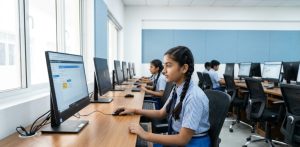
- Computer or digital exposure
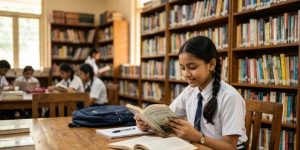
- Library or reading programmes
- Project work or hands-on activities
Some schools also include structured life skills, public speaking, STEM exposure, theatre, dance, or social-emotional learning at this stage.
Under newer curriculum thinking, especially NEP-aligned and NCF-aligned interpretation, the curriculum is expected to move beyond memorising content and toward understanding, application, communication, and experience. NCERT’s National Curriculum Framework for School Education 2023 describes an integrated curriculum framework for ages 3 to 18 and links it to the 5+3+3+4 pedagogical structure proposed in NEP 2020.
That means parents should not ask only, “Which subjects are taught?”
They should also ask:
- How are those subjects taught?
- How much hands-on work is there?
- How much reading culture is built?
- Are children encouraged to ask questions?
- Is assessment based only on tests?
- Do teachers adapt to different learning speeds?
Those questions reveal the real curriculum experience.
Primary school under NEP 2020: what changed for parents and schools
One of the strongest high-intent themes across education explainers today is the role of NEP 2020. That is not just a buzzword. It has changed how parents think about early schooling.
Here is the parent-friendly version of what NEP 2020 means for primary education:
It pushes schools to strengthen foundational learning
Reading, writing, and numeracy are no longer treated as simple basics that will “just happen.” They are a formal national priority. That is a positive shift because children cannot build higher-order learning on weak foundations.
It supports developmentally appropriate pedagogy
Younger children learn differently from older ones. The policy framework recognises that. It encourages age-appropriate methods, experiential learning, reduced dependence on rote memorisation, and a smoother transition from early years to formal schooling.
It values mother tongue and multilingual exposure
NEP discusses the importance of home language or mother tongue as a medium of learning in the early years where possible. For parents, this should not be reduced to a simplistic “English versus not English” debate. The real point is that strong comprehension and expression in early years support learning.
It expands the idea of good schooling
A good school is no longer defined only by exam preparation. The policy vision is broader: conceptual understanding, skills, values, flexibility, exposure, and all-round development.
It nudges schools toward competency-based learning
This means children should not merely repeat content. They should demonstrate what they understand, apply, create, discuss, and solve.
For parents, the biggest implication is this:
Primary school should now be judged less by how much homework it sends and more by how meaningfully it develops the child.
Why primary education matters more than many families realise
Let me put this plainly: when primary education is weak, children spend later years catching up. When it is strong, later schooling becomes more coherent, more joyful, and less stressful.
Primary education matters because it shapes:
Reading confidence
Once children begin reading independently, they gain access to every other subject. Weak reading ability quietly affects Maths word problems, science understanding, social science comprehension, and later exam performance.
Numeracy confidence
Children who understand numbers conceptually are not just “good at Maths.” They are more comfortable reasoning, estimating, noticing patterns, and solving problems.
School identity
Children form deep emotional beliefs early:
- “I am good at learning.”
- “I am always behind.”
- “School is exciting.”
- “School is scary.”
- “My questions matter.”
- “I should stay quiet.”
These beliefs are powerful.
Self-expression
Primary years shape vocabulary, confidence, listening, speaking, and classroom participation.
Attention and independence
Children learn how to stay with a task, move between activities, manage materials, and complete age-appropriate responsibilities.
Character and well-being
Confidence, empathy, self-control, inclusion, resilience, and teamwork are not secondary outcomes. They are life outcomes.
This is one reason parent-friendly school brands increasingly talk about holistic development, confidence building, future readiness, and well-being alongside academics. When those ideas are genuinely practised, they are not marketing fluff. They are what strong primary schooling actually looks like.
What good primary teaching looks like in practice
Parents often ask, “How do I know if a primary school is actually good once I visit?”
Here is what I look for.
The classroom feels active, not chaotic
Children are not frozen in silence all day, but they are also not drifting without direction. A good classroom has energy with structure.
Teachers ask questions that require thinking
Instead of only asking children to repeat, copy, or recall, teachers ask them to observe, compare, explain, predict, and connect.
Children handle materials
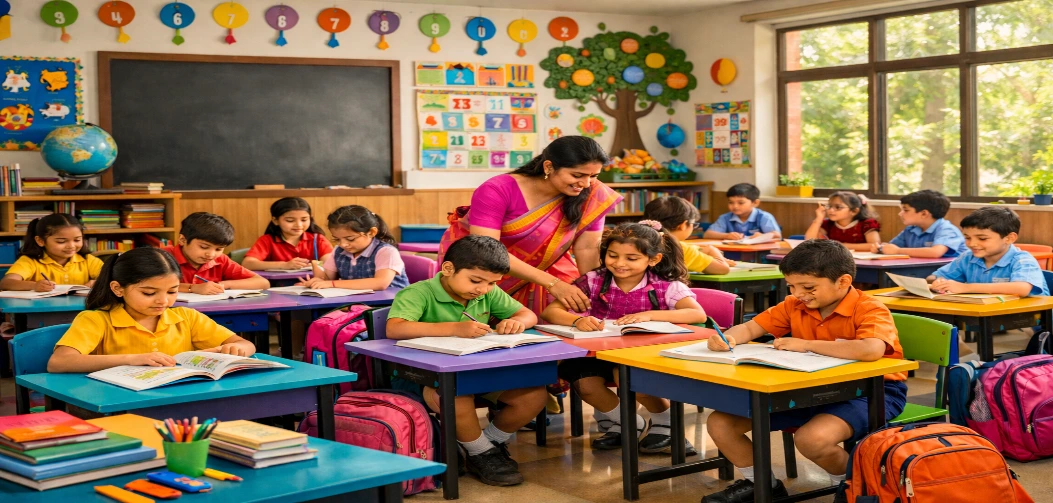
You see books, manipulatives, charts, writing work, project displays, reading corners, art, and evidence of child participation.
There is visible warmth
Teachers know children by name. Children are not afraid to respond. Mistakes are treated as part of learning.
Learning is explained to parents clearly
The school can articulate what it is trying to build in the child and why.
Assessment is broader than marks
There may still be tests, but the school also tracks understanding, participation, projects, reading progress, and skills development.
Co-curricular activity is not an afterthought
Strong schools understand that movement, arts, performance, and clubs support confidence, discipline, and identity building.
This combination of academic grounding with co-curricular exposure and child-centred pedagogy is exactly why many parents are drawn to school groups that position themselves around multidimensional learning rather than purely test-centric schooling.
Common primary school subjects and what parents should really look for in each
It helps to go subject by subject because schools often sound similar at a brochure level.
English
Look beyond whether the school uses English as a formal medium of instruction. Ask whether it genuinely builds:
- reading fluency
- comprehension
- vocabulary
- expression
- storytelling
- writing confidence
- listening and speaking
A child who can read a page smoothly but cannot explain it is not fully secure yet.
Mathematics
Do not judge only by whether the school “finishes the syllabus.” Ask whether children learn through concrete materials, pattern recognition, reasoning, and real-life application. Strong primary Maths should build understanding, not fear.
EVS or integrated learning
Environmental Studies in good schools is not simply factual recall. It should help children connect home, community, nature, people, and everyday systems.
Languages
Language exposure should support confidence and comprehension rather than overload. In multilingual India, the goal is not just to add more languages early, but to build meaningful communication.
Art, music, movement, sports
These are often dismissed as extras, but they shape confidence, expression, discipline, sensory learning, and belonging. For many children, co-curricular spaces are where self-worth first emerges.
Digital exposure
At the primary stage, digital tools should support learning rather than dominate it. Schools should be thoughtful about screen balance, not dazzled by it.

What is the difference between primary school, elementary school, and secondary school?
This confusion is common enough that it deserves a clean explanation.
Primary school
Usually Classes 1 to 5. This is the first formal school stage for most children.
Elementary school
A broader umbrella term often covering Classes 1 to 8, which includes both primary and upper primary.
Secondary school
Usually begins after elementary education. In many Indian references, secondary education includes Classes 9 to 10, while senior secondary or higher secondary covers Classes 11 to 12.
So if a parent asks, “Is primary school the same as elementary school?” the most accurate answer is:
Not exactly. Primary school is usually a part of elementary education, not the whole of it.
What primary school is not
Sometimes the easiest way to guide parents is by clearing away misconceptions.
Primary school is not supposed to be:
- a mini version of board-exam coaching
- endless worksheets without understanding
- silent compliance mistaken for discipline
- academic pressure dressed up as rigour
- a race to introduce advanced concepts too early
- a place where co-curricular learning is treated as decoration
- a stage where confident children dominate and quieter children disappear
A strong primary school does not make children look artificially advanced for social media. It makes them genuinely stronger learners.
Common mistakes parents make when choosing a primary school
This section matters because school choice errors often begin with the wrong evaluation lens.
Mistake 1: equating more homework with better learning
Heavy homework can create an illusion of seriousness. It does not guarantee understanding. In primary years, the quality of classroom learning matters far more.
Mistake 2: choosing only by brand familiarity
A well-known school group may still vary significantly by campus leadership, teacher quality, class size, culture, and implementation.
Mistake 3: asking only about syllabus and not pedagogy
Two schools may follow the same board but teach in very different ways.
Mistake 4: underestimating well-being
If a child feels chronically anxious, unheard, or lost, academic performance usually suffers later.
Mistake 5: overvaluing early acceleration
Parents sometimes feel impressed when a young child appears to be doing much more advanced work. But premature academic push can reduce confidence and curiosity if it is not developmentally aligned.
Mistake 6: ignoring reading culture
A school that talks constantly about performance but has weak reading habits is missing a core primary-school priority.
Mistake 7: not checking transition support
How does the school onboard new children? How does it support first-time schoolgoers? How does it help a child who takes longer to settle?
These questions are often more revealing than the admissions presentation.
How to evaluate a primary school as a parent in India
I find that parents make better decisions when they use a framework instead of relying on one campus visit feeling.
Here is a practical evaluation model.
A. Child fit
Ask:
- Will my child feel safe here?
- Does the school understand different temperaments?
- Will my child have room to speak, explore, and grow?
B. Academic fit
Ask:
- Is the curriculum age-appropriate?
- Is learning conceptual or rote-heavy?
- Does the school build reading and numeracy seriously?
C. Pedagogy fit
Ask:
- Are teaching methods activity-based and experiential where appropriate?
- Are children encouraged to ask questions?
- Is there visible evidence of student work and projects?
D. Environment fit
Ask:
- Are classrooms warm and orderly?
- How does the school handle behaviour?
- What is the approach to inclusion, safety, and emotional support?
E. Future-readiness fit
Ask:
- Does the school build confidence, communication, collaboration, and problem-solving?
- Is co-curricular exposure meaningful?
F. Family fit
Ask:
- Is the commute realistic?
- Is the fee level sustainable over multiple years?
- Is communication with parents transparent and respectful?
That last point matters more than parents admit. A school may look strong on paper, but if the school-family relationship is strained, the child often feels that tension.
A parent-friendly checklist before you apply
Here is the shortlist I would actually carry into a school visit.
Curriculum and learning
- Which board or curriculum does the school follow?
- How is the primary curriculum delivered in practice?
- How do you build reading and numeracy?
- How do you support children who learn at different paces?
Teacher quality
- What kind of teacher training happens regularly?
- How stable is the primary teaching team?
- How do teachers communicate progress?
Assessment
- How are children assessed in primary classes?
- How much weight is given to projects, observation, class participation, and skill development?
Well-being and safety
- How is emotional adjustment handled?
- What happens if a child is shy, anxious, or struggling socially?
- What are the transport and campus safety protocols?
Co-curricular
- What opportunities exist for sports, art, music, theatre, dance, and clubs?
- Are these integrated or occasional?
Parent partnership
- How often do parents receive meaningful feedback?
- What does orientation look like?
- How are concerns handled?
Practical decision
- Is the fee structure sustainable?
- Is the location practical?
- Is the admissions process transparent?
What parents commonly consider when shortlisting schools in India
Again, this is not a ranking. It is a curated set of school options many parents commonly consider, especially when they want a recognised brand with broad visibility, a mainstream or premium-mainstream positioning, and a balance between academics and all-round development. Fees vary significantly by campus, city, grade, board, and academic year, so families should always verify locally.
1. Podar International School
Podar is one of the most widely recognised school brands in India and is commonly shortlisted by parents who want scale, familiarity, multiple campus options, and a broad holistic-learning narrative. Its official positioning emphasises all-round development, mainstream board pathways, and strong parent awareness. For families who want a known brand that is often more accessible than ultra-premium niche international schools in many markets, Podar frequently enters the shortlist.
2. Billabong High International School
Billabong is a strong option for parents who want a more child-centric, future-ready, and experience-oriented school environment without losing sight of academic seriousness. Its official brand positioning highlights multiple curriculum options across its network, co-curricular programmes, and a learning experience built around holistic development. What often makes Billabong stand out in parent conversations is the attempt to combine academic growth with confidence building, innovation in learning, and a more engaging school culture. For families who do not want primary education to feel overly rigid or purely score-driven, this kind of balance can be especially appealing.
3. Delhi Public School network
DPS remains one of the most familiar names in Indian schooling. Parents often consider it when they want a known academic brand with a long institutional presence and structured school culture. Different DPS campuses vary, but the broader network reputation is associated with a multidimensional curriculum, academic grounding, and strong co-curricular systems in many schools.
4. Ryan International School
Ryan is commonly considered by families looking for a well-known K-12 brand that combines academics, confidence development, and a broader future-ready narrative. Official curriculum communication from the group highlights practical skills, confidence, and a low-stress structured approach under mainstream curriculum pathways in relevant campuses.
5. Orchids The International School
Orchids is often shortlisted by parents seeking a widely present school brand with strong visibility around technology-enabled learning, structured curriculum delivery, and co-curricular activity. Its official positioning emphasises innovation, smart classes, and a broad network across India.
Quick comparison table: school options many parents commonly consider
| Curated option | Broad positioning parents often associate it with | Curriculum visibility | Primary-stage appeal | Co-curricular emphasis | Parent-fit note |
| Podar International School | Recognised large network, broad mainstream appeal | CBSE/ICSE and wider network options | Familiar structure, widely known | Holistic learning emphasis | Useful for parents who value scale and recognisability |
| Billabong High International School | Child-centric, future-ready, balanced and experience-led | CBSE, ICSE, CAIE/IGCSE across network | Strong fit for families seeking engagement plus academic grounding | Co-curricular and holistic positioning is visible | Appealing when parents want warmth, confidence-building, and modern learning culture |
| Delhi Public School network | Established academic legacy with structured school culture | Commonly mainstream board-led | Strong for families valuing tradition plus rigour | Often well-developed in larger campuses | Good for parents who prefer an established institutional brand |
| Ryan International School | Mainstream K-12 brand with global-citizen narrative | Mainstream curriculum pathways highlighted | Broad appeal for all-round development | Visible co-curricular narrative | Useful for families seeking recognised brand value |
| Orchids The International School | Large network with innovation and smart-class positioning | CBSE/ICSE network visibility | Attractive for parents seeking contemporary presentation | Strong visibility around exposure and activities | Good for families comparing multiple city campuses |
This table is not a scorecard. It is a starting point for better questions.
Why Billabong can be a compelling primary-school option for many families
Let me keep this grounded and subtle.
When parents ask what makes one school meaningfully different from another at the primary stage, my answer is usually this: it is not only the board. It is the lived learning experience.
That is where a school like Billabong can naturally enter the conversation.
From its official communication, Billabong positions itself around holistic education, co-curricular programmes, multiple curriculum pathways across its network, and a more engaged school life. That matters because primary school is exactly the stage where balance matters most. Too much looseness can weaken academic foundations. Too much rigidity can weaken confidence and curiosity. The better schools are those that know how to balance structure with discovery.
For many parents, Billabong’s appeal is not just the word “international.” It is the possibility of a school experience that feels:
- academically serious without being joyless
- holistic without being vague
- modern without losing human warmth
- structured without being overly rigid
- future-ready without becoming gadget-led for its own sake
In primary school, those trade-offs matter immensely.
How primary school boards and curriculum pathways affect your child
Parents in India often ask a second question right after what is primary school:
Which board is better for primary years?
The honest answer is that no board is universally better for every child. But the board does shape classroom culture, language balance, assessment style, and long-term pathways.
Here is a simple parent view:
| Pathway | What parents usually associate it with | Primary-stage consideration |
| CBSE | Structured curriculum, broad acceptance, national alignment | Often preferred by families seeking continuity and exam familiarity later |
| ICSE | Strong language orientation and detailed curriculum in many schools | Can suit families who value strong English and broad subject texture |
| Cambridge / CAIE / IGCSE | Inquiry, skill-building, broader international framing in many schools | Can appeal to families looking for application-oriented and flexible learning culture |
| School-specific integrated models | Blended pedagogy or school-led enrichment around the board | Quality depends heavily on implementation, not just label |
Billabong’s network-level communication notes the presence of CBSE, ICSE, CAIE, and IGCSE options across its schools. That can be useful for parents who want flexibility or are considering future pathway fit early.
Still, my advice is simple: for primary school, board fit matters less than teaching quality and school culture. A brilliant primary classroom under a mainstream board will usually serve a child better than a weakly implemented premium-labelled curriculum.
The difference between a school that teaches primary education and a school that truly understands childhood
This is the heart of the matter.
A school may have a primary section. That does not automatically mean it understands primary learners.
A school that truly understands childhood usually does five things well.
It respects developmental pace
Not every child reads, writes, speaks, settles, or socialises at the same speed. Good schools do not panic or shame children for natural variation.
It treats play and exploration seriously
Even in formal schooling, children learn through movement, experimentation, storytelling, and interaction.
It invests in relationships
Young children learn best when they feel secure and seen.
It uses routine without killing curiosity
Primary children need structure, but they also need space to think, imagine, ask, and try.
It builds confidence deliberately
Confidence does not appear automatically. It grows when children are supported to participate, perform, express, and recover from mistakes.
That is why the strongest primary-school environments are not just “academic.” They are growth-oriented.
Activity-based learning in primary school: what it really means
This phrase appears in many reference articles and school pages because parents search for it constantly. But it is often misunderstood. Activity-based learning does not mean children are busy all day doing decorative tasks.
Real activity-based learning means the child is actively involved in meaning-making.
Examples:
- using objects to understand numbers
- observing leaves and weather patterns in EVS
- reading stories and discussing character actions
- learning sentence structure through spoken examples and writing
- role-play and dramatization
- thematic projects
- visual mapping and sorting
- peer discussions
- presentations at an age-appropriate level
The value of this approach is that children remember more when they understand through doing. Several reference sources and school explainers emphasise activity-led and experiential learning precisely because it supports engagement and understanding in the primary years.
So when a school says it uses activity-based learning, parents should ask for examples, not slogans.
What admissions-stage parents should look for in a primary school
Admissions guidance is often where content becomes either too salesy or too vague. Let us make it useful.
When you are evaluating schools for Class 1 or the early primary years, these are the signals that matter most:
The school can explain its primary philosophy clearly
If the admissions team can explain how children learn in those years, that is a good sign. If the conversation is only about infrastructure and events, go deeper.
The school has a clear onboarding process
Young children need transition support. Ask how the school settles first-time students.
Parent orientation exists
Billabong’s own FAQ language mentions parent orientation and onboarding, which is a good reminder that school-family alignment begins from the start.
Documentation and process are transparent
Strong schools are clear about stages, documents, timelines, interaction process if any, and parent communication.
The campus culture matches the promise
Watch what happens outside the formal presentation. How do teachers speak to children? How do children move through space? Does it feel warm and alive?
There is clarity on support systems
Ask about counselling access, health protocols, transport safety, and how concerns are escalated.
Primary admissions are not just about getting a seat. They are about choosing the right environment for your child’s first serious school years.
What families should ask on a school tour
Here are the questions I think reveal the most.
- How do you build foundational literacy and numeracy in Classes 1 to 3?
- How is learning made age-appropriate and engaging?
- What does assessment look like in the primary years?
- How do you support shy children or children who take time to settle?
- How much reading happens beyond textbook work?
- How are co-curricular activities integrated into the weekly schedule?
- How do teachers communicate progress to parents?
- What does a typical school day look like?
- How are values, empathy, and confidence built in daily school life?
- How do you manage screen use and technology in the early grades?
These questions usually reveal more than a glossy brochure ever will.

If you want a simpler rule: choose the school where your child can build three things together
Parents often overcomplicate school decisions because the market is noisy. So here is my simplified rule.
The right primary school is the one where your child can build:
1. Strong foundations
They should read, write, think, and understand confidently.
2. Strong selfhood
They should feel seen, capable, safe, and able to express themselves.
3. Strong readiness for the future
They should develop curiosity, communication, collaboration, adaptability, and love for learning.
When a school can do all three, the child is usually on the right path.
This is where Billabong’s brand strengths are relevant in a natural way. A school environment that combines balanced academics, child-centric education, experiential learning, co-curricular exposure, and confidence building is often better aligned with what primary education should accomplish than a narrowly score-driven model.
A different way to think about primary school: not as a stage, but as a foundation architecture
Most articles treat primary school as a segment of schooling. I think parents make better decisions when they think of it as foundation architecture.
Here is why.
In these years, schools are shaping:
- cognitive architecture: how children think
- language architecture: how children understand and express
- emotional architecture: how they feel about learning
- social architecture: how they relate to others
- identity architecture: how they see themselves in school
- habit architecture: how they work and persist
If the architecture is weak, later repair is expensive, stressful, and uneven.
If the architecture is strong, later learning rests on something dependable.
That is why the phrase primary education in India should never be treated as a low-stakes topic. It is one of the highest-stakes decisions in the K-12 journey.
For parents worried about affordability and practicality
Let us address a real concern many families have but do not always articulate directly.
Sometimes parents want a school that is well known, respected, and reasonably within reach compared with ultra-premium international schools whose fees can place them outside consideration. That is why widely recognised school groups with multiple campuses often become common shortlist candidates. But affordability is relative. A school that feels manageable in one city or grade may not feel so in another. Fee structures can also change every academic year.
So the smart approach is not to search for the single “cheap” or “best value” school in the abstract. It is to compare schools through three lenses:
- total cost over time, not only year-one fees
- fit for your child, not just brand name
- value of experience, including teaching quality, safety, communication, and long-term continuity
In other words, an affordable school is not simply the school with the lowest fee. It is the school that offers sustainable value for your family and real growth for your child.
How this topic connects to the broader state of school education in India
Parents are not choosing schools in a vacuum. They are responding to a larger national conversation about quality, equity, and learning.
Education analyses continue to highlight that while access has improved significantly, quality and learning outcomes remain central challenges. Public data systems like UDISE+ exist precisely because planning, transparency, and school-level data matter in improving education systems. For parents, the broad lesson is that school quality cannot be assumed from infrastructure or enrollment alone. Teaching quality, leadership, classroom practice, and accountability are what shape real learning.
That is why today’s parents are right to ask more detailed questions.
A practical parent conclusion
So, what is primary school?
It is the first formal stage of schooling, usually Classes 1 to 5 in India. But more importantly, it is the period in which a child builds the academic, emotional, social, and behavioural base for everything that follows. It is where literacy, numeracy, confidence, classroom identity, and love for learning begin to take shape. Under NEP 2020 and NCF 2023, the emphasis is increasingly on foundational skills, experiential learning, developmentally appropriate pedagogy, and broader child development rather than rote learning alone.
For parents, the real job is not simply to find a school that starts from Class 1. It is to find a primary-school environment where children can learn deeply, feel secure, explore widely, and grow steadily.
And if you are comparing school options in India, the right choice will rarely come from a brochure headline. It will come from asking better questions about curriculum, pedagogy, culture, care, and child fit.
That is where thoughtful schools begin to separate themselves.
Key Takeaways
- Primary school in India usually refers to Classes 1 to 5, generally covering children aged 6 to 10 or 11, though exact cut-offs vary by school and city.
- Primary school is part of the wider elementary education framework, which is protected under the Right to Education system for children aged 6 to 14.
- A good primary school does much more than teach textbooks. It builds literacy, numeracy, habits, confidence, communication, social skills, and joy in learning.
- Under NEP 2020 and NCF 2023, primary education is expected to become more developmentally appropriate, experiential, competency-oriented, and child-centric.
- Parents should judge schools not only by brand or syllabus, but by teaching quality, classroom warmth, assessment style, co-curricular integration, and overall child fit.
- The school-options section in this guide is not a ranking. It is a curated set of commonly considered options meant to support comparison and better decision-making.
- Billabong can be a compelling option for families seeking a balanced, holistic, future-ready, and child-centric primary school environment with visible emphasis on co-curricular development and engaging learning culture.
FAQ section
Primary school is the first stage of formal schooling after kindergarten or pre-primary. In India, it usually means Class 1 to Class 5.
Most children in primary school are around 6 to 10 or 11 years old, depending on the class and school admission cut-off dates.
Not exactly. Primary school usually means Classes 1 to 5, while elementary education is broader and usually includes Classes 1 to 8.
Primary education builds foundational literacy, numeracy, school habits, confidence, and social-emotional skills. These early years strongly influence later academic success and a child’s relationship with learning.
Most primary schools in India teach English, Mathematics, EVS, one or more languages, art, music, physical education, and often project-based or skill-based activities as well.
NEP 2020 pushes stronger foundational learning, more age-appropriate teaching, less rote focus, and greater emphasis on understanding, skills, and holistic development.
Look for strong teaching, warm classrooms, age-appropriate curriculum delivery, reading culture, co-curricular opportunities, emotional safety, and transparent parent communication.
There is no one best board for every child. In the primary years, teaching quality, school culture, and child fit usually matter more than the board label alone.
Yes. Music, sports, art, theatre, movement, and clubs help children build confidence, discipline, creativity, social skills, and overall well-being.
Ask about curriculum, classroom methods, foundational literacy and numeracy, assessment, teacher support, parent communication, well-being systems, co-curricular activities, and transition support for new students.