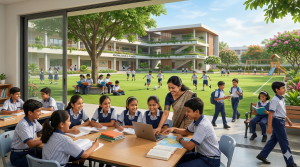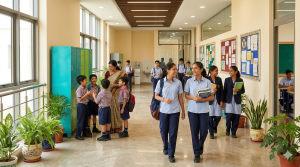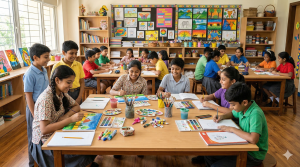


What is primary school? Meaning, Curriculum and Education in India (2026 Guide)
Primary school is the stage of formal education where children build core foundations in reading, writing, numeracy, reasoning, and learning habits—along with social and emotional skills that shape how confidently they learn in later years.
If you’re researching schools in India, you’re probably not just asking “which grade is primary.” You’re asking something more practical: What will my child actually learn, how will they be taught, and what should I look for to know the school is doing primary education well?
This guide is written to help you make those decisions with clarity. It explains how primary education works in India, what changes for children developmentally between ages 6–11, what quality teaching looks like in a real classroom, and how to shortlist schools in a way that protects both learning outcomes and child wellbeing.
Table of Contents
- Primary school meaning in one clear answer
- Why primary school shapes lifelong learning
- Age group and structure of primary school in India
- What children learn in primary years: beyond subjects
- How primary teaching works when done well
- Classroom illustrations parents can visualise
- Assessment in primary school: why feedback matters
- Research-backed reasons primary education is critical
- Primary vs preschool vs middle school transitions
- Myths parents hear and what’s actually true
- How to evaluate a primary school: a practical framework
- What to observe on a school visit
- How Billabong High approaches primary learning
- Final guidance for parents
1) Primary school meaning in one clear answer
Introduction
Parents often receive vague responses like “primary school is Grades 1–5.” That’s not wrong, but it’s incomplete. A parent’s real concern is rarely the grade number. It’s about whether these years are building the right foundations—and whether the school is using the right approach for how children learn at this age.
Explanation in detail
Primary school is the first stage where education becomes structured, cumulative, and skill-building. This is the age when children move from learning through play and imitation to learning through deliberate practice, understanding, and explanation.
A strong primary school does three things at the same time:
- Builds foundational skills
Children learn to read fluently, write clearly, and understand numbers as concepts—not just as symbols to memorise. - Builds learning behaviours
Children develop attention, persistence, curiosity, and the ability to work with feedback. These behaviours often predict long-term academic success more reliably than early marks. - Builds social and emotional readiness
Primary school is also where children learn to manage frustration, collaborate with peers, ask for help appropriately, and speak with confidence in a classroom.
If you remember only one thing, let it be this: primary school is where children learn how to learn, not just what to learn.
2) Why primary school shapes lifelong learning
Introduction
In Indian parent conversations, it’s common to hear: “Primary is easy, the real pressure starts later.” The truth is, the pressure may start later—but the foundation is laid earlier. A child’s relationship with learning is formed in the primary years.
Primary school is influential because it affects both capability and confidence.
- A child who learns reading properly in the early years finds every subject easier later, because most learning depends on reading comprehension.
- A child who develops number sense early finds mathematics less frightening later, because they understand “why” a method works.
- A child who feels safe to ask questions becomes more engaged and less anxious—even when academics become harder.
This is also why global education bodies emphasise “foundational learning.” UNESCO notes that many children worldwide reach the end of primary school without minimum proficiency in reading and mathematics, and that foundational learning is essential for progress later.
Imagine two children in Grade 7:
- Child A reads slowly and guesses words. They avoid long word problems and struggle in science because the textbook feels heavy.
- Child B reads fluently, summarises paragraphs, and asks questions. They don’t find science “easy,” but they can access it.
The difference was not created in Grade 7. It was created in primary years. A strong primary school reduces the need for “fixing” later. It builds a child who can cope, adapt, and progress when academics become demanding.
3) Age group and structure of primary school in India
Parents often worry about readiness: “Is my child too young?” or “Will my child struggle?” Understanding the typical age mapping—and what children can reasonably handle at each stage—helps parents set healthy expectations.
In most Indian school structures, primary school includes Grades 1 to 5, broadly covering ages 6 to 11 (exact cut-offs can vary by state norms and school policies).
Grade | Typical Age | What’s Developing Most |
Grade 1 | 6–7 | basic literacy, classroom routines, confidence |
Grade 2 | 7–8 | reading fluency, number sense, attention span |
Grade 3 | 8–9 | comprehension, writing structure, reasoning |
Grade 4 | 9–10 | multi-step problem solving, independence |
Grade 5 | 10–11 | deeper concepts, reflection, organised study habits |
What matters is not just the grade but the developmental fit. Between ages 6–11, children become increasingly capable of logical thinking with real examples. That means primary teaching should move gradually from concrete materials (counters, pictures, objects) to abstract reasoning (formulas, mental maths, structured writing).
A quality primary school respects development: it stretches children thoughtfully without rushing them into pressure-driven learning.
4) What children learn in primary years beyond subjects
Parents usually ask, “What subjects are taught?” That’s a reasonable question—but in primary years, subjects are only half the story. The bigger story is the skills children develop through those subjects.
Primary learning typically includes:
Language and literacy
Children learn reading, writing, speaking, and listening. But strong literacy instruction does more than teach spelling. It teaches:
- how to understand meaning (comprehension)
- how to infer (read between the lines)
- how to structure thoughts in writing
- how to speak with clarity and confidence
Why this matters: A child who can read and express ideas well tends to do better in every subject, because learning becomes accessible.
Numeracy and mathematics
Primary maths is not just arithmetic. Good primary maths builds:
- number sense (understanding quantities)
- pattern recognition
- reasoning (explaining why a method works)
- real-life application (money, time, measurement)
Why this matters: When maths is taught as “steps to follow,” children often panic later. When it’s taught as reasoning, children build resilience and clarity.
Environmental understanding and early science thinking
Children learn observation, simple cause-and-effect, curiosity-driven questioning, and basic scientific vocabulary. The goal is not to create “mini scientists,” but to create children who can look at the world carefully and describe what they see.
Social learning, values, and citizenship
Primary years shape behaviour: teamwork, empathy, respectful disagreement, and responsibility. These directly affect classroom learning, because a child who cannot manage frustration often struggles even if they are “smart.”
A lesson on “plants” can build multiple skills:
- reading a short informational passage
- observing a plant’s growth and recording it
- measuring and comparing changes
- discussing environmental care
- writing a few clear sentences explaining findings
That’s what good primary learning looks like: integrated skills, not isolated memorisation.
Primary school is not just “subjects.” It is a structured system for building literacy, numeracy, thinking, communication, and behaviour—together.
5) How primary teaching works when done well
Teaching quality matters more in primary years than parents often realise. At this age, children don’t just absorb information—they absorb the message about learning: whether it is scary or safe, confusing or clear, meaningful or pointless.
High-quality primary teaching usually includes:
Guided inquiry (not unguided “free learning”)
Inquiry-based learning can be powerful when teachers provide structure. A major meta-analysis found inquiry learning is more effective when students receive appropriate guidance.
For parents, the practical translation is simple: the best classrooms allow exploration, but teachers still teach.
Scaffolding
Teachers give support early (examples, prompts, step-by-step thinking) and gradually reduce it as children become more independent. This helps children feel capable without becoming dependent.
Discussion and explanation
Children are asked to explain answers in sentences, not just give final answers. This builds reasoning and language at the same time.
Practice with purpose
Practice is still important. The difference is that practice should reinforce understanding, not replace it. Drill without meaning often creates short-term marks but long-term confusion.
Multiplication taught well
Instead of: “memorise tables only”
Children are first shown arrays, grouping, repeated addition, and real examples (like sharing items equally). Then tables become easier because they represent something the child understands.
Good primary teaching builds understanding first, then speed. It develops confident learners, not anxious memorisers.
6) Classroom illustrations parents can visualise
Parents often want to know: “What will my child’s day actually look like?” The easiest way to answer is to describe what strong primary learning feels like across a typical day.
A realistic primary day:
Morning circle / settling routine
Children build emotional readiness: planning the day, sharing thoughts briefly, learning to listen.
Literacy block
The teacher reads a story or passage with the class, asks meaning-based questions, explores vocabulary, then children write a short response. The focus is clarity, not perfect handwriting.
Math block
Children solve a problem using materials or visuals first, then write the solution. They share strategies, and the teacher highlights different ways to think.
Inquiry / EVS time
Children observe, compare, ask questions, and record findings. This can be simple but powerful when done consistently.
Creative expression and movement
Art, music, or physical education isn’t “extra.” It supports attention, confidence, and emotional regulation—all of which improve learning.
Reflection and feedback
Children learn to say: “Today I found this difficult” or “I solved this using…” Teachers give specific feedback like: “Your explanation is clear; next time add one example.”
A good primary day balances structure with curiosity. It helps children learn academically without draining their confidence.
7) Assessment in primary school and why feedback matters
Introduction
Assessment is one of the most misunderstood parts of primary education. Many parents equate assessment with exams and marks. But in primary years, the most important assessment is not a big test—it’s continuous feedback.
Explanation in detail
Formative assessment means teachers regularly check understanding and adjust teaching. Research reviews in assessment show that strengthening formative assessment practices can produce meaningful learning gains.
In parent terms, this means:
- mistakes are treated as information, not failure
- feedback is specific and actionable
- teachers identify gaps early, before they become chronic
Examples of good primary assessment:
- observing how a child solves a problem, not only whether they got it right
- using short quizzes to see patterns of misunderstanding
- collecting writing samples over time to track growth
- having children explain reasoning orally (which reveals real understanding)
In primary years, the best assessment helps children improve without fear. It builds the habit of learning from feedback.
8) Research-backed reasons primary education is critical
Parents don’t need academic jargon—but they do deserve credible reasons. Strong primary education isn’t just a preference; it’s supported by decades of research across psychology, economics, and learning science.
Foundational learning matters globally
UNESCO highlights global challenges in foundational learning, noting minimum proficiency in reading and mathematics at the end of primary school as a critical benchmark.
Feedback improves learning
Classic and ongoing research on formative assessment emphasises that frequent feedback supports achievement and deeper learning.
Early investment has high returns
Heckman’s work on early human capital development is widely cited for showing strong returns on early investment and the idea that “skills beget skills.”
Research consistently points to one conclusion: when primary education is strong, everything later becomes easier—academically and emotionally.
9) Primary vs preschool vs middle school transitions
A lot of parent stress comes from mismatched expectations. If you expect a preschool child to behave like a middle schooler, everyone struggles. Understanding transitions reduces anxiety for both parent and child.
Preschool builds readiness: routines, play, communication, and social comfort.
Primary school builds foundations: literacy, numeracy, thinking, and learning habits.
Middle school builds depth: abstract concepts, subject complexity, and independence.
The transition into primary should feel like:
“More structure, but still warmth.”
Not: “Suddenly everything is pressure.”
The best schools make transitions gentle and developmentally appropriate.
10) Myths parents hear and what’s actually true
In India, primary education is surrounded by myths that push unnecessary pressure. Clearing these myths helps parents protect learning joy while still maintaining academic ambition.
Myth 1: More homework means better learning
In primary years, homework is helpful only when it reinforces understanding. Excessive worksheets often create fatigue and resistance.
Myth 2: Early pressure creates future toppers
Pressure may create short-term compliance, but it can damage confidence and curiosity—the two things children need most as learning gets harder.
Myth 3: Marks are the only evidence of learning
In primary years, a child’s explanation, reasoning, reading fluency, and ability to persist are often better indicators of future success than one test score.
Healthy learning habits beat early competition every time.
11) How parents should evaluate a primary school
Most school comparisons focus on facilities, fee, and brand perception. But primary school quality is best judged by learning design, teacher practice, and child experience.
Parent evaluation framework (practical and quick)
1) Teaching quality
Ask how teachers explain concepts, handle mistakes, and build thinking skills.
2) Literacy approach
Ask how reading is taught: phonics, comprehension, speaking, vocabulary.
3) Numeracy approach
Ask how maths is taught: number sense, reasoning, real-world use.
4) Emotional safety and support
Ask what happens when a child is anxious, shy, or struggling.
5) Feedback and communication
Ask how often parents receive meaningful feedback, not just marks.
In primary years, teacher quality and learning culture matter more than glossy infrastructure.
12) What to observe during a school visit
A school visit can reveal more than a brochure if you know what to look for. The aim is not to judge a perfect classroom; it’s to see whether learning is happening with clarity and care.
What to observe (and why)
- Are children speaking in full thoughts? That indicates language development and confidence.
- Are teachers asking “why” and “how” questions? That indicates reasoning and understanding are valued.
- Do children look safe to make mistakes? That indicates emotional safety and healthy feedback culture.
- Is student work displayed with meaning (not just decoration)? That indicates learning is visible and valued.
A good primary school feels purposeful, calm, and child-respecting.
13) How Billabong High approaches primary education
At Billabong High International School, the primary years are treated as foundation-building years—where learning must be rigorous yet child-centred, structured yet inquiry-driven.
Explanation in detail (Billabong positioning without hype)
The approach emphasises:
- Child-centric progression so expectations match development
- Inquiry-led learning where children ask, explore, and explain
- Strong academic foundations in language and numeracy
- Communication and collaboration as daily learning outcomes
- Supportive classroom culture so children stay confident and curious
Primary learning succeeds when children feel capable, supported, and progressively challenged.
14) Final guidance for parents
Primary education is not the “warm-up” phase of schooling. It is the phase that shapes your child’s learning identity.
If you are choosing a primary school in 2026, focus on three things:
- strong literacy and numeracy foundations
- teaching that builds understanding, not fear
- a culture where children can ask questions and recover from mistakes
A great primary school does not push children into pressure early. It builds children who are ready for anything later.
E) FAQ
- What is the meaning of primary school in India?
Primary school is the first formal stage of schooling where children build foundational reading, writing, numeracy, thinking, and classroom learning habits, typically in Grades 1–5. - What age do children start primary school in India?
Most children start Grade 1 around age 6, though age cut-offs can vary slightly by state norms and individual school policies. - Which grades are considered primary school?
Primary school generally includes Grades 1 to 5. Some schools may also refer to “lower primary” and “upper primary” depending on structure. - Why is primary education important for future success?
Primary years shape literacy, numeracy, reasoning, confidence, and learning habits. Strong foundations reduce learning gaps and stress later. - What do children learn in primary school besides subjects?
Children learn attention control, collaboration, emotional regulation, problem-solving, communication, and the ability to learn from feedback. - How should primary school teach reading?
A strong approach builds decoding skills, vocabulary, comprehension, and speaking confidence, not only memorisation of passages. - How should primary school teach maths?
Good primary maths builds number sense and reasoning using visuals and real examples before moving to speed and abstraction. - How much homework is appropriate in primary school?
Homework should reinforce understanding and remain manageable. Excessive worksheets can create fatigue and resistance to learning. - How are children assessed in primary school?
Quality assessment includes regular feedback, teacher observations, short checks for understanding, and work samples—alongside tests when needed. - What is formative assessment and why does it matter?
Formative assessment is frequent feedback used to improve learning. Research shows it can lead to meaningful learning gains when implemented well. - Is inquiry-based learning suitable for primary children?
Yes, when it is guided and structured. Evidence suggests inquiry is most effective when teachers provide appropriate guidance. - How can parents judge primary school quality during a visit?
Observe whether children can explain ideas, whether teachers ask reasoning-based questions, and whether mistakes are treated as learning opportunities. - What signs show a child is thriving in primary school?
A thriving child becomes more confident in reading and speaking, tries problems without fear, asks questions, and recovers from mistakes. - What should parents prioritise while choosing a primary school?
Prioritise teaching quality, literacy and numeracy foundations, emotional safety, feedback culture, and clear communication with parents.
Latest Blogs



CATEGORIES

March 18, 2026
Top Cambridge Schools in India for 2026: Parent Guide to IGCSE, Fees, Admissions and Fit
Read More
March 18, 2026
Top ICSE Schools in India 2026: Parent Guide to Admissions, Curriculum and Fit
Read More
March 18, 2026
Top Schools in Gujarat 2026-27: A Parent’s Guide to Boards, Fees, Admissions and School Fit
Read More