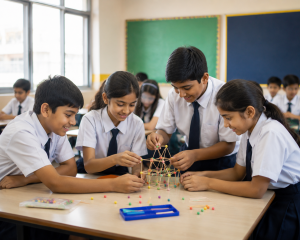


A Complete Comparison Guide to ICSE vs CBSE Board Updated 2026

A parent-friendly guide to choosing the right curriculum for your child’s learning style, future goals, and overall development
Choosing between ICSE vs CBSE is one of the most common decisions Indian parents face when selecting a school. Both boards are nationally recognised, respected by universities, and followed by reputed schools across India. The better choice depends less on which board is “superior” and more on which board fits your child’s learning style, family priorities, academic goals, and the quality of the school implementing the curriculum.
For many families, the real question is not simply CBSE vs ICSE board. It is: Which learning environment will help my child grow with confidence, curiosity, academic readiness, communication skills, and future-ready capabilities?
This 2026 guide explains the ICSE board vs CBSE board comparison in a clear, practical, parent-focused way.
Executive Summary: ICSE vs CBSE in One Clear Answer
CBSE is often preferred by families who want a nationally standardised curriculum, smoother school transfers across cities, strong alignment with NCERT-based learning, and a practical pathway for Indian competitive examinations. ICSE is often preferred by families who value depth, language strength, detailed subject exposure, analytical writing, and a broader academic approach.
However, the board alone does not determine the quality of education. A child’s growth depends on how the school teaches, supports, assesses, mentors, and engages learners every day.
At Billabong High International School, this distinction matters. The school’s child-centric approach focuses not only on board readiness but also on joyful learning, creativity, confidence, life skills, co-curricular exposure, and holistic development. This is especially important because parents today are not just choosing a board. They are choosing a learning ecosystem.
CBSE’s academic wing describes its role as supporting curriculum, academic guidelines, training, innovation, and balanced academic activities in affiliated schools. CISCE, which conducts the ICSE and ISC examinations, describes ICSE as a Class X school examination after ten years of schooling, with candidates required to sit for six subjects and Socially Useful Productive Work. These official board structures help explain why CBSE is often seen as streamlined and nationally standardised, while ICSE is often viewed as broader and more detailed.
Quick Comparison Table: CBSE vs ICSE Board
| Factor | CBSE Board | ICSE Board |
| Full form | Central Board of Secondary Education | Indian Certificate of Secondary Education |
| Conducting body | Central Board of Secondary Education | Council for the Indian School Certificate Examinations |
| Class 10 exam | CBSE Class X Board Examination | ICSE Examination |
| Class 12 pathway | CBSE Class XII | ISC, conducted by CISCE |
| Curriculum style | Structured, nationally aligned, concept-focused | Detailed, broad, language-rich, application-oriented |
| Common parent perception | Good for competitive exam preparation and mobility | Good for language, depth, humanities, and analytical skills |
| Transfer convenience | Generally easier due to wide national presence | Good in many cities, but availability may vary by location |
| English emphasis | Strong, with balanced subject load | Very strong, especially in language and written expression |
| Competitive exam alignment | Often seen as helpful for JEE, NEET, CUET due to NCERT linkage | Also accepted, but students may need separate exam-focused preparation |
| Best fit for | Families seeking structure, mobility, Indian exam alignment | Families seeking depth, language strength, broad subject exposure |
| Final decision factor | Quality of school implementation | Quality of school implementation |
What Is CBSE?
CBSE stands for Central Board of Secondary Education. It is a national-level board of school education in India. CBSE-affiliated schools follow a curriculum structure that is widely used across the country, making it a popular choice for families who may relocate or who want a more standardised school pathway.
CBSE is commonly associated with NCERT-based textbooks, a concept-oriented curriculum, and strong relevance for Indian entrance examinations. This does not mean CBSE is only for competitive exams. Good CBSE schools today also focus on experiential learning, skill development, interdisciplinary projects, values, sports, arts, and student well-being.
CBSE has also been moving toward competency-based education. Its competency-based education resources refer to the National Education Policy 2020’s shift away from assessments that primarily test rote memorisation and toward assessment that promotes analysis, critical thinking, conceptual clarity, and higher-order skills.
Why CBSE matters for parents
CBSE often appeals to parents because it offers consistency. If a family moves from Mumbai to Pune, Gurugram, Noida, Bengaluru, Hyderabad, or another city, it may be easier to find another CBSE school with a broadly familiar academic structure.
Parents also appreciate CBSE because many Indian competitive examinations draw heavily from NCERT concepts. For students who may later prepare for JEE, NEET, CUET, NDA, or other national-level entrance pathways, CBSE can feel like a natural academic base.
Parent-friendly summary
CBSE is a strong choice for families looking for a nationally recognised, structured, transferable, and exam-aligned curriculum. Its effectiveness depends greatly on whether the school makes learning meaningful rather than merely textbook-driven.

What Is ICSE?
ICSE stands for Indian Certificate of Secondary Education. It is the Class X examination conducted by the Council for the Indian School Certificate Examinations, commonly known as CISCE. After ICSE in Class X, students typically move to ISC in Classes XI and XII if they continue within the CISCE pathway.
ICSE is known for its detailed syllabus, strong English language emphasis, broad subject exposure, and focus on analytical writing. Many parents associate ICSE with depth, articulation, literature, humanities, science concepts, and a more expansive academic experience.
CISCE states that the ICSE examination is designed as a school examination after a ten-year course of study and requires candidates to sit for six subjects along with Socially Useful Productive Work. CISCE also states that the ISC Class XII examination is conducted through the medium of English after a two-year course beyond ICSE or an equivalent examination.
Why ICSE matters for parents
ICSE can be especially appealing for families who want their child to develop strong reading, writing, comprehension, expression, research, and analytical skills. The board is often seen as academically rich and well-rounded.
Students who enjoy language, literature, history, geography, project work, and conceptual detail may thrive in an ICSE environment. It can also support children who may later explore liberal arts, law, media, design, humanities, international education, or communication-heavy careers.
Parent-friendly summary
ICSE is a strong choice for families who value academic depth, English fluency, detailed learning, and broad intellectual development. Like CBSE, its success depends on the school’s teaching quality and student support systems.
CBSE vs ICSE Full Form: What Parents Should Know
A common search query is CBSE vs ICSE full form, but the difference goes beyond the names.
| Term | Full Form | Meaning for Parents |
| CBSE | Central Board of Secondary Education | A national board that affiliates schools and conducts Class X and XII examinations |
| ICSE | Indian Certificate of Secondary Education | The Class X examination conducted by CISCE |
| CISCE | Council for the Indian School Certificate Examinations | The council that conducts ICSE and ISC examinations |
| ISC | Indian School Certificate | The Class XII examination conducted by CISCE |
This distinction is useful because CBSE refers to the board, while ICSE refers specifically to the Class X examination under CISCE. In everyday parent conversations, however, “ICSE board” is commonly used to describe the CISCE school pathway.
ICSE vs CBSE: Which Board Is Better?
There is no single board that is better for every child. CBSE may be better for students who need a structured, nationally portable, exam-aligned curriculum. ICSE may be better for students who benefit from deeper subject exposure, strong English, analytical writing, and a broad academic base.
The better question is: Which board will help your child learn well, stay motivated, build confidence, and remain future-ready?
A child who loves reading, expression, project work, and detailed exploration may enjoy ICSE. A child who benefits from concise structure, competitive exam alignment, and a more standardised progression may prefer CBSE. But these are only broad tendencies. A progressive CBSE school can be deeply experiential. A well-designed ICSE school can be structured and supportive.
At Billabong High International School, the emphasis is on helping children become confident learners rather than passive exam-takers. This matters because the board is only one layer of schooling. The daily learning culture, teacher quality, classroom engagement, assessment practices, safety, peer environment, and co-curricular exposure shape the child’s actual experience.
ICSE Board vs CBSE Board: Detailed Comparison for Parents
1. Curriculum Depth and Structure
CBSE is generally considered more streamlined. Its curriculum is structured around core concepts, especially in mathematics and science, and is often easier to align with national-level entrance exam preparation.
ICSE is generally considered more detailed. It gives significant importance to English, literature, social sciences, science, mathematics, and project-based learning. The syllabus can feel broader and more intensive, especially in middle and secondary years.
| Curriculum Factor | CBSE | ICSE |
| Overall approach | Structured and concept-focused | Detailed and broad-based |
| Subject depth | Strong in core concepts | Strong in depth and range |
| Language exposure | Balanced | Extensive |
| Project work | Present, varies by school | Often more prominent |
| Best for | Clarity, continuity, entrance exam alignment | Depth, expression, analytical development |
What parents should consider
A curriculum should stretch a child without overwhelming them. If the school teaches through real-life examples, projects, discussions, and personalised support, both boards can lead to excellent outcomes.
2. Difficulty Level
Parents often ask: Is ICSE tougher than CBSE?
The common answer is that ICSE can feel more demanding because of its detailed syllabus, language expectations, and broader subject coverage. CBSE can feel more manageable because it is comparatively streamlined and structured. But the difficulty is not only about the board. It also depends on the child’s learning habits, the school’s teaching methods, homework load, assessment design, and parental expectations.
| Difficulty Area | CBSE | ICSE |
| Syllabus load | Usually more concise | Often more extensive |
| English expectations | Strong but balanced | High emphasis |
| Exam preparation | More standardised | Requires detailed preparation |
| Student workload | Moderate to high, depending on school | Often high in senior classes |
| Stress level | Depends on school culture | Depends on school culture |
ICSE may feel more difficult for students who struggle with writing, reading volume, or managing multiple subjects in depth. CBSE may feel easier to navigate for students who prefer clear structure and focused exam preparation. But a supportive school can make either board manageable and meaningful.
3. Language, Communication, and Writing Skills
ICSE is widely recognised for strong English language orientation. Students often engage with literature, composition, comprehension, and expressive writing in greater detail. This can support vocabulary, articulation, reading confidence, and communication skills.
CBSE also builds language competence, but its curriculum is usually seen as more balanced between language, mathematics, science, and other subjects.
| Language Factor | CBSE | ICSE |
| English depth | Good | Very strong |
| Literature exposure | Present | Usually deeper |
| Writing practice | Good, school-dependent | Often extensive |
| Communication readiness | Strong in good schools | Strong, especially in written expression |
| Best fit | Balanced language development | Language-rich academic development |
Why this matters
Communication is now a future-ready skill. Whether a child becomes an engineer, entrepreneur, designer, lawyer, researcher, doctor, educator, or creator, the ability to express ideas clearly matters. A school that builds speaking, listening, reading, writing, presentation, and collaboration skills gives students a lifelong advantage.
Billabong’s focus on confidence building, creativity, and expressive learning fits naturally into this broader need. The board matters, but the classroom culture matters more.
4. Mathematics and Science Preparation
CBSE is often preferred by students aiming for Indian competitive examinations because its curriculum is closely associated with NCERT-based learning, which is central to many national entrance exam pathways.
ICSE also builds strong conceptual understanding in mathematics and science. In some cases, students from ICSE backgrounds may have strong analytical and application skills. However, they may need to separately align their preparation with NCERT patterns if they plan to take exams such as NEET or JEE.
| Factor | CBSE | ICSE |
| NCERT alignment | Strong | Less direct |
| Competitive exam familiarity | Often easier | Requires additional alignment |
| Conceptual science | Strong | Strong and detailed |
| Mathematics | Structured | Detailed and rigorous |
| Best for | JEE, NEET, CUET alignment | Concept depth and analytical preparation |
If your child is already inclined toward engineering, medicine, or central university entrance pathways, CBSE can offer a more direct route. If your child is still exploring interests, ICSE can provide broad academic exposure. But neither board guarantees success. Coaching, self-study, school support, emotional resilience, and disciplined practice all matter.
5. Humanities, Liberal Arts, and Social Sciences
ICSE is often appreciated for its treatment of English, history, geography, civics, literature, and analytical subjects. Students who enjoy reading, writing, debating, researching, and connecting ideas across disciplines may benefit from the ICSE style.
CBSE also offers humanities subjects and can be excellent in schools that teach beyond the textbook. However, parents often perceive ICSE as more humanities-friendly because of its depth and emphasis on expression.
| Factor | CBSE | ICSE |
| Humanities exposure | Good | Often broader |
| Research orientation | School-dependent | Often stronger through projects |
| Reading load | Moderate | Higher |
| Writing expectations | Balanced | Higher |
| Best for | Structured humanities learning | Deep humanities and language orientation |
Parent guidance
For careers in law, design, psychology, media, public policy, writing, education, international relations, business, and liberal arts, strong reading and writing skills are valuable. ICSE can support this well, but a forward-thinking CBSE school can also develop these skills through debates, projects, Model United Nations, theatre, writing programmes, and interdisciplinary learning.

CBSE vs ICSE Board: Which Is Better for Future Careers?
CBSE and ICSE are both valid for future careers in India and abroad. Universities do not reject students merely because they studied in either board. The child’s marks, subject choices, portfolio, entrance exam scores, skills, communication ability, and overall profile matter more.
That said, each board may offer certain practical advantages depending on the future pathway.
| Future Pathway | CBSE Advantage | ICSE Advantage |
| JEE / NEET / CUET | Strong NCERT alignment | Strong concepts, but needs NCERT alignment |
| UPSC foundation | Structured basics | Strong reading and humanities exposure |
| Law | Good if language skills are built | Strong reading, writing, analytical advantage |
| Liberal arts | Good with right school exposure | Strong language and humanities base |
| International education | Accepted, but profile matters | Strong English and academic depth can help |
| Design / media | Depends on portfolio and creativity | Strong expression can help |
| Business / entrepreneurship | Depends on school culture and skills | Depends on school culture and skills |
| STEM careers | Strong pathway if supported | Strong concept depth if supported |
What future-ready really means
Future-ready education is not only about choosing science, commerce, humanities, CBSE, or ICSE. It is about building:
- conceptual clarity
- communication skills
- creativity
- problem-solving
- collaboration
- digital awareness
- emotional resilience
- ethical decision-making
- curiosity
- confidence
This is where school culture becomes central. Billabong High International School’s learner-first approach, holistic environment, and emphasis on curiosity, creativity, and confidence are aligned with the needs of modern learners. The Billabong website describes the school network as offering CBSE, ICSE, CAIE, and IGCSE education across campuses, while its school locator shows different campuses offering different curricula such as CBSE, CIE, and ICSE depending on location.
CBSE vs ICSE for Competitive Exams
Is CBSE better for JEE and NEET?
For many students, yes, CBSE can be more convenient for JEE and NEET preparation because of its NCERT alignment. NEET, in particular, has strong dependence on NCERT concepts in Biology, Chemistry, and Physics. JEE preparation also requires rigorous problem-solving, but CBSE provides a familiar foundation.
Can ICSE students crack JEE and NEET?
Absolutely. ICSE students regularly prepare for and succeed in competitive exams. However, they may need to consciously adapt to NCERT terminology, exam pattern, objective question practice, and time-bound problem solving.
| Competitive Exam Factor | CBSE | ICSE |
| NCERT familiarity | High | Requires adaptation |
| Objective exam style | Easier to integrate | Needs additional practice |
| Subject depth | Strong enough for foundation | Often detailed |
| Coaching compatibility | Very common | Also common |
| Transition to entrance prep | Usually smoother | Manageable with planning |
Do not choose CBSE only because of coaching pressure. Choose it if it suits the child’s academic temperament and goals. Do not avoid ICSE out of fear that competitive exams will become impossible. They will not. The right study plan matters.
CBSE vs ICSE for International Education
Both CBSE and ICSE are accepted by many universities in India and abroad, subject to admission criteria. For international admissions, universities often look at grades, subject choices, English proficiency tests where required, extracurriculars, essays, recommendations, portfolios, and standardised tests depending on the country and programme.
ICSE and ISC students may benefit from strong English and writing exposure. CBSE students may benefit from a familiar academic structure and strong STEM preparation. But neither board automatically guarantees international admission.
| International Readiness Factor | CBSE | ICSE |
| Recognition | Widely recognised | Widely recognised |
| English writing | Good | Often stronger |
| STEM preparation | Strong | Strong |
| Portfolio building | School-dependent | School-dependent |
| Global readiness | Depends on school ecosystem | Depends on school ecosystem |
If international education is a serious possibility, look beyond board names. Ask the school about counselling, subject guidance, portfolio opportunities, leadership activities, research exposure, public speaking, sports, arts, community service, and student well-being.
CBSE vs ICSE for Early Years and Primary School
In early years, the board should not be the only deciding factor. Young children need safety, warmth, play, language exposure, movement, storytelling, social development, curiosity, sensory learning, and emotional security.
The choice between ICSE and CBSE becomes more academically visible in middle and secondary school. In preschool and primary years, parents should look at the school’s learning environment more closely than the board label.
What matters most in early years
A strong early years programme should offer:
- joyful learning
- phonics and language readiness
- numeracy through activities
- play-based exploration
- motor skill development
- music, movement, art, and stories
- social confidence
- emotional comfort
- safe classrooms
- caring teachers
- parent communication
Billabong’s early learning philosophy is naturally aligned with child-centric education. The school’s ecosystem emphasises curiosity, creativity, confidence, and joyful learning, which are foundational for children before board complexity becomes important.
For Nursery to Grade 2, do not over-focus on CBSE vs ICSE. Focus on whether your child feels safe, happy, curious, heard, and engaged. A child who loves learning early is better prepared for any board later.
CBSE vs ICSE for Middle School
Middle school is where the board’s learning style becomes more visible. Students begin handling more subjects, more homework, more assessments, and more abstract concepts.
CBSE middle school typically offers a structured path that builds toward secondary concepts. ICSE middle school may introduce broader subject depth, more detailed English, and project-based learning.
| Middle School Factor | CBSE | ICSE |
| Academic structure | Clear and progressive | Broad and detailed |
| Homework load | Moderate to high | Often higher |
| Language exposure | Balanced | Strong |
| Project work | Depends on school | Often more visible |
| Best support needed | Concept clarity | Time management and writing stamina |
Middle school is also when children develop self-image. They may start saying, “I am good at maths” or “I am bad at English.” A good school prevents labels from becoming limitations. Teachers should support children with differentiated learning, feedback, encouragement, and practical strategies.
CBSE vs ICSE for Secondary School
Grades 9 and 10 are critical because students prepare for board examinations and begin thinking about future streams. The academic demands become more serious, and the child’s learning habits matter more.
CBSE Class X generally feels more streamlined and exam-oriented. ICSE Class X can feel more detailed and language-intensive.
| Secondary Factor | CBSE | ICSE |
| Board exam preparation | Structured | Detailed |
| Subject breadth | Focused | Broad |
| Writing requirement | Moderate to high | High |
| Revision planning | Easier to standardise | Requires consistent planning |
| Parent role | Support routine and stress management | Support routine, writing, and time management |
What parents should avoid
Do not wait until Grade 10 to build study habits. Children need note-making, revision discipline, reading stamina, self-assessment, and exam confidence from earlier grades.
CBSE vs ICSE for Senior Secondary: Classes 11 and 12
After Class 10, CBSE students continue into CBSE Class XI and XII. ICSE students usually move into ISC if they remain with CISCE. At this stage, subject choice becomes more important than board identity.
Parents should ask:
- Does the school offer the stream my child wants?
- Are the subject combinations flexible?
- Is career counselling available?
- Are teachers experienced in senior secondary preparation?
- Is there support for entrance exams?
- Are students guided without excessive pressure?
- Are co-curricular achievements encouraged alongside academics?
Senior secondary comparison
| Factor | CBSE Class XI-XII | ISC Class XI-XII |
| Science | Strong and widely used | Strong and detailed |
| Commerce | Strong | Strong |
| Humanities | Strong in good schools | Often language and humanities rich |
| Competitive exam alignment | Often more direct | Requires additional alignment |
| Writing and analytical expression | Good | Often very strong |
In Classes 11 and 12, choose the school and subject combination carefully. A strong teacher, healthy peer group, balanced schedule, and good counselling can matter more than the board.
Learning Style: Which Child May Prefer CBSE?
CBSE may be a good fit for children who:
- prefer clear structure
- like focused syllabi
- may prepare for Indian competitive exams
- need easier mobility across cities
- are comfortable with NCERT-style learning
- benefit from predictable assessment patterns
- want a balanced academic load
- prefer concept clarity over extensive writing
This does not mean CBSE is less creative or less holistic. In progressive schools, CBSE can be taught through projects, experiments, discussions, research, design thinking, field experiences, and interdisciplinary learning.
Billabong’s CBSE campuses, for example, highlight holistic learning, expert faculty, modern facilities, curiosity, creativity, and critical thinking as part of the learning approach.
Learning Style: Which Child May Prefer ICSE?
ICSE may be a good fit for children who:
- enjoy reading and writing
- have strong language interest
- are comfortable with detailed study
- like literature, history, geography, and projects
- may explore humanities, law, media, liberal arts, design, or global pathways
- can manage a broader syllabus with support
- benefit from analytical and expressive learning
ICSE can also work well for science-oriented students, provided they manage the syllabus and later align with competitive exam patterns if needed.
Billabong’s ICSE curriculum page describes its ICSE approach as supporting critical thinking, creativity, and global readiness. This fits well with the strengths many parents associate with the ICSE pathway.

The Real Deciding Factor: Board vs School Quality
Parents often spend months comparing icse board vs cbse board, but the more important comparison is often school vs school.
A strong school can make a demanding board feel joyful and manageable. A weak school can make even a simpler curriculum feel stressful.
What a good school should offer
A high-quality school should provide:
- trained and empathetic teachers
- clear academic planning
- safe infrastructure
- active parent communication
- balanced homework
- student counselling
- sports and arts exposure
- life skills
- digital responsibility
- inclusive support
- transparent assessment
- meaningful feedback
- leadership opportunities
- values and character education
Why implementation matters
Two schools following the same board can feel completely different. One may rely on rote worksheets and exam pressure. Another may use inquiry, projects, collaboration, reading, reflection, sports, arts, and personalised mentoring.
This is why Billabong’s positioning as a learner-first, holistic, future-ready school is relevant. Parents choosing a board should also ask how the school brings that board alive.
Parent Decision Framework: How to Choose Between ICSE and CBSE
Use this practical framework before making a decision.
Step 1: Understand your child’s learning personality
Ask yourself:
| Question | If Yes, Consider |
| Does my child enjoy reading, stories, language, and writing? | ICSE may be a good fit |
| Does my child prefer clear structure and concise preparation? | CBSE may be a good fit |
| Does my child get overwhelmed by heavy writing tasks? | CBSE may feel easier |
| Does my child enjoy projects and detailed learning? | ICSE may be engaging |
| Does my child need frequent school transfers? | CBSE may be practical |
| Is my child likely to prepare for JEE/NEET? | CBSE may offer alignment |
| Is my child inclined toward law, media, humanities, or liberal arts? | ICSE may offer useful depth |
Step 2: Clarify family priorities
Parents should consider:
- Will the family relocate in the next few years?
- Is the child likely to study in India or abroad?
- Are competitive exams a major goal?
- Is the family looking for academic depth or manageable structure?
- Does the child need additional learning support?
- How much time can the family realistically support homework and revision?
- Which good schools are available nearby?
Step 3: Compare schools, not just boards
Visit campuses. Speak to admissions counsellors. Meet academic coordinators if possible. Observe how the school talks about children. Do they speak only about marks, or do they speak about confidence, curiosity, well-being, and growth?
Step 4: Ask board-specific questions
For CBSE schools:
- How do you teach beyond NCERT?
- How do you build conceptual understanding?
- How do you support competitive exam readiness without pressure?
- What is your approach to projects, arts, sports, and life skills?
For ICSE schools:
- How do you manage syllabus depth without overburdening children?
- How do you support writing skills?
- How do you help students transition to ISC or other boards?
- How do you support students preparing for Indian entrance exams?
Step 5: Prioritise child well-being
A board that looks impressive on paper may not be right if it creates chronic stress. Children learn best when they feel safe, respected, challenged, and supported.
Common Mistakes Parents Make When Comparing CBSE vs ICSE
Mistake 1: Assuming one board is automatically superior
No board is universally better. The right board depends on the child and the school.
Mistake 2: Choosing only based on competitive exams
Competitive exam goals matter, but children also need communication, creativity, resilience, ethics, collaboration, and emotional balance.
Mistake 3: Ignoring school culture
A school’s culture affects daily learning more than the board label.
Mistake 4: Underestimating language skills
Even STEM careers require strong communication. Reading and writing should not be treated as secondary skills.
Mistake 5: Overlooking the child’s temperament
A child who feels constantly overwhelmed may lose confidence. A child who is under-challenged may lose curiosity.
Mistake 6: Not checking campus-specific board offerings
Large school networks may offer different boards at different campuses. Parents should always verify the specific campus, grade, and board pathway before applying.
ICSE vs CBSE: Admissions Considerations for Parents
When applying to a school, parents should ask practical questions that go beyond the board.
| Admissions Factor | What Parents Should Ask |
| Board availability | Which board is offered at this campus and for which grades? |
| Grade continuity | Can my child continue the same board through Grade 10 or 12? |
| Admission process | What documents, assessments, or interactions are required? |
| Learning support | How does the school help children transitioning from another board? |
| Fee structure | What is included and what is charged separately? |
| Transport | Is school transport available and safe? |
| Safety | What are the campus safety protocols? |
| Co-curriculars | What sports, arts, clubs, and activities are available? |
| Parent communication | How often do teachers update parents? |
| Counselling | Is academic and emotional counselling available? |
Why admissions research matters
Board selection is only useful if the school can support your child across years. Parents should examine curriculum, teaching quality, safety, values, peer environment, and long-term academic pathways.
Schools Worth Considering: A Neutral Parent Shortlisting Note
The schools mentioned in this section are not ranked. They are included only as examples of school brands and networks that parents in India may consider while researching CBSE, ICSE, international, or integrated curriculum options. Parents should verify board affiliation, campus quality, fee details, facilities, teacher quality, and admissions criteria directly with each school.
| School / Network | Why Parents May Consider It | What to Verify |
| Billabong High International School | Known for child-centric learning, holistic development, joyful education, and multiple curriculum options across campuses | Campus-specific board, grade availability, admissions, fees |
| Podar International School | Large school network with multiple curriculum offerings in many cities | Exact board and facilities at the local campus |
| VIBGYOR Group of Schools | Known in several urban centres with academic and co-curricular offerings | Board pathway, fees, transport, class size |
| Ryan International School | Large national presence and multiple locations | Campus quality, board, academic support |
| Delhi Public School network | Well-known school brand across India | Independent campus management, board, admission criteria |
| The Shri Ram Schools / Shri Educare-associated schools | Often considered by parents seeking progressive education in select cities | Location availability, curriculum, fees |
| EuroSchool | Present in several cities with school-level offerings | Board, facilities, learning support |
| Orchids The International School | Expanding urban school network | Board, teacher quality, academic approach |
| Local reputed standalone schools | Often strong in culture, community, and teacher continuity | Board recognition, safety, results, facilities |
Do not select a school only because of brand recall. Visit the campus. Ask specific questions. Compare how the school supports your child’s academic, emotional, social, physical, and creative development.
Why Billabong High International School Is a Strong Option for Parents Comparing Boards
Billabong High International School is relevant for parents researching CBSE vs ICSE board because the school network offers multiple curriculum pathways across campuses, including CBSE, ICSE, Cambridge, and IGCSE options depending on location. The official Billabong website describes it as a chain offering CBSE, ICSE, CAIE, and IGCSE primary and secondary education, while campus pages show specific board offerings by location.
What makes Billabong worth considering is not only the board availability, but the educational philosophy behind the learning experience.
Billabong’s parent-relevant strengths
Billabong’s approach naturally reflects:
- child-centric learning
- joyful education
- experiential learning
- holistic development
- academic readiness
- creativity and curiosity
- confidence building
- life skills
- future-ready learning
- co-curricular and extracurricular exposure
- safe and engaging school environments
- personalised support
The school’s Malad page, for example, describes learning as alive in classrooms, playgrounds, and creative expression, with a purpose to help children dream fearlessly, learn joyfully, and grow beautifully.
Why this matters in the CBSE vs ICSE decision
A curriculum becomes meaningful only when it is taught with care. Parents should look for a school where academic structure is balanced with curiosity, where assessments do not crush confidence, and where children are encouraged to participate, question, create, collaborate, and reflect.
Billabong’s philosophy fits this expectation well. It allows the board to become a framework for growth rather than a source of pressure.
Curriculum Is Not the Whole Story: The Future-Ready Skills Parents Should Look For
Whether you choose CBSE or ICSE, your child will need more than marks.
1. Critical thinking
Children should learn to ask why, compare ideas, evaluate information, and solve problems.
2. Communication
Students need to express ideas clearly in speech and writing.
3. Creativity
Creativity helps children think differently, design solutions, and adapt.
4. Collaboration
Modern learning and workplaces require teamwork.
5. Emotional resilience
Children need to manage stress, feedback, failure, and uncertainty.
6. Digital and AI awareness
Students need responsible, ethical, and effective use of technology.
7. Leadership
Leadership begins with responsibility, initiative, empathy, and confidence.
8. Global awareness
Children should understand cultures, communities, sustainability, and citizenship.
Recap
CBSE and ICSE can both support future-ready education if the school intentionally builds these skills. Parents should ask how the school integrates life skills, co-curricular activities, technology, values, and student well-being into everyday learning.
Fees, Facilities, and Value: How Parents Should Compare Schools
School fees vary widely by city, campus, facilities, grade level, transport, meals, activities, and curriculum. Instead of comparing only the total fee, parents should compare the value.
Fee comparison checklist
| Fee Area | Questions to Ask |
| Tuition fee | What does it include? |
| Admission fee | Is it one-time or recurring? |
| Activity fee | Are sports, arts, clubs, or events included? |
| Transport fee | Is transport optional? What safety systems exist? |
| Meals | Are meals provided or optional? |
| Books and uniform | Are these included or separate? |
| Technology fee | Are digital platforms included? |
| Exam fee | Is board exam fee separate? |
| Refund policy | What is refundable and when? |
Facilities comparison checklist
| Facility | Why It Matters |
| Safe classrooms | Emotional and physical security |
| Science labs | Experiential STEM learning |
| Library | Reading culture and research skills |
| Sports grounds | Fitness, teamwork, confidence |
| Arts spaces | Creativity and self-expression |
| ICT labs | Digital readiness |
| Counselling support | Emotional well-being |
| Medical support | Safety and emergency readiness |
| Transport safety | Daily child protection |
| Activity spaces | Holistic growth |
A higher fee does not automatically mean a better school. A lower fee does not automatically mean poor quality. Look at teacher engagement, child safety, learning outcomes, communication, infrastructure use, and student happiness.
Board Change: Can a Child Shift from ICSE to CBSE or CBSE to ICSE?
Yes, children can shift boards, especially in earlier grades, but the transition needs planning.
Moving from ICSE to CBSE
This may feel easier in terms of syllabus load, but students may need to adapt to NCERT terminology, CBSE-style assessment, and objective exam preparation.
Moving from CBSE to ICSE
This may require adjustment to more detailed English, writing expectations, project work, and broader subject coverage.
| Transition | Main Challenge | Parent Support Needed |
| ICSE to CBSE | Adapting to NCERT and exam pattern | Concept mapping and practice |
| CBSE to ICSE | Managing depth and writing load | Reading, writing, time management |
| Any board change | Emotional adjustment | Patience and teacher communication |
Best time to switch
Earlier grades are usually easier. Switching in Grades 9 to 12 should be done carefully because board exam requirements, subject choices, and registration rules may apply.
How to Evaluate a CBSE School
When visiting a CBSE school, ask:
- How do teachers build conceptual clarity?
- How is competency-based learning implemented?
- How much homework is given?
- How are assessments designed?
- How do you support children who need extra help?
- How do you encourage reading, speaking, and writing?
- What co-curricular activities are available?
- How do you prepare students for senior classes?
- How do you support emotional well-being?
- How do you communicate with parents?
Red flags
- Only marks are discussed.
- Teachers cannot explain learning methods.
- The school has limited co-curricular exposure.
- Parent communication is unclear.
- Children appear fearful or disengaged.
- Homework is excessive without meaningful feedback.
How to Evaluate an ICSE School
When visiting an ICSE school, ask:
- How do you manage syllabus depth?
- How do you build English and writing skills?
- How much project work is expected?
- How do you prevent academic overload?
- How do you support students who struggle with writing?
- What is the school’s approach to science and mathematics?
- How do students transition to ISC or other boards?
- Is competitive exam preparation supported?
- What co-curricular opportunities exist?
- How do you balance academic rigour with well-being?
Red flags
- Heavy workload is treated as a badge of honour.
- The school does not offer support for struggling learners.
- Assessments are mainly memory-based.
- There is little focus on confidence or well-being.
- Parent communication happens only during problems.
The Parent’s Board Selection Matrix
Use this table as a practical decision guide.
| Parent Priority | Better Fit May Be |
| Frequent relocation | CBSE |
| Strong English and writing | ICSE |
| JEE / NEET / CUET alignment | CBSE |
| Broad humanities exposure | ICSE |
| Manageable syllabus | CBSE |
| Academic depth | ICSE |
| National school availability | CBSE |
| Detailed project-based learning | ICSE |
| Balanced structure | CBSE |
| Language-rich learning | ICSE |
| School quality and holistic growth | Depends on school |
Important note
This table is not a rulebook. It is a starting point. A strong school can deliver excellent outcomes through either board.
What Parents Should Look for in 2026 and Beyond
Education in 2026 is changing. Parents are no longer satisfied with rote learning, exam pressure, and one-size-fits-all classrooms. They want schools that prepare children for a future shaped by technology, AI, global careers, environmental challenges, interdisciplinary work, and emotional complexity.
Look for schools that offer:
- competency-based learning
- experiential teaching
- safe classrooms
- strong reading culture
- sports and fitness
- performing and visual arts
- public speaking
- coding and digital literacy
- AI awareness
- values education
- counselling and well-being
- career guidance
- parent partnership
CBSE’s own competency-based education direction reflects a broader national shift toward conceptual clarity, analysis, critical thinking, and higher-order skills.
Parent takeaway
The best school is not the one that only completes the syllabus. It is the one that helps children understand, apply, question, communicate, and grow.
Key Takeaways: ICSE vs CBSE Board
- CBSE and ICSE are both respected boards. Neither is universally better for every child.
- CBSE is often preferred for structure, national mobility, and competitive exam alignment.
- ICSE is often preferred for English, academic depth, writing, and broad subject exposure.
- The school matters as much as the board, often more.
- Children in early years need joyful learning, safety, and confidence before board pressure.
- For JEE, NEET, and CUET, CBSE can offer a more direct NCERT-aligned pathway.
- For humanities, communication, law, media, and liberal arts, ICSE can offer strong foundations.
- Board switching is possible but should be planned carefully.
- Parents should compare teaching quality, safety, co-curriculars, counselling, and learning support.
- Billabong High International School is a strong option for parents seeking board readiness with holistic, child-centric, future-ready education.
Conclusion: So, Which Is Better, ICSE or CBSE?
The best board is the one that helps your child learn with confidence, curiosity, discipline, and joy.
Choose CBSE if your family values a nationally standardised curriculum, easier relocation, structured learning, and smoother alignment with Indian competitive exams.
Choose ICSE if your family values academic depth, strong English, expressive writing, broad subject exposure, and analytical learning.
But do not stop there. Visit the school. Understand the teachers. Ask about emotional well-being. Look at how children speak, play, question, create, and participate. Ask whether the school sees your child as a mark sheet or as a growing person.
A future-ready school does more than prepare children for exams. It prepares them for life.
For parents exploring CBSE, ICSE, Cambridge, or integrated pathways, Billabong High International School offers a thoughtful environment where academic readiness is balanced with creativity, confidence, holistic development, life skills, and joyful learning. That balance is what many children need most.
FAQs on ICSE vs CBSE
1. What is the main difference between ICSE and CBSE?
The main difference is curriculum style. CBSE is generally more structured, nationally standardised, and aligned with NCERT-based learning. ICSE is generally broader, more detailed, and stronger in English, writing, and subject depth.
2. Which board is better, ICSE or CBSE?
Neither board is better for every child. CBSE may suit students who prefer structure, mobility, and competitive exam alignment. ICSE may suit students who enjoy reading, writing, detailed learning, and broad academic exposure.
3. What is CBSE vs ICSE full form?
CBSE stands for Central Board of Secondary Education. ICSE stands for Indian Certificate of Secondary Education. ICSE is the Class X examination conducted by CISCE, the Council for the Indian School Certificate Examinations.
4. Is ICSE tougher than CBSE?
ICSE is often considered more demanding because of its detailed syllabus, strong English focus, and broader subject coverage. CBSE is usually considered more streamlined. However, difficulty also depends on the school, teachers, homework, and the child’s learning style.
5. Is CBSE better for NEET and JEE?
CBSE is often preferred for NEET and JEE preparation because of its NCERT alignment. However, ICSE students can also perform very well in these exams with focused preparation and NCERT-based practice.
6. Is ICSE better for English?
ICSE is widely known for strong English language, literature, comprehension, and writing exposure. It can be a good fit for children who enjoy reading, writing, debate, literature, humanities, or communication-heavy careers.
7. Which board is better for studying abroad?
Both CBSE and ICSE are recognised for higher education pathways. For international admissions, grades, subject choices, English proficiency, extracurriculars, essays, recommendations, and portfolios often matter more than the board alone.
8. Can a child shift from ICSE to CBSE?
Yes, a child can shift from ICSE to CBSE, especially in earlier grades. The child may need support in adapting to NCERT textbooks, CBSE assessment patterns, and competitive exam-style preparation.
9. Can a child shift from CBSE to ICSE?
Yes, a child can shift from CBSE to ICSE, but the transition may require support in English, writing, project work, and managing a broader syllabus. Earlier grades are usually easier for board changes.
10. How should parents choose between CBSE and ICSE?
Parents should consider the child’s learning style, future goals, relocation needs, language strengths, academic temperament, and the quality of schools available nearby. The best choice is the board and school combination that supports the child’s confidence, curiosity, well-being, and long-term growth.
Latest Blogs




CATEGORIES
![Comparative Guide on Core Differences between International vs Public vs Private Schools [Updated 2026]](https://www.billabonghighschool.com/blogs/wp-content/uploads/2026/06/cb60997a-4c5b-4a14-a3fa-656ad38caad5-300x240.png)