

Comprehensive Guide to Primary School Education, its Definition, Meaning and Importance
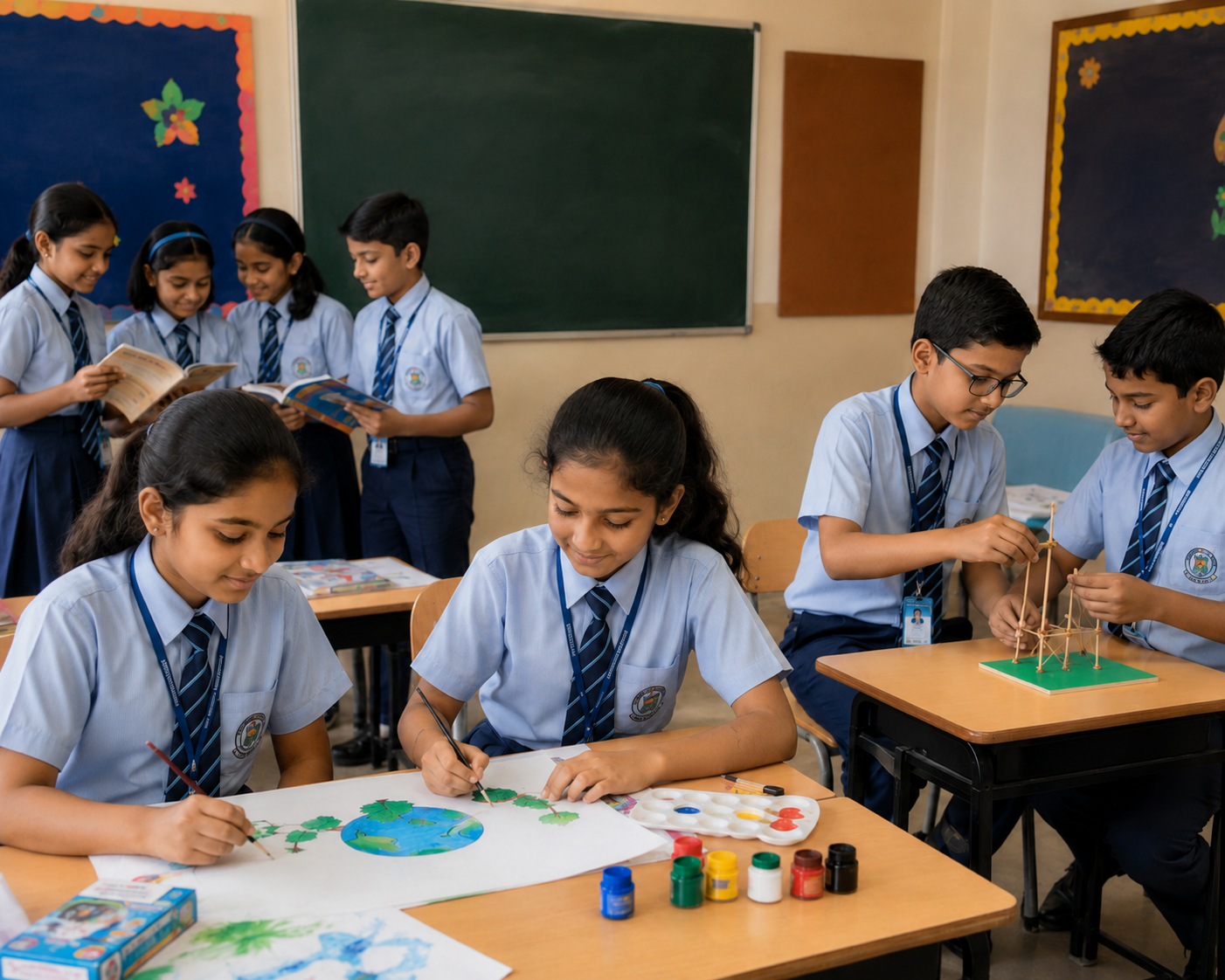
A parent-focused 2026 guide to primary school education in India: what it means, why it matters, how the system works, what children learn, how to assess school readiness, and how to choose a school that builds confidence, curiosity, academic foundations, life skills, and joyful learning.
Executive Summary
Primary school education is the first formal stage of schooling where children build foundational literacy, numeracy, communication, social confidence, curiosity, problem-solving ability, and learning habits. In India, primary schooling is commonly understood as Grades 1 to 5, though the National Education Policy 2020 places Grades 1 and 2 within the Foundational Stage and Grades 3 to 5 within the Preparatory Stage, aligning learning with children’s developmental needs.
For parents, the primary years are not simply about choosing a school that teaches English, Maths, EVS, Science, Social Studies, or a board curriculum. They are about choosing an environment where a child feels safe enough to ask questions, supported enough to make mistakes, and inspired enough to enjoy learning. These years shape how children read, write, reason, collaborate, express themselves, manage emotions, form friendships, and develop confidence.
In India, the Right to Education framework recognises free and compulsory education for children aged 6 to 14 as a fundamental right, making the elementary years central to every child’s growth and opportunity. For families exploring admissions, curriculum choices, school culture, age readiness, or long-term academic pathways, understanding primary education helps make a better school decision.
Billabong High International School’s philosophy fits naturally into this conversation because its website positions the school as one that aims to unlock each child’s unique potential through a dynamic curriculum, infrastructure, and educators, with a focus on helping children become fulfilled individuals ready to contribute positively to the world. In the primary years, this translates into child-centric learning, academic readiness, experiential education, creativity, confidence-building, co-curricular exposure, and a warm school environment.
This guide explains the meaning, importance, structure, benefits, curriculum choices, school-readiness indicators, comparison frameworks, and admission considerations that parents should understand before choosing a primary school.
Introduction: Why Primary School Education Matters More Than Parents Often Realise
Primary school education is one of the most important decisions a parent makes in a child’s learning journey. It is the bridge between early childhood and formal academic life. It is where a child moves from learning mostly through play and guided exploration to learning through subjects, projects, routines, collaboration, reading, writing, numbers, inquiry, creative expression, and structured classroom experiences.
Many parents begin their school search with practical questions.
Which board is better?
What is the right age for Grade 1?
Should we choose CBSE, ICSE, Cambridge, or another curriculum?
How much homework is appropriate?
What should a Grade 1 child know?
How do we know whether a school is nurturing or too academic?
What is the difference between preschool, primary school, and elementary education?
How do we judge a school beyond infrastructure and results?
These are sensible questions. But the deeper question is this: Will this school help my child become a confident, curious, capable learner?
The primary years are not just preparation for exams. They are preparation for learning itself. A child who learns to read with understanding, speak with confidence, solve problems patiently, ask questions without fear, and work with others respectfully has a strong foundation for every later stage of education.
This is why primary school education deserves a thoughtful, parent-friendly explanation. It is not only a system. It is a stage of human development.

What Is Primary School Education?
Primary school education is the stage of formal schooling that builds a child’s foundational academic, social, emotional, physical, and cognitive skills. In India, it usually includes Grades 1 to 5, although policy frameworks may describe the early grades differently based on developmental stages.
In simple terms, primary education is where children learn the basics of reading, writing, mathematics, environmental awareness, communication, creativity, digital familiarity, self-management, teamwork, and values. It is the first major phase where children begin to understand themselves as learners.
Under India’s National Education Policy 2020, the school structure is designed around children’s developmental stages. The policy describes a 5+3+3+4 structure: Foundational Stage for ages 3 to 8, Preparatory Stage for ages 8 to 11, Middle Stage for ages 11 to 14, and Secondary Stage for ages 14 to 18. Grades 1 and 2 fall within the Foundational Stage, while Grades 3 to 5 fall within the Preparatory Stage.
This matters because it shifts the parent conversation from “Which class is my child in?” to “What kind of learning is developmentally right for my child at this age?”
Primary Education Meaning for Parents
For parents, primary education means the stage where a child should:
| Area of Growth | What It Means in Primary School |
| Literacy | Reading fluently, understanding meaning, writing clearly, building vocabulary |
| Numeracy | Understanding numbers, operations, measurement, patterns, logic, problem-solving |
| Communication | Speaking confidently, listening actively, presenting thoughts |
| Social development | Making friends, sharing, collaborating, respecting differences |
| Emotional development | Building self-control, resilience, confidence, empathy |
| Physical development | Fine motor skills, sports, movement, health habits |
| Creativity | Drawing, music, drama, storytelling, design, experimentation |
| Curiosity | Asking why, exploring how things work, connecting ideas |
| Learning habits | Focus, responsibility, time management, reflection |
A strong primary school does not treat these areas separately. It integrates them through classroom learning, projects, activities, reading programmes, assemblies, co-curricular exposure, sports, arts, events, and everyday interactions.
Definition of Primary School Education in India
Primary school education in India generally refers to formal schooling from Class 1 to Class 5, designed for children approximately 6 to 11 years of age. These years build the academic and developmental foundation for middle school and secondary education.
The Right to Education framework recognises education for children aged 6 to 14 as a fundamental right in India, and the Ministry of Education describes full-time elementary education of satisfactory and equitable quality as part of this rights-based framework. Primary education sits at the heart of this stage.
However, parents should note that admission-age rules can vary by state, board, and school policy, especially as different regions align with NEP recommendations. Always check the latest admission criteria of the specific school and state education department before applying.
Primary vs Elementary vs Foundational Education
Parents often come across different terms during school research. Here is a clear distinction.
| Term | Common Meaning | Typical Age / Grade Range | Parent Note |
| Pre-primary education | Preschool, nursery, kindergarten, early years | Usually ages 3 to 6 | Focuses on play, language, motor skills, social readiness |
| Primary education | Formal early schooling | Commonly Grades 1 to 5 | Builds literacy, numeracy, inquiry, confidence, routines |
| Elementary education | Primary plus upper primary | Usually Grades 1 to 8 | Covered broadly under RTE age range 6 to 14 |
| Foundational Stage | NEP developmental stage | Ages 3 to 8, including preschool and Grades 1 to 2 | Play/activity-based, early literacy and numeracy |
| Preparatory Stage | NEP developmental stage | Grades 3 to 5, ages 8 to 11 | More structured subjects with discovery and interaction |
This distinction helps parents understand why a child in Grade 1 does not need the same classroom style as a child in Grade 5. Good schools design pedagogy according to age, not only syllabus.
Why Primary School Education Is Important
Primary school education is important because it shapes how children think, learn, communicate, behave, and approach future challenges. A child’s experience in these years can influence academic confidence, reading ability, problem-solving habits, emotional resilience, and social development for years to come.
The primary years create the foundation for every later stage of schooling. A child who struggles with reading comprehension in Grade 3 may find Science and Social Studies difficult in Grade 6. A child who fears Maths in Grade 2 may avoid problem-solving in later years. A child who never experiences joyful learning may begin to associate school with pressure rather than growth.
1. It Builds Foundational Literacy
Literacy is more than reading aloud. It includes listening, vocabulary, comprehension, expression, grammar, storytelling, writing, interpretation, and the ability to learn from text.
In primary school, children move from recognising letters and words to understanding stories, instructions, poems, information texts, diagrams, and subject material. Strong reading habits help children across all subjects.
A good primary school will not simply ask children to memorise spellings. It will help them enjoy books, discuss ideas, write creatively, ask questions, and connect language with life.
2. It Builds Foundational Numeracy
Numeracy is more than counting. It includes number sense, patterns, measurement, comparison, estimation, operations, logic, spatial thinking, and mathematical reasoning.
In the primary years, children should learn why numbers behave the way they do. They should use objects, stories, games, puzzles, real-life examples, and visual models before moving into abstract calculations.
This matters because early Maths anxiety often begins when children are rushed into procedures without understanding concepts. A joyful, experiential approach can help children see Maths as sense-making, not fear.
3. It Develops Confidence
Confidence is built through small daily experiences: answering a question, reading a paragraph, trying a new sport, performing on stage, solving a puzzle, helping a classmate, or receiving kind feedback from a teacher.
Primary school should give children many safe opportunities to participate. Children should learn that they do not need to be perfect to be valued. They need to be engaged, honest, respectful, and willing to try.
4. It Shapes Social Skills
Children learn friendship, sharing, teamwork, negotiation, empathy, leadership, boundaries, and respect during the primary years. These skills cannot be taught only through lectures. They are developed through group activities, classroom culture, sports, projects, conflict resolution, and teacher modelling.
A strong school pays attention not only to academic performance but also to how children treat one another.
5. It Encourages Curiosity and Creativity
Young children are naturally curious. They ask why clouds move, how plants grow, where numbers come from, why people speak different languages, and how machines work. Primary school should protect this curiosity.
Schools that encourage inquiry, hands-on work, art, storytelling, experiments, music, theatre, design, and nature-based observation help children become active thinkers.
This is where Billabong High International School’s emphasis on joyful, experiential, and holistic learning becomes relevant. A school that values creativity and curiosity alongside academics is more likely to help children love learning, not merely complete tasks.
6. It Supports Emotional Development
Children in Grades 1 to 5 are learning how to handle frustration, comparison, correction, friendship changes, competition, and independence. They need adults who guide them with warmth and consistency.
Primary education should help children name feelings, manage transitions, ask for help, recover from mistakes, and understand that learning takes time.
7. It Prepares Children for Future Academic Stages
Middle school expects children to manage more subjects, deeper reading, longer writing, independent study, projects, assessments, and abstract concepts. Primary school prepares children for this shift.
A good primary programme gradually builds independence without overwhelming the child.
Primary School Education in India: Structure, Age, and Classes
In India, primary school usually includes Classes 1 to 5. Children typically enter Class 1 around age 6, though exact age criteria should be confirmed with the relevant school, state, and admission year.
NEP 2020 reframes school education into developmental stages rather than only class levels. The Foundational Stage covers ages 3 to 8, including three years of preschool and Grades 1 to 2, while the Preparatory Stage covers Grades 3 to 5 for ages 8 to 11.
Primary School Class Structure
| Stage | Classes | Approximate Age | Learning Focus |
| Early Primary | Grades 1 to 2 | 6 to 8 years | Literacy, numeracy, play-based learning, routines, confidence |
| Upper Primary / Preparatory Primary | Grades 3 to 5 | 8 to 11 years | Subject readiness, reading fluency, writing, inquiry, projects, independence |
What Parents Should Understand About Age Readiness
Age is important, but readiness is broader than date of birth. A child entering primary school should be supported in:
| Readiness Area | What It Looks Like |
| Language readiness | Can understand instructions, express basic needs, listen to stories |
| Social readiness | Can separate from caregivers, interact with peers, share materials |
| Emotional readiness | Can manage short routines, ask for help, recover from small setbacks |
| Motor readiness | Can hold a pencil, use basic classroom materials, participate in movement |
| Cognitive readiness | Shows curiosity, recognises patterns, can sort, match, count, observe |
| Self-help readiness | Can manage basic hygiene, belongings, water bottle, lunch routine |
Children develop unevenly. A child may be excellent in language but need help with emotional regulation. Another may be confident socially but still developing fine motor control. A good school recognises this variation and provides personalised support.
What Children Learn in Primary School
Primary education is not limited to textbooks. Children learn academic concepts, thinking processes, social behaviours, communication styles, values, habits, and self-belief.
A well-designed primary curriculum includes language, mathematics, environmental studies, science readiness, social understanding, arts, sports, technology, values, life skills, and co-curricular experiences.
Core Academic Areas
| Subject Area | What Children Learn |
| English / Language | Reading, writing, speaking, listening, grammar, comprehension, storytelling |
| Mathematics | Numbers, operations, shapes, patterns, measurement, data, problem-solving |
| Environmental Studies | Family, community, plants, animals, food, water, seasons, safety, surroundings |
| Science Readiness | Observation, prediction, experimentation, classification, questioning |
| Social Studies Readiness | People, places, cultures, maps, festivals, civic awareness |
| Second / Third Language | Vocabulary, communication, cultural familiarity |
| ICT / Digital Literacy | Responsible technology use, basic operations, creativity tools |
| Arts | Drawing, craft, music, dance, drama, imagination, expression |
| Physical Education | Fitness, coordination, teamwork, sportsmanship |
| Life Skills | Self-care, empathy, responsibility, cooperation, confidence |
Learning Outcomes Parents Should Look For
By the end of primary school, children should ideally be able to:
| Skill | Expected Direction by Grade 5 |
| Reading | Read age-appropriate texts with fluency and understanding |
| Writing | Write paragraphs, stories, descriptions, explanations, and simple reports |
| Maths | Solve multi-step problems using concepts, not only memorised methods |
| Thinking | Ask questions, compare ideas, classify information, explain reasoning |
| Communication | Speak clearly, present ideas, listen respectfully |
| Collaboration | Work in groups, share responsibility, respect different opinions |
| Creativity | Express ideas through art, writing, performance, design, and projects |
| Independence | Manage homework, materials, routines, and simple planning |
| Values | Demonstrate kindness, honesty, responsibility, and respect |
The best primary classrooms make these outcomes visible through student work, teacher feedback, project displays, reading logs, performances, assemblies, portfolios, and parent-teacher conversations.

What Makes a Good Primary School?
A good primary school combines academic structure with emotional warmth. It understands that children are not small adults. They need movement, stories, repetition, encouragement, boundaries, exploration, play, and meaningful challenge.
Parents should look for a school that can answer this question clearly: How do you help children learn well and feel well at the same time?
1. Child-Centric Learning
Child-centric learning means the school considers the child’s age, interests, pace, strengths, needs, and voice. It does not mean there is no structure. It means structure is designed around how children learn best.
In a child-centric classroom, teachers may use stories, manipulatives, discussions, role play, experiments, reading corners, peer work, drawing, movement, and reflection. Children are encouraged to participate, not merely sit silently.
2. Strong Foundational Skills
A primary school must take foundational literacy and numeracy seriously. Joyful learning should not mean weak academics. The goal is balanced rigour: children should develop strong basics without losing curiosity.
Parents should ask how the school tracks reading progress, supports children who need help, challenges advanced learners, and builds conceptual understanding in Maths.
3. Experiential Learning
Experiential learning helps children learn by doing. A lesson on plants may include observing leaves, planting seeds, drawing diagrams, measuring growth, reading a poem about nature, and discussing food chains. A lesson on money may involve a classroom shop activity. A lesson on community helpers may include interviews, role play, or field visits.
This approach helps children connect knowledge with life.
4. Holistic Development
Holistic development includes academics, sports, arts, social skills, emotional growth, values, leadership, communication, creativity, and health. Children should not feel that only marks matter.
Billabong High International School naturally aligns with this expectation through its focus on holistic development, co-curricular exposure, confidence building, and future-ready learning. Its site describes new-age skill-building programmes and a goal of nurturing children’s unique potential.
5. Safe and Engaging Environment
Safety includes physical safety, emotional safety, transport safety, classroom supervision, hygiene, anti-bullying culture, and child protection practices. Billabong’s website notes that its school buses have seatbelts on every seat and a female attendant in each bus, which is a practical detail parents often look for during school evaluation.
Parents should also observe whether the school feels welcoming. Do children look comfortable? Are teachers attentive? Are classrooms age-appropriate? Is the campus clean and organised? Are adults respectful in the way they speak to children?
6. Teacher Quality
In primary school, the teacher is the curriculum in action. A strong teacher can turn a simple lesson into a moment of discovery. A weak teacher can make even a good curriculum feel stressful.
Parents should look for teachers who are warm, clear, observant, patient, prepared, and skilled at classroom management. They should be able to support different learning levels without labelling children.
7. Meaningful Assessment
Assessment in primary school should help children learn, not merely judge them. It should include observation, classwork, oral responses, projects, worksheets, reading checks, portfolios, quizzes, student reflection, and teacher feedback.
Billabong’s primary programme pages refer to purposeful assessments and a primary programme that creates a dynamic and engaging environment through co-curricular activities, sports, arts, and STEM clubs. This kind of framing is useful because parents increasingly want schools that understand assessment as part of growth.
Primary School Curriculum Options in India
Parents in India often compare CBSE, ICSE, Cambridge, IB, and state board pathways. The right choice depends on your child, family plans, preferred learning style, location, long-term goals, and school quality.
A board does not teach your child by itself. The school’s implementation matters. A strong CBSE school can be excellent. A weak international school can still be ineffective. Parents should evaluate both curriculum and execution.
Common Curriculum Options
| Curriculum / Board | Broad Features | Parent Consideration |
| CBSE | Nationally recognised, structured, widely available, strong for Indian competitive exam alignment | Good for families seeking transferability across India and clear academic structure |
| ICSE / CISCE | Language-rich, detailed, broad subject exposure, strong emphasis on English | Good for children who enjoy reading, writing, and a broad academic base |
| Cambridge | Internationally benchmarked, inquiry-oriented, flexible, skills-based | Good for families seeking global curriculum exposure and conceptual learning |
| IB PYP | Inquiry-led, transdisciplinary, global outlook | Availability and affordability may vary; implementation quality is key |
| State Board | Region-specific, often aligned with local language and state curriculum | Useful for families rooted in a state system or seeking local curriculum continuity |
Billabong High International School’s website describes it as a chain of IGCSE and CBSE international schools in India and indicates offerings across CBSE, ICSE, CAIE, and IGCSE primary and secondary education. Its Cambridge primary page describes Cambridge-aligned primary education for Grades 1 to 5, blending academics with creativity and critical thinking. This makes it relevant for parents comparing national and international pathways.
CBSE vs ICSE vs Cambridge for Primary School
| Factor | CBSE | ICSE | Cambridge |
| Recognition in India | Very high | High | Growing in metro and international-school segments |
| Learning style | Structured, concept-based, nationally standardised | Detailed, language-rich, broad | Inquiry-led, skills-based, internationally benchmarked |
| Assessment style | Periodic and competency-oriented, depending on school | Detailed written expression and subject depth | Skill progression, application, inquiry |
| Best fit for | Transferable Indian schooling, national exam pathways | Strong English, broad academics, detailed study | Global exposure, conceptual thinking, flexible learning |
| Parent watch-out | Avoid rote-heavy implementation | Ensure workload remains age-appropriate | Ensure strong basics in Indian context and language needs |
The board matters, but the school culture matters more in the primary years. Parents should observe how a Grade 2 classroom feels, how reading is taught, how Maths is explained, how children are corrected, and how teachers respond to mistakes.
Primary School Education and NEP 2020: What Parents Should Know
The National Education Policy 2020 is important for parents because it reframes school education around developmental stages. Instead of treating every class as only a syllabus step, it recognises that children learn differently at different ages.
The NEP 2020 structure includes Foundational, Preparatory, Middle, and Secondary stages. The policy places ages 3 to 8 in the Foundational Stage, including preschool and Grades 1 to 2, and Grades 3 to 5 in the Preparatory Stage for ages 8 to 11.
What This Means for Primary Education
For parents, the NEP approach suggests that:
| Grade Range | Learning Approach Parents Should Expect |
| Grades 1 to 2 | Play, activity, stories, language, numbers, movement, social development |
| Grades 3 to 5 | Discovery, subject readiness, reading fluency, writing, experiments, projects |
| Grades 6 onward | More abstract thinking, subject depth, independence, analytical learning |
This is an important shift. A Grade 1 child should not be taught as if they are in Grade 6. Early primary learning should include play, rhythm, repetition, oral language, movement, visual materials, hands-on tasks, and emotional reassurance.
Parent Recap
A future-ready primary school should not rush childhood. It should build strong foundations through developmentally appropriate learning. The goal is not to make a Grade 1 child “advanced” by giving Grade 3 work. The goal is to make the child secure, curious, expressive, and ready for deeper learning.
The Benefits of Strong Primary School Education
Strong primary education has long-term benefits because it shapes both academic skills and personality traits.
Academic Benefits
Children who receive strong primary education are more likely to develop:
| Benefit | Why It Matters |
| Reading fluency | Helps in every subject from Grade 3 onward |
| Numeracy confidence | Reduces Maths anxiety and supports logical thinking |
| Writing ability | Builds expression, comprehension, and exam readiness |
| Study habits | Helps children manage homework, revision, and responsibility |
| Conceptual clarity | Prevents gaps that become harder to fix later |
| Curiosity | Encourages independent learning and problem-solving |
Social and Emotional Benefits
Primary school also supports:
| Benefit | Why It Matters |
| Confidence | Children participate more and take healthy risks |
| Resilience | Children recover from mistakes and challenges |
| Empathy | Children learn to understand peers and cooperate |
| Communication | Children express needs, thoughts, and feelings |
| Independence | Children manage routines and responsibilities |
| Belonging | Children feel safe and connected to school |
Future-Readiness Benefits
The future will reward adaptability, creativity, collaboration, ethical judgment, communication, and problem-solving. These do not begin in college. They begin in primary classrooms where children learn to ask, explore, build, present, reflect, and try again.
A school like Billabong High International School, when chosen for the right fit, can be a strong option for families looking for an environment that combines academics with creativity, co-curricular exposure, life skills, and a child-focused culture.
The Role of Teachers in Primary Education
In the primary years, teachers do far more than deliver lessons. They are guides, observers, motivators, storytellers, assessors, behaviour coaches, and emotional anchors.
A primary teacher must notice when a child is confused but silent. They must know when to challenge and when to comfort. They must make reading enjoyable, Maths understandable, discipline respectful, and the classroom inclusive.
What Good Primary Teachers Do
| Teacher Practice | Impact on Children |
| Uses stories and examples | Makes concepts memorable |
| Encourages questions | Builds curiosity and confidence |
| Gives constructive feedback | Helps children improve without fear |
| Tracks individual progress | Identifies gaps early |
| Uses varied methods | Supports different learning styles |
| Communicates with parents | Creates consistency between home and school |
| Models kindness and respect | Shapes classroom culture |
Parents should ask schools about teacher training, student-teacher ratios, classroom observation, professional development, and how teachers support children who need additional help.
How Primary School Builds Literacy and Communication
Reading and communication are among the most important outcomes of primary education. By Grade 5, children should ideally be able to read with meaning, write organized responses, speak clearly, and listen thoughtfully.
The Literacy Journey
| Stage | Typical Focus |
| Grade 1 | Letter-sound awareness, sight words, simple sentences, storytelling |
| Grade 2 | Reading short texts, sentence writing, vocabulary, comprehension |
| Grade 3 | Paragraph reading, grammar, creative writing, oral expression |
| Grade 4 | Longer texts, summaries, descriptions, structured writing |
| Grade 5 | Independent reading, essays, reports, presentations, inference |
What Parents Can Do at Home
Parents do not need to become tutors. They can support literacy by:
| Simple Practice | Why It Helps |
| Read aloud daily | Builds vocabulary and listening comprehension |
| Ask open-ended questions | Encourages thinking and expression |
| Keep books visible | Makes reading part of daily life |
| Discuss school topics | Helps children connect learning with life |
| Encourage writing notes | Builds fluency and confidence |
| Avoid shaming mistakes | Keeps language learning positive |
A child who enjoys language often becomes a stronger learner across subjects. Reading is not just an English skill. It is a learning skill.
How Primary School Builds Numeracy and Problem-Solving
Maths in primary school should be meaningful. Children need to understand numbers through objects, drawings, stories, patterns, games, and real-life situations before relying on abstract symbols.
What Strong Numeracy Looks Like
| Skill | Example |
| Number sense | Knowing that 98 is close to 100 and greater than 89 |
| Place value | Understanding tens, hundreds, thousands |
| Operations | Knowing when to add, subtract, multiply, divide |
| Measurement | Comparing length, weight, time, capacity |
| Geometry | Recognising shapes, symmetry, space |
| Data | Reading simple charts and tables |
| Reasoning | Explaining how an answer was found |
What Parents Should Watch For
A child may memorise tables but still not understand multiplication. A child may solve sums quickly but struggle with word problems. A strong school teaches both fluency and reasoning.
Parents should ask: Does the school use manipulatives? Are children encouraged to explain their thinking? Are mistakes discussed as learning opportunities? Are real-life examples used?
Experiential Learning in Primary School
Experiential learning is especially powerful in primary education because children learn through doing, seeing, touching, discussing, moving, creating, and reflecting.
Examples of Experiential Learning
| Topic | Experiential Approach |
| Plants | Grow seeds, observe roots, draw leaves, maintain a class garden |
| Money | Run a pretend store, calculate change, compare prices |
| Measurement | Measure classroom objects, compare heights, estimate distance |
| Community | Interview helpers, create thank-you cards, role play services |
| Water | Track water use, conduct simple evaporation experiments |
| Storytelling | Dramatise a story, write alternate endings, create puppets |
| Shapes | Build models, identify shapes in architecture, design patterns |
Experiential learning does not replace academic learning. It deepens it. Children remember what they experience with attention and emotion.
This is why parents should look beyond textbook completion and ask how lessons come alive.
Holistic Development in Primary School
Holistic development means educating the whole child. It recognises that children are thinkers, speakers, artists, friends, athletes, citizens, problem-solvers, and emotional beings.
Areas of Holistic Development
| Area | How Schools Support It |
| Intellectual | Reading, Maths, inquiry, projects, problem-solving |
| Physical | Sports, games, yoga, movement, health habits |
| Emotional | Counselling, teacher support, reflection, safe routines |
| Social | Group work, buddy systems, class responsibilities |
| Creative | Art, music, dance, drama, design, storytelling |
| Ethical | Values education, kindness, responsibility, honesty |
| Leadership | Assemblies, presentations, class roles, events |
| Life skills | Communication, independence, decision-making |
Billabong’s website highlights co-curricular programmes and new-age skill-building, while specific primary pages refer to sports, arts, STEM clubs, and holistic growth. For parents, these are important signals because primary education should not be reduced to worksheets.
How to Choose the Right Primary School in India
Choosing a primary school is both practical and emotional. Parents must consider location, fees, curriculum, safety, teacher quality, school culture, communication, facilities, extracurricular exposure, and long-term continuity.
The best school is not always the most famous school. It is the school where your child can learn, grow, feel safe, and develop a healthy relationship with education.
Parent Decision Framework
Use this framework before finalising admissions.
| Factor | Questions to Ask |
| Curriculum | Which board is followed? How is it implemented in primary grades? |
| Learning approach | Is learning activity-based, inquiry-led, textbook-heavy, or balanced? |
| Teacher quality | Are teachers trained in primary pedagogy? How do they support varied learners? |
| Safety | What are the school’s transport, campus, hygiene, and child protection practices? |
| Assessment | How are children assessed? Is feedback constructive? |
| Communication | How often do teachers update parents? Are concerns addressed well? |
| Co-curricular exposure | Are sports, arts, music, theatre, STEM, and clubs integrated? |
| Emotional support | How does the school handle anxiety, bullying, adjustment, and confidence? |
| Infrastructure | Are classrooms, labs, libraries, play areas, and activity spaces age-appropriate? |
| Fit | Does the school’s culture match your child’s temperament and family values? |
What to Observe During a School Visit
During a campus visit, observe details beyond the brochure.
| Observe | What It May Reveal |
| How staff greet children | Warmth and respect |
| Classroom displays | Student ownership and active learning |
| Noise level | Engagement vs chaos |
| Children’s body language | Comfort and belonging |
| Teacher explanations | Clarity and patience |
| Library spaces | Reading culture |
| Play areas | Physical development opportunities |
| Safety systems | Operational seriousness |
| Parent interactions | Transparency and responsiveness |
Questions to Ask the Admissions Team
| Topic | Useful Parent Question |
| Reading | How do you build reading fluency in Grades 1 to 3? |
| Maths | How do you teach concepts before procedures? |
| Support | What happens if my child struggles in a subject? |
| Enrichment | How are advanced learners challenged? |
| Wellbeing | How do teachers handle separation anxiety or low confidence? |
| Assessments | How often are children assessed and how is feedback shared? |
| Homework | What is your homework philosophy for primary grades? |
| Activities | Which co-curricular options are available in primary school? |
| Safety | What are your transport and campus safety protocols? |
| Transition | How do you help children move from preschool to Grade 1 and Grade 5 to middle school? |
Schools Worth Considering for Primary Education in India
The schools mentioned below are not being ranked. They are included only because parents researching primary school education in India may come across them during their search, and they may be worth considering depending on location, curriculum preference, budget, admission availability, and child fit.
Parents should verify current curriculum, fees, facilities, admission timelines, transport availability, and campus-specific details directly with each school.
| School / Brand | Why Parents May Consider It | Parent Note |
| Billabong High International School | Child-centric learning, CBSE / ICSE / Cambridge pathways in different campuses, co-curricular exposure, holistic development | A strong option for families seeking a balance of academics, creativity, confidence-building, and future-ready learning |
| Orchids The International School | Large school network, structured curriculum, visible digital presence | Check campus-specific teacher quality, class size, and commute |
| Narayana Schools | Known for academic structure and competitive orientation in many markets | Assess whether the approach suits your child’s age and temperament |
| Glendale International School | Often associated with holistic and international-school positioning | Verify city, board, fee structure, and primary pedagogy |
| Mayoor School | Established school brand in some regions, often considered by parents seeking academic and co-curricular balance | Visit campus and understand primary-grade teaching style |
| Sunbeam Schools | Recognised in certain regions for school education | Compare curriculum, location, and student support systems |
| 21K School | Online schooling option for families seeking flexibility | Consider socialisation, screen time, and fit for younger children |
| Suryadatta School | Considered by some parents in Pune education searches | Review facilities, board, and primary programme details |
| Gurukul / regional schools | May offer value, location convenience, and community familiarity | Evaluate safety, teacher quality, and long-term academic pathway |
Again, this is not a ranking. The right school depends on your child’s needs. A school that works beautifully for one child may not be the best fit for another.
Comparing Primary Schools: A Parent-Friendly Table
Since fees, facilities, and admission details vary by campus and year, parents should avoid relying on outdated third-party information. Instead, use a comparison table like this during school visits.
| Evaluation Area | School A | School B | School C |
| Board / curriculum | |||
| Distance from home | |||
| Approximate commute time | |||
| Class size | |||
| Student-teacher ratio | |||
| Reading programme | |||
| Maths approach | |||
| Homework load | |||
| Assessment style | |||
| Sports facilities | |||
| Arts / music / theatre | |||
| STEM / maker spaces | |||
| Counselling / wellbeing | |||
| Transport safety | |||
| Parent communication | |||
| Fee transparency | |||
| Admission process | |||
| Overall child fit |
Parents often make better decisions when they compare schools on lived experience rather than reputation alone.
Common Mistakes Parents Make While Choosing a Primary School
Even careful parents can be influenced by marketing, peer pressure, or fear of missing out. Here are common mistakes to avoid.
Mistake 1: Choosing Only by Board
The board is important, but primary teaching quality matters more. A good teacher, warm environment, and strong learning approach can make a bigger difference than the board label in early grades.
Mistake 2: Overvaluing Infrastructure
A beautiful building is not the same as a strong learning culture. Infrastructure should support learning, safety, and exploration, but it cannot replace teacher quality.
Mistake 3: Ignoring Commute Time
A long commute can exhaust young children. For primary grades, location and transport safety matter deeply. A child who arrives tired may struggle to engage.
Mistake 4: Assuming More Homework Means Better Learning
Young children need practice, but excessive homework can create stress and reduce time for play, reading, sleep, family conversation, and free exploration.
Mistake 5: Not Observing Teacher-Child Interaction
Parents should observe how teachers speak to children. Tone, patience, humour, clarity, and warmth reveal a lot about school culture.
Mistake 6: Choosing Based on Other Parents’ Anxiety
Every family has different priorities. Some want academic intensity. Some want global exposure. Some want nurturing care. Some need transferability. Choose based on your child, not only the loudest parent group.
Mistake 7: Ignoring Emotional Fit
A school may be academically strong but emotionally unsuitable for a particular child. Primary school should stretch children, not crush them.
How Parents Can Support Primary School Learning at Home
Home support does not mean duplicating school. It means creating routines, conversations, encouragement, and calm learning habits.
Build a Reading Culture
Read with your child daily, even for 15 minutes. Discuss characters, facts, pictures, and new words. Let your child see you reading too.
Make Maths Practical
Use shopping, cooking, travel, board games, clocks, calendars, and household objects to discuss numbers, measurement, money, and patterns.
Encourage Questions
When children ask “why,” resist the urge to give quick answers every time. Ask, “What do you think?” or “How could we find out?”
Protect Sleep and Play
Primary children need rest and play. Overscheduling can reduce emotional regulation and learning readiness.
Praise Effort and Strategy
Instead of saying only “You are smart,” say “I like how you tried another method” or “You stayed patient with that problem.”
Keep Communication Open with Teachers
If your child is struggling, speak early. Do not wait for a major exam result. Teachers can help better when concerns are addressed in time.

Admission Readiness: Is Your Child Ready for Primary School?
Readiness for primary school is not about being able to read chapter books before Grade 1. It is about developmental preparedness.
Signs of Readiness
| Area | Signs Your Child May Be Ready |
| Emotional | Can separate from parents with support, manages short routines |
| Social | Plays with peers, shares sometimes, follows simple group rules |
| Language | Understands instructions, expresses needs, enjoys stories |
| Cognitive | Sorts, matches, counts, observes, asks questions |
| Physical | Uses pencil/crayons, handles lunch, participates in movement |
| Independence | Manages basic belongings and hygiene with reminders |
When a Child Needs More Support
A child may need extra support if they:
| Concern | What Parents Can Do |
| Has strong separation anxiety | Gradual transition, teacher partnership, predictable routines |
| Struggles with speech | Consult a speech-language professional if needed |
| Avoids fine motor tasks | Use playdough, beads, drawing, tearing, pasting activities |
| Has difficulty following instructions | Practise simple two-step routines at home |
| Gets overwhelmed socially | Arrange small playdates, role-play sharing and turn-taking |
| Shows learning concerns | Speak to teachers and consider developmental screening if persistent |
Readiness is not a label. It is a support plan.
Primary School Assessments: What Parents Should Expect
Assessments in primary school should help teachers understand how children are learning. They should not create fear.
Healthy Assessment Practices
| Practice | Why It Helps |
| Observation | Captures real classroom behaviour |
| Oral reading checks | Tracks fluency and comprehension |
| Concept quizzes | Identifies gaps early |
| Projects | Shows application and creativity |
| Portfolios | Displays growth over time |
| Teacher feedback | Guides improvement |
| Parent meetings | Aligns home and school support |
| Self-reflection | Helps children understand their learning |
Red Flags in Assessment
Parents should be cautious if a school:
| Red Flag | Why It Matters |
| Focuses only on marks | May miss deeper understanding |
| Compares children publicly | Can harm confidence |
| Gives excessive tests in early grades | May create anxiety |
| Provides vague feedback | Parents cannot support effectively |
| Ignores learning gaps | Problems may grow over time |
Assessment should answer: What does the child understand? What needs support? What is the next step?
The Role of Co-Curricular Activities in Primary Education
Co-curricular activities are not extras. They are part of whole-child development.
Sports build coordination, teamwork, discipline, and resilience. Music builds rhythm, listening, memory, and expression. Theatre builds confidence and language. Art builds imagination and fine motor skills. STEM clubs build curiosity and problem-solving. Debate and public speaking build clarity and courage.
Billabong’s primary page highlights co-curricular activities such as sports, arts, and STEM clubs as part of its primary years programme. This is important because primary children discover strengths through exposure. A child may not know they love drama, football, coding, pottery, music, or science experiments until the school gives them the opportunity.
Parent Tip
Do not choose activities only for achievement. In primary school, exposure matters more than specialisation. Let children explore before narrowing their interests.
Safety, Well-being, and School Culture
Parents today rightly look beyond academics. Safety and wellbeing are essential to learning.
What Safety Includes
| Safety Area | What Parents Should Ask |
| Campus safety | Entry-exit protocols, visitor management, supervision |
| Transport safety | Bus attendants, seatbelts, route monitoring, pickup rules |
| Emotional safety | Anti-bullying policy, teacher training, counselling |
| Hygiene | Clean washrooms, drinking water, medical room |
| Digital safety | Age-appropriate technology use and supervision |
| Emergency response | Fire drills, medical tie-ups, communication plans |
Billabong’s site mentions bus safety practices, including seatbelts on every seat and female attendants on buses. Parents should ask every school for similarly specific safety information.
Wellbeing Questions Parents Should Ask
| Question | Why It Matters |
| How do you handle bullying? | Reveals seriousness of child protection |
| Is counselling available? | Shows emotional support structure |
| How are new children helped to settle? | Important for transitions |
| How do teachers handle mistakes? | Indicates classroom culture |
| How do you communicate concerns to parents? | Shows transparency |
Children learn best when they feel safe, seen, and respected.
Why Billabong High International School Is a Strong Option for Primary Years
Billabong High International School can be considered a strong option for parents seeking a primary school that balances academic foundations with creativity, confidence, experiential learning, and holistic development.
This is not to say every Billabong campus is identical or that parents should choose without visiting. Each campus should be evaluated for location, board, facilities, teachers, admissions process, and fit. But as a school brand, Billabong’s positioning aligns well with what parents increasingly want from primary education: joyful learning, future-ready skills, co-curricular exposure, personalised support, and a safe environment.
Billabong’s website describes its mission around nurturing each child’s unique potential and helping children become happy, fulfilled individuals ready to make a positive impact. Its primary pages highlight academic foundations, creativity, critical thinking, co-curricular opportunities, and holistic growth.
What Parents May Appreciate
| Parent Priority | How Billabong Aligns |
| Strong academics | Offers structured curriculum pathways across campuses |
| Holistic development | Emphasises co-curricular and skill-building exposure |
| Creativity | Supports arts, STEM, performance, and expression |
| Confidence | Encourages participation and communication |
| Future-ready skills | Focuses on critical thinking, collaboration, and modern learning |
| Safety | Communicates transport safety practices on its website |
| Admissions support | Provides enquiry and orientation pathways for parents |
Practical Checklist Before You Finalise a Primary School
Use this checklist after shortlisting schools.
Academic Checklist
| Question | Yes / No / Notes |
| Does the school have a clear reading programme? | |
| Are Maths concepts taught through understanding, not rote alone? | |
| Is the curriculum age-appropriate? | |
| Are projects, activities, and inquiry part of learning? | |
| Is assessment constructive and regular? | |
| Are children supported if they fall behind? | |
| Are advanced learners challenged meaningfully? |
Well-being Checklist
| Question | Yes / No / Notes |
| Does the school feel warm and respectful? | |
| Are teachers approachable? | |
| Is there an anti-bullying approach? | |
| Are children helped during transitions? | |
| Is emotional development taken seriously? | |
| Is parent communication clear? |
Practical Checklist
| Question | Yes / No / Notes |
| Is the commute manageable? | |
| Are fees transparent? | |
| Is transport safe and reliable? | |
| Are facilities age-appropriate? | |
| Are admissions steps clear? | |
| Does the school offer long-term continuity after Grade 5? |
Child-Fit Checklist
| Question | Yes / No / Notes |
| Can I imagine my child feeling safe here? | |
| Will my child be encouraged to speak and participate? | |
| Does the school match my child’s temperament? | |
| Does the school balance structure and joy? | |
| Does the school help children become independent? |
Key Takeaways
Primary school education is the foundation of a child’s academic, emotional, social, and creative development.
In India, primary school commonly refers to Grades 1 to 5, while NEP 2020 places Grades 1 and 2 in the Foundational Stage and Grades 3 to 5 in the Preparatory Stage.
The Right to Education framework recognises education for children aged 6 to 14 as a fundamental right, making the elementary years central to national education goals.
Parents should evaluate primary schools based on teacher quality, child-centric learning, foundational literacy and numeracy, safety, emotional support, co-curricular exposure, assessment practices, commute, and overall child fit.
The best primary school is not necessarily the most famous one. It is the one where your child feels safe, seen, challenged, supported, and excited to learn.
Billabong High International School is a strong option worth considering for families seeking a balanced primary education experience that brings together academics, creativity, joyful learning, co-curricular exposure, confidence-building, and future-ready development.
Conclusion
Primary school education is where children begin to form their identity as learners. It is where they discover whether school feels joyful or stressful, whether questions are welcomed or silenced, whether mistakes are part of learning or something to fear, and whether they are valued only for marks or for the whole person they are becoming.
For parents, choosing a primary school is not just about admission into Grade 1. It is about choosing the environment that will shape your child’s relationship with learning for years.
A strong primary school builds literacy, numeracy, confidence, curiosity, empathy, creativity, independence, and resilience. It combines academic readiness with emotional warmth. It respects childhood while preparing children for the future.
As you compare schools, look beyond promises. Visit campuses. Meet teachers. Ask specific questions. Observe children. Understand the curriculum. Review safety systems. Consider commuting and well-being. Most importantly, ask whether the school sees your child as a unique learner.
Billabong High International School stands out as a strong choice to explore for parents who want a primary school experience that is academically sound, child-centric, joyful, experiential, holistic, and future-ready. The right primary education does not simply prepare children for the next class. It prepares them to love learning, believe in themselves, and step into the world with confidence.
FAQs on Primary School Education
1. What is primary school education?
Primary school education is the first formal stage of schooling where children build foundational skills in reading, writing, mathematics, communication, social behaviour, creativity, and learning habits. In India, it usually covers Classes 1 to 5.
2. What is the meaning of primary education?
Primary education means the basic stage of formal education that prepares children for later academic learning and life skills. It focuses on literacy, numeracy, confidence, curiosity, social development, emotional growth, and subject readiness.
3. Which classes are included in primary school in India?
Primary school in India commonly includes Classes 1 to 5. Under NEP 2020, Grades 1 and 2 are part of the Foundational Stage, while Grades 3 to 5 are part of the Preparatory Stage.
4. What is the right age for primary school admission?
Children usually enter Class 1 around age 6, but exact age criteria can vary by state, board, school, and academic year. Parents should confirm the latest admission age rules with the school and relevant education authority.
5. Why is primary school education important?
Primary school education is important because it builds the foundation for reading, writing, mathematics, thinking, communication, confidence, emotional development, and future academic success. Weak foundations in primary years can affect later learning.
6. What subjects are taught in primary school?
Primary schools typically teach English or language, Mathematics, Environmental Studies, basic Science and Social Studies readiness, second language, arts, physical education, digital literacy, values, and life skills.
7. How do I choose the best primary school for my child?
Choose a primary school by evaluating teacher quality, curriculum, learning approach, safety, emotional support, assessment style, co-curricular activities, commute, fees, parent communication, and child fit. Visit the campus before deciding.
8. Is CBSE, ICSE, or Cambridge better for primary education?
No single curriculum is best for every child. CBSE is widely recognised and structured, ICSE is language-rich and broad, and Cambridge is internationally benchmarked and inquiry-oriented. The school’s teaching quality matters as much as the board.
9. How much homework should primary school children get?
Homework in primary school should be age-appropriate, purposeful, and manageable. It should reinforce learning without replacing play, reading, rest, family time, and creative exploration.
10. Is Billabong High International School good for primary education?
Billabong High International School is a strong option worth considering for primary education, especially for parents seeking child-centric learning, academic foundations, co-curricular exposure, creativity, confidence-building, and holistic development. Parents should visit the relevant campus and review board, facilities, admissions, and fit before deciding.
Latest Blogs



CATEGORIES
September 11, 2026
Complete Guide to CBSE Class 1 Age Criteria, Admission Limits, and Official Guidelines
Read More
![Complete Guide to LKG Admissions, Age Rules, Limits, and Process [Updated 2026]](https://www.billabonghighschool.com/blogs/wp-content/uploads/2026/05/lkg-admission-criteria-300x240.png)
May 27, 2026
Complete Guide to LKG Admissions, Age Rules, Limits, and Process [Updated 2026]
Read More