

Choosing between IB and ICSE is not about finding the “best” board on paper. It is about finding the learning environment that best fits your child’s personality, academic goals, family priorities, and future pathway. This parent-friendly guide explains the difference between IB and ICSE in India, how each board shapes learning, and how to make a confident school decision in 2026.
For most parents comparing IB vs ICSE, the simplest answer is this: IB is usually better suited for families seeking inquiry-led, globally oriented, interdisciplinary learning, while ICSE is often a strong choice for families looking for a structured Indian curriculum with strong English, detailed subject depth, and recognised academic rigour.
Neither board is universally better. The better board depends on the child.
The International Baccalaureate, or IB, offers a continuum of international education for students aged 3 to 19 through programmes such as the Primary Years Programme, Middle Years Programme, Diploma Programme, and Career-related Programme. The IB describes its programmes as encouraging personal development, academic achievement, critical thinking, questioning, and interdisciplinary learning.
The Indian Certificate of Secondary Education, or ICSE, is conducted by CISCE, the Council for the Indian School Certificate Examinations. CISCE conducts the ICSE examination for Class X and the ISC examination for Class XII, and ICSE is designed as a school examination after a ten-year course of study.
In practical parent terms:
| Parent Priority | IB May Suit Better If… | ICSE May Suit Better If… |
| Learning style | Your child enjoys asking questions, projects, research, discussions, and independent thinking | Your child does well with structured syllabus coverage, detailed subject study, and regular academic practice |
| Future goals | You are considering international higher education or globally mobile pathways | You are considering Indian higher education, strong English foundations, and subject depth |
| Assessment comfort | Your child can manage continuous assessment, portfolios, presentations, essays, and inquiry tasks | Your child is comfortable with written examinations, internal assessments, and structured preparation |
| Family context | You may relocate internationally or want a globally recognised framework | You prefer a well-established Indian board with broad school availability |
| Budget | You are comfortable with typically higher international-school fee structures | You prefer relatively wider fee options across Indian schools |
| Parent involvement | You can support open-ended learning, reading, research, and reflection | You can support syllabus planning, homework routines, and exam readiness |
The right decision should not be made only by comparing board names. Parents should look closely at the school’s teaching quality, teacher training, student support, safety standards, co-curricular exposure, classroom culture, and how the curriculum is actually delivered. A thoughtfully implemented ICSE programme can be more meaningful than a poorly implemented international curriculum, and a well-delivered IB programme can be transformative for the right learner.
At Billabong High International School, the larger philosophy is to build confident, curious, joyful learners through child-centric learning, experiential education, holistic development, creativity, and future-ready skills. Billabong’s wider school network offers multiple board pathways across locations, including CBSE, ICSE, IGCSE/Cambridge and other curriculum options, so families can evaluate the child first and then choose the most suitable academic route.

For today’s parents, choosing a school board is no longer a simple administrative choice. It feels like a decision about the child’s confidence, communication skills, global readiness, competitive exam preparation, emotional wellbeing, future university choices, and even the kind of adult they may become.
That is why searches for IB vs ICSE have grown beyond a basic syllabus comparison. Parents are not only asking, “Which board has better subjects?” They are asking:
Which board will help my child think independently?
Which board will make my child future-ready?
Which board is better for Indian college admissions?
Which board is better for studying abroad?
Which board is less stressful?
Which board supports creativity and confidence?
Which board will help my child develop strong English and communication skills?
Which school will deliver the board well?
These are thoughtful questions. They deserve more than a one-line answer.
In 2026, the education conversation in India is shifting. Parents want academic strength, but they also want their children to be adaptable, emotionally balanced, articulate, collaborative, curious, and capable of solving unfamiliar problems. The best schools are responding by moving beyond textbook completion and exam preparation alone. They are building learning environments where children can inquire, create, communicate, reflect, collaborate, and build resilience.
This is where the IB vs ICSE comparison becomes interesting.
IB and ICSE both have strong academic value, but they approach learning differently. IB is built around inquiry, conceptual understanding, international-mindedness, research, and interdisciplinary thinking. ICSE is known for its broad and detailed curriculum, strong English emphasis, structured subject learning, and rigorous written assessment pattern.
For parents, the decision is not simply between “global” and “Indian”. It is between two different learning cultures.
The purpose of this guide is to help you understand those cultures clearly, without marketing noise. It explains curriculum design, assessment style, learning outcomes, future pathways, practical advantages, limitations, school selection factors, and the questions every parent should ask before making a final decision.
The International Baccalaureate, commonly called IB, is an international education framework designed to develop students who think critically, ask meaningful questions, connect ideas across subjects, and engage with the world as active learners.
The IB offers four educational programmes for students aged 3 to 19: the Primary Years Programme, Middle Years Programme, Diploma Programme, and Career-related Programme. These programmes are used by authorised IB World Schools in many countries. The IB states that its programmes encourage personal development, academic achievement, critical thinking, and interdisciplinary learning.
| IB Programme | Typical Age Range | Simple Parent Explanation |
| PYP, Primary Years Programme | 3 to 12 years | Inquiry-led learning for early and primary years |
| MYP, Middle Years Programme | 11 to 16 years | Conceptual, interdisciplinary learning for middle school |
| DP, Diploma Programme | 16 to 19 years | Rigorous pre-university programme widely used for international university pathways |
| CP, Career-related Programme | 16 to 19 years | Career-oriented pathway combining academic and practical learning |
The IB Primary Years Programme is designed for children aged 3 to 12 and focuses on active, self-regulated learners within a transdisciplinary curriculum framework. The Middle Years Programme is for students aged 11 to 16 and encourages students to make practical connections between their studies and the real world. The Diploma Programme is taught to students aged 16 to 19 and is designed as a pre-university academic programme.
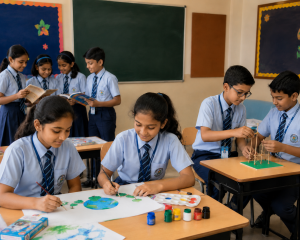
An IB classroom often feels discussion-rich, project-oriented, and inquiry-driven. Instead of only asking students to memorise a chapter and reproduce it in an exam, teachers may ask students to investigate a real-world problem, compare perspectives, design a solution, present findings, and reflect on what they learned.
For example, a unit on water may not be limited to a science chapter. Students may explore water through geography, economics, environmental science, civic responsibility, data interpretation, art, and communication. They may ask: Who has access to clean water? How do communities conserve it? What does water scarcity mean for cities? How can technology help? How can we communicate the issue responsibly?
This kind of learning can be powerful for children who enjoy curiosity, conversation, research, creativity, and independent thinking.
Parents often consider IB because it supports:
The IB Diploma Programme assessment is designed to measure advanced academic skills such as analysing and presenting information, evaluating and constructing arguments, and solving problems creatively, along with knowledge, understanding, and application.
IB can be excellent, but it requires the right fit. It may demand consistent engagement, reading, writing, research, presentations, independent work, and comfort with open-ended tasks. Some students thrive in this environment. Others may need time and support to adjust, especially if they come from a highly textbook-based learning background.
Parents should also evaluate whether the school has trained teachers, strong academic counselling, good libraries and laboratories, robust project support, transparent assessment communication, and experience with university guidance.
ICSE, or Indian Certificate of Secondary Education, is a Class X examination conducted by CISCE, the Council for the Indian School Certificate Examinations. It is known for a broad curriculum, strong English focus, detailed subject coverage, and a structured academic approach.
CISCE conducts the ICSE examination for Class X and the ISC examination for Class XII. ICSE is designed as a school examination after a ten-year course of study, and students are required to enter and sit for six subjects and Socially Useful Productive Work.
Parents often use the word “ICSE” to describe the school board from Classes I to XII, but technically:
| Stage | Examination | Conducted By |
| Class X | ICSE, Indian Certificate of Secondary Education | CISCE |
| Class XII | ISC, Indian School Certificate | CISCE |
So, when parents compare IB vs ICSE, they are usually comparing the IB educational pathway with the CISCE-affiliated ICSE/ISC school pathway.
An ICSE classroom is typically structured around syllabus depth, subject clarity, language development, written expression, regular assessments, and detailed academic preparation. The curriculum is often perceived as broad and content-rich, with strong importance given to English language, literature, sciences, mathematics, social studies, and other subjects.
A strong ICSE school may not rely only on lectures. Many good ICSE schools use projects, experiments, debates, presentations, reading programmes, field trips, co-curricular activities, and experiential methods. However, the board structure itself is more syllabus-defined than IB.
Parents often consider ICSE because it supports:
ICSE can be especially attractive for parents who want a rigorous Indian curriculum but also want strong communication skills and a broader academic base.
ICSE can be demanding. The curriculum may feel detailed, and students may need regular study habits, reading discipline, writing practice, and exam readiness. In a good school, this rigour can build confidence and academic stamina. In a poorly implemented school, it can become stressful or overly marks-focused.
Parents should therefore look beyond the board label. Ask whether the school balances academics with sports, performing arts, visual arts, life skills, emotional wellbeing, and future readiness. A child-centric ICSE school can offer a strong blend of structure and creativity.
The biggest difference between IB and ICSE is the learning approach. IB is inquiry-led and globally oriented, while ICSE is syllabus-led and academically structured. Both can lead to strong outcomes when delivered well.
Here is a parent-friendly comparison.
| Factor | IB | ICSE |
| Full form | International Baccalaureate | Indian Certificate of Secondary Education |
| Governing body | International Baccalaureate Organization | CISCE, Council for the Indian School Certificate Examinations |
| Orientation | Global, inquiry-based, interdisciplinary | Indian, structured, subject-focused |
| Learning style | Conceptual, research-led, project-based | Detailed syllabus, written work, subject depth |
| Assessment style | Continuous assessment, projects, portfolios, essays, exams depending on programme | Internal assessments and board examinations |
| Classroom culture | Inquiry, discussion, collaboration, reflection | Structured learning, syllabus coverage, written expression |
| Strength | Critical thinking, global readiness, independent learning | English, academic rigour, structured subject mastery |
| Common parent concern | Cost, availability, adjustment to open-ended learning | Syllabus load, exam pressure, subject density |
| International mobility | Strong | Moderate to strong, depending on pathway |
| Indian exam alignment | May need additional planning for JEE, NEET, CUET or other entrance exams | More familiar to Indian academic ecosystem, though entrance coaching may still be needed |
| Best fit for | Globally mobile, inquiry-driven, independent learners | Academically steady learners who benefit from structure and depth |
A helpful way to think about it is this: IB teaches students how to investigate and connect ideas; ICSE teaches students how to study subjects in depth and express knowledge clearly.
Both are valuable. The right choice depends on what your child needs next.
IB focuses on concepts, inquiry, real-world connections, and interdisciplinary learning. ICSE focuses on defined subjects, syllabus depth, English proficiency, and structured academic development.
The IB curriculum is not simply a list of chapters. It is a framework. Schools use the framework to design units that connect subjects, concepts, skills, and real-world contexts.
In the MYP, for instance, students study across broad subject groups and are encouraged to make practical connections between studies and the real world. The PYP uses a transdisciplinary framework for younger learners.
In practice, this means students may learn through:
IB is especially strong when a school wants students to become self-directed learners who can ask: What do I know? How do I know it? How can I apply it? What other perspective should I consider?
ICSE is more structured and subject-specific. It offers detailed syllabi and expects students to build a strong academic base across languages, mathematics, sciences, humanities, and other subject areas. CISCE regulations state that ICSE candidates must enter for at least six subjects and meet pass standards in at least five subjects, including English, to receive pass certificates.
In practice, ICSE students often develop:
ICSE’s broad and detailed curriculum can help students develop a strong foundation, especially when schools make learning engaging rather than mechanical.
Choose IB if your child enjoys exploring ideas, asking questions, working on projects, presenting, researching, and connecting subjects to real life.
Choose ICSE if your child benefits from clear academic structure, detailed subject learning, regular practice, written expression, and a recognised Indian board pathway.
Choose the school, not just the board, if your child needs both. A strong school can bring experiential methods into ICSE or academic structure into IB.
IB assessment is more varied and skills-based, while ICSE assessment is more examination-oriented with internal assessment components. Parents should choose the model that matches their child’s learning temperament and long-term goals.
IB assessments vary by programme, but the broad philosophy is to assess understanding, skills, application, reflection, and communication. The Diploma Programme includes assessments that measure advanced academic skills such as analysis, argument construction, creative problem-solving, knowledge, understanding, and application.
IB students may be assessed through:
This can be excellent for students who are not always best represented by one final exam. It also builds skills useful for university and workplace settings, such as research, communication, time management, and independent thinking.
However, IB assessment can feel demanding because work is spread across the year. Students must manage deadlines, feedback, revisions, documentation, and reflection. Parents should not assume IB means “less pressure”. It is a different kind of pressure.
ICSE assessment is more familiar to many Indian parents. Students prepare for subject-wise examinations, and internal assessment is also part of the system. ICSE regulations include requirements around subjects and pass certification, with English being compulsory for pass certification.
ICSE students are usually assessed through:
This can suit students who like clarity: a defined syllabus, expected question formats, written answers, and exam milestones. It can also build discipline and academic stamina.
The challenge is that some children may experience stress if the school overemphasises marks and speed. A good ICSE school must balance academic seriousness with wellbeing, creativity, sports, arts, and life skills.
There is no universal winner.
| Child Profile | Better-Fit Assessment Style |
| Enjoys projects, presentations, research, and reflection | IB |
| Performs well in written exams and structured preparation | ICSE |
| Needs frequent feedback rather than one final exam | IB |
| Needs a clear syllabus and predictable study routine | ICSE |
| Wants international university readiness | IB, especially DP |
| Wants strong Indian board familiarity | ICSE/ISC |
Parents should ask schools how they support children before high-stakes assessments. The board matters, but school culture matters more.
For the future, IB may offer stronger preparation for global universities and inquiry-based higher education, while ICSE offers a strong academic base for Indian pathways and subject depth. Both can support excellent futures when paired with the right school guidance.
Many parents ask, “Which is better for the future: IB or ICSE?” The better question is: Which board will help my child develop the right mix of academic competence, confidence, communication, curiosity, resilience, and direction?
Future readiness today includes:
IB and ICSE develop these differently.
IB tends to build future readiness through inquiry, research, global perspectives, interdisciplinary learning, presentations, reflection, and student agency.
ICSE tends to build future readiness through subject depth, strong English, disciplined study habits, written expression, detailed academic understanding, and examination confidence.
The IB Diploma Programme is widely used by students who plan to apply to universities abroad. Its emphasis on research, extended writing, subject combinations, international-mindedness, and independent work aligns well with many global university expectations.
However, parents should not assume that IB automatically guarantees admission abroad. University admissions depend on grades, subject choices, profile, essays, extracurriculars, recommendations, standardised tests where applicable, and the student’s fit with the course.
IB can help students build the habits needed for international higher education, but the school’s college counselling support is very important.
ICSE and ISC are well-recognised Indian school pathways. ICSE can give students a strong foundation in English and subject depth, while ISC in Classes XI and XII supports further academic specialisation.
For Indian entrance exams such as JEE, NEET, CLAT, CUET, design entrance tests, liberal arts admissions, commerce pathways, and other professional courses, students may still need focused preparation beyond school, depending on the course and exam.
This is true for almost every board. A school board is not the same as entrance exam coaching.
Careers are changing rapidly. A child who enters Grade 1 today may work in fields that do not fully exist yet. That is why the board should not be evaluated only by past patterns. Parents should ask:
Does the school help children think?
Does it help them communicate?
Does it build confidence?
Does it teach them how to learn?
Does it make them curious?
Does it support creativity and discipline?
Does it expose them to sports, arts, technology, leadership, and service?
Does it prepare them for both Indian and global possibilities?
From this perspective, both IB and ICSE can be future-ready if the school implements the curriculum with depth, care, and innovation.
Billabong High International School’s philosophy of joyful, child-centric, experiential learning is relevant here because board choice works best when it is embedded in a larger culture of curiosity, confidence, creativity, academic readiness, and holistic growth. Billabong’s admissions page also frames schooling as a pathway for growth beyond the classroom, with curiosity, adaptability, and resilience as part of the foundation.
ICSE may feel more familiar for Indian competitive exam preparation, but no board alone is sufficient for exams such as JEE, NEET, CUET, CLAT, or design entrance tests. Students from both IB and ICSE can succeed with the right subject choices, study plan, and preparation strategy.
A common misconception is that one school board automatically prepares students for every competitive exam. That is rarely true.
Competitive exams have their own patterns. They test speed, accuracy, syllabus familiarity, problem-solving under time pressure, and exam-specific strategies. A student may be in CBSE, ICSE, IB, Cambridge, or a state board and still require additional preparation depending on the exam.
ICSE students often develop strong subject depth and written skills. This can help in academic understanding. However, for exams such as JEE or NEET, students may need to align closely with the specific entrance syllabus and practice objective-style questions extensively.
ICSE can provide a strong foundation, but exam alignment must be planned.
IB students may develop excellent conceptual thinking, research skills, and analytical ability. However, if a child is preparing for highly syllabus-specific Indian entrance exams, families must plan subject alignment and exam-style practice carefully.
IB is not impossible for Indian competitive pathways, but it may require a more deliberate strategy, especially in the senior years.
If your child is likely to pursue Indian engineering or medical entrance exams, ask the school:
The answer is not only IB or ICSE. The answer is planning.

IB is often preferred by families considering international university pathways because of its global framework, research orientation, and international recognition. ICSE/ISC can also support study abroad, especially when students build strong grades, English proficiency, extracurriculars, and a well-rounded application profile.
IB students often gain experience in:
These skills are useful for international university applications and undergraduate learning.
The IB has a presence across the world, and IB World Schools operate internationally. The IB’s India country page notes that India has had IB World Schools since 1976 and lists 264 IB World Schools currently offering one or more IB programmes.
Yes. ICSE/ISC students can and do study abroad. International universities evaluate students holistically. They look at academic performance, subject choices, standardised tests where required, English proficiency tests, essays, recommendations, extracurriculars, portfolio work for certain courses, and evidence of readiness.
ICSE’s strong English and academic rigour can support such applications. However, families may need additional counselling support to navigate international admissions timelines, documentation, and profile building.
If study abroad is a possibility, ask schools:
IB may have an advantage in global alignment, but a strong ICSE school with good counselling can also support international aspirations.
The best board is often the one that fits the child’s learning temperament. IB may suit independent, curious, expressive learners, while ICSE may suit students who thrive with structure, detail, and clear academic expectations.
This child asks why, connects ideas quickly, enjoys projects, loves discussions, and may find rote-heavy learning limiting.
Likely fit: IB may be a strong match.
What to watch: The child still needs discipline, deadlines, and academic precision.
This child likes clear instructions, defined chapters, written practice, tests, and measurable progress.
Likely fit: ICSE may be a strong match.
What to watch: The child should still get opportunities for creativity, leadership, sports, and independent thinking.
This child enjoys storytelling, speaking, art, drama, design, music, writing, or presenting ideas.
Likely fit: Both can work. IB may offer more integrated expression, while ICSE may build strong language foundations.
What to watch: Choose a school with strong co-curricular programmes.
This child may not speak first in class but thinks deeply, reads carefully, and needs emotional safety.
Likely fit: Both can work if the school provides personalised support.
What to watch: Avoid schools that equate confidence only with loud participation.
This child is motivated by marks, ranks, and goal-driven preparation.
Likely fit: ICSE may feel more familiar, especially for Indian exam pathways.
What to watch: Ensure the child also builds conceptual understanding and wellbeing.
This child may relocate across countries or may apply to universities abroad.
Likely fit: IB may offer smoother continuity across international schools.
What to watch: Confirm programme availability, fees, and transition support.
The impact of board choice changes by age. In early years, school culture matters more than board labels. In middle and senior years, curriculum structure, assessment style, and future pathways become more important.
For younger children, parents should prioritise:
At this stage, the board label should not overshadow the quality of teaching. Whether a school follows an IB-inspired, ICSE, CBSE, Cambridge, or integrated approach, young children need nurturing adults, meaningful experiences, and a safe environment.
Billabong’s educational philosophy is especially relevant for early and primary years because it values child-friendly education, aspiration over ambition, wisdom over knowledge, and creative thought over rote learning.
Middle school is when learning habits begin to matter more. Students start forming identities as learners. Some begin to say, “I am good at science,” or “I am not good at maths,” or “I don’t like writing.” A good school can change these narratives.
In IB MYP, students may experience interdisciplinary units, projects, and real-world inquiry. In ICSE, students often begin to engage more deeply with subject content, written work, and academic structure.
This is the right stage to observe:
This is a critical decision stage. ICSE students prepare for the Class X board examination. IB students in MYP may complete projects and assessments depending on the school’s programme structure.
Parents should consider future transitions. If the child may switch boards after Grade 10, ask about subject mapping, academic counselling, and adjustment support.
Senior secondary choices are highly consequential. IB DP can be rigorous and internationally oriented. ISC can offer structured academic depth for Indian and global pathways.
At this stage, parents should not choose based on brand perception. They should choose based on:
A child who wants Indian medical entrance preparation may need a different plan from a child applying for liberal arts abroad. A child who wants design, architecture, law, business, data science, psychology, or humanities may need different subject and portfolio planning.
IB’s main advantage is that it helps students become independent, reflective, globally aware learners who can apply knowledge across contexts.
IB encourages students to ask questions, investigate, and construct understanding. This can make learning more meaningful because children are not only told what to learn; they are invited to think about why it matters.
IB exposes students to international contexts and encourages them to understand multiple perspectives. This can be valuable in a world where students may study, work, or collaborate across cultures.
IB students often develop strong research habits through essays, projects, investigations, and reflective tasks. These skills are useful for university-level study.
Many real-world problems do not fit neatly into one subject. IB’s interdisciplinary orientation helps students connect science with ethics, economics with environment, literature with history, and design with human need.
Presentations, discussions, collaborative projects, and reflective work can help students become more articulate and confident.
IB often gives students more ownership of learning. This can build motivation and responsibility.
The IB Diploma Programme can support students who are aiming for international universities, especially when paired with strong school counselling.
Critical thinking, collaboration, creativity, communication, research, and self-management are all highly relevant for future careers.
IB can be highly rewarding, but it may not be the easiest fit for every child or every family. Parents should understand the workload, costs, assessment style, and need for self-management.
IB schools often have higher fee structures because of international authorisation, teacher training, infrastructure, resources, and programme delivery costs. Fees vary widely by city and school.
IB schools are fewer in number compared with Indian boards. The IB India page lists 264 IB World Schools offering one or more programmes, while CISCE has thousands of affiliated schools in India and abroad.
Students moving from a textbook-heavy system may need time to adjust to open-ended tasks, research, presentations, and reflective work.
IB is not necessarily less stressful. Deadlines, projects, essays, portfolios, and assessments can create sustained pressure if students do not manage time well.
Students aiming for Indian competitive exams may need additional planning to align school learning with exam-specific preparation.
IB is a framework. Its quality depends heavily on teachers, school leadership, resources, assessment practices, and student support.
ICSE’s main advantage is that it offers a structured, rigorous, English-rich academic foundation that can support both Indian and international pathways.
ICSE is widely known among parents for its emphasis on English language and literature. This can support communication, writing, reading comprehension, and confidence in higher education.
ICSE’s broad curriculum can help students build depth across sciences, humanities, mathematics, languages, and other areas.
Many children benefit from clear syllabi, defined expectations, regular assessments, and visible academic milestones.
ICSE and ISC are well-established Indian school pathways. Families relocating within India may find ICSE schools in many cities, though availability differs by region.
ICSE often demands detailed answers and strong written expression. This can help students in humanities, law, liberal arts, communication, management, and other fields.
Before senior specialisation, ICSE students often experience a broad subject base, which can help them discover strengths and interests.
Many Indian parents understand ICSE’s structure more easily than IB. This can make home support simpler.
ICSE can be academically strong, but parents should ensure that the school does not make learning overly exam-heavy or stressful. The best ICSE schools balance rigour with joy, creativity, wellbeing, and exposure.
The ICSE syllabus can feel detailed. Students need steady study habits and regular revision.
While internal assessment and projects exist, the system is still more examination-oriented than IB. Some children may feel pressure if marks become the dominant focus.
ICSE is respected, but families moving internationally may find IB or Cambridge pathways easier to transfer across in certain contexts.
A strong ICSE curriculum can be delivered in a lively, experiential way, or it can be reduced to textbook completion. Parents should observe teaching style closely.
ICSE itself does not guarantee arts, sports, leadership, life skills, or innovation exposure. The school must intentionally provide these.
IB schools are often more expensive than ICSE schools, but fees vary significantly by city, campus, facilities, grade level, and school positioning. Parents should compare total cost, not only tuition.
| Cost Factor | IB | ICSE |
| Tuition fees | Often higher | Wide range, often comparatively lower |
| Infrastructure costs | Usually high in premium IB schools | Varies widely |
| Teacher training | International programme training may add cost | Varies by school |
| Learning resources | Digital platforms, labs, libraries, global resources | Textbooks, labs, libraries, school resources |
| Assessment and programme costs | May include international assessment-related costs | Board and school assessment-related costs |
| Co-curricular fees | Varies | Varies |
| Transport | Varies | Varies |
| Uniforms, books, activities | Varies | Varies |
Do not compare only annual tuition. Ask for a full fee sheet including admission fee, caution deposit, annual charges, transport, meals, books, uniforms, technology, activities, examination fees, and optional programmes.
Also ask what is included. A higher fee may include counselling, sports, arts, technology, lab access, international exposure, and personalised support. A lower fee may still be excellent if the school is well-run and child-centric.
The best value is not the cheapest option. It is the school that delivers strong learning, safety, wellbeing, and growth in a way that fits the family’s priorities.
Admissions for both IB and ICSE schools usually evaluate age eligibility, previous schooling, academic readiness, interaction, parent-school alignment, and seat availability. The process varies by school.
Billabong High International School’s admissions page indicates admissions across Kangaroo Kids Preschool and Grades 1 to 12 for CBSE, ICSE, and IGCSE board options, depending on campus and availability.
| Step | What Usually Happens |
| Enquiry | Parents submit an online or offline enquiry |
| Counselling | School explains curriculum, campus, fees, and grade fit |
| Campus visit | Parents tour classrooms, labs, sports areas, safety systems |
| Child interaction | School understands the child’s readiness and personality |
| Academic review | Previous report cards or assessments may be reviewed |
| Parent interaction | School discusses expectations and alignment |
| Offer and documentation | Parents complete admission forms and documents |
| Orientation | Child and parents are introduced to school routines |
Admissions are not only about securing a seat. They are about understanding whether the school and family share the same vision for the child.
The learning approach is the heart of the IB vs ICSE decision. IB starts with inquiry and concepts; ICSE starts with subject structure and syllabus depth.
| Learning Element | IB Approach | ICSE Approach |
| Starting point | Inquiry question or concept | Chapter, subject topic, or syllabus unit |
| Teacher role | Facilitator, guide, question designer | Instructor, mentor, subject expert |
| Student role | Investigator, collaborator, presenter | Learner, reader, writer, problem-solver |
| Classroom mode | Discussion, projects, research, reflection | Explanation, practice, written work, tests |
| Knowledge style | Conceptual and applied | Detailed and subject-specific |
| Skill focus | Research, communication, reflection, critical thinking | Reading, writing, accuracy, subject mastery |
| Output | Projects, presentations, essays, portfolios, exams | Written answers, projects, practicals, exams |
| Best when | Child needs exploration and agency | Child needs structure and academic depth |
A child-centric school can blend strengths from both worlds. For example, an ICSE school can use experiential learning, and an IB school can maintain academic rigour. Parents should visit classrooms and ask how learning actually happens.
IB and ICSE both support strong academics, but their subject strengths show up differently. IB emphasises application and connections; ICSE emphasises depth and written clarity.
ICSE is widely valued for English language and literature. Students often develop strong reading, grammar, comprehension, and writing skills.
IB also values language, communication, and literature, but often places language within broader inquiry, analysis, and global contexts.
Parent view: For traditional English depth, ICSE is strong. For communication across contexts and reflective writing, IB can be strong.
ICSE mathematics can provide structured practice and a strong foundation. IB mathematics, especially in senior years, can be conceptually rich and application-oriented.
Parent view: For Indian exam-style preparation, ICSE may feel more familiar. For conceptual and global university-style learning, IB can be useful.
ICSE science can be detailed and content-rich. IB science often emphasises inquiry, investigation, lab thinking, data interpretation, and real-world application.
Parent view: ICSE can build strong content knowledge. IB can build investigative thinking. The better choice depends on teaching quality.
ICSE provides structured coverage of history, civics, geography, economics, and related areas. IB often explores humanities through global contexts, perspectives, inquiry, evidence, and argument.
Parent view: ICSE may build detailed knowledge. IB may build analytical perspective and independent interpretation.
IB often integrates creativity and design thinking more naturally into its framework. ICSE schools may also offer strong arts and co-curricular programmes, but this depends on the school.
Parent view: Look at the school’s timetable, facilities, exhibitions, performances, clubs, and student work.
Neither IB nor ICSE is automatically stress-free. Stress depends on workload, school culture, assessment design, teacher support, parent expectations, and the child’s temperament.
IB stress can come from:
Some students love the variety. Others may feel overwhelmed if they lack time management skills.
ICSE stress can come from:
Some students feel secure with clear expectations. Others may feel burdened if the school is too marks-driven.
The board is only one part of the child’s experience. Stress reduces when schools offer:
Billabong’s emphasis on joyful education, confidence building, creativity, curiosity, and holistic development is important because children learn best when they feel safe, seen, and inspired.
To choose between IB and ICSE, evaluate your child, your family context, future goals, school quality, budget, and transition possibilities. Do not choose only by reputation.
Use this framework.
Ask:
A board that suits one sibling may not suit another.
For younger children, do not over-plan careers. But for older children, especially Grades 8 onwards, start thinking about broad direction.
| Future Possibility | Board Planning Note |
| Study abroad | IB may offer smoother alignment; ICSE/ISC can also work with counselling |
| Indian engineering or medicine | ICSE may feel more familiar; IB requires careful subject and exam planning |
| Liberal arts | Both can work; IB may support research and interdisciplinary thinking |
| Law | ICSE English and writing can help; IB argumentation and analysis can also help |
| Design or architecture | Look for portfolio support, creativity, visual arts, design exposure |
| Business or economics | Both can work; school counselling and subject choices matter |
| Undecided | Choose a school with broad exposure and strong guidance |
This is the most important step.
A strong school should show evidence of:
A board is a framework. School is a lived experience.
If moving from ICSE to IB, or IB to ICSE, ask:
The best school is one the family can sustain emotionally, financially, and logistically. Long travel times, overstretched budgets, or misaligned expectations can affect the child’s experience.
During a school visit, observe:
Do not choose based only on social media, rankings, or one parent’s opinion. Ask for real examples of student learning, assessment feedback, projects, support systems, and outcomes.
The most common mistake is treating board choice as a shortcut to success. A child’s growth depends on the board, school culture, teachers, family support, peer environment, and the child’s own readiness.
International does not automatically mean better. IB is excellent when delivered well and matched to the child. But it may not be ideal for every learner or every goal.
Many ICSE schools today use experiential learning, projects, digital tools, sports, arts, and student-led initiatives. The board may be structured, but the school can still be progressive.
Higher fees do not guarantee better learning. Lower fees do not mean lower quality. Evaluate value, not price alone.
Parents sometimes choose a board based on aspiration rather than fit. A child who needs structure may struggle in an open-ended environment. A child who needs exploration may feel limited in a rigid one.
Children need reading habits, sleep, routines, encouragement, emotional safety, and balanced expectations at home. No board can replace that.
Grade 11 subject choices can affect university options. Start conversations by Grade 8 or 9.
A warm, safe, skilled school can make a demanding board feel manageable. A poor school culture can make even a good curriculum stressful.
Important note: The schools mentioned below are not ranked. They are included only as examples of schools and school networks parents may consider while researching curriculum options, campus fit, location, learning approach, and admissions. Parents should verify current board availability, fees, facilities, and admissions details directly with each school.
Because this article is for Billabong High International School India, it is natural to highlight Billabong as a strong option where relevant. However, the purpose of this section is not to rank schools or declare one school “best”. It is to help parents understand the kind of options they may encounter while researching.
Billabong High International School is a school network in India associated with curriculum options including CBSE, ICSE, CAIE/Cambridge and IGCSE across different campuses. The official website lists locations such as Mumbai, Pune, Gurugram, Vadodara, Hyderabad, Bhopal, Gwalior, Indore, Jabalpur, Rewa, Kanpur, Noida, Chennai, Puducherry, and Maldives across the wider network.
Billabong is worth considering for parents who want a child-centric learning environment that values joyful education, academic readiness, creativity, life skills, holistic development, and future-ready learning. The school’s broader philosophy reflects a move away from rote learning toward individual creative thought and child-friendly education.
Parents should check the specific Billabong campus because board offerings vary by location.
Often considered by Mumbai parents exploring international curricula, Dhirubhai Ambani International School is known in the market for global curriculum pathways and academic ambition. Parents should verify current curriculum details, admissions process, fees, and grade-wise availability directly with the school.
Ecole Mondiale is another Mumbai school often considered by parents looking for international curriculum options. It may be relevant for families exploring IB-style learning environments. Parents should check current programme authorisation, fees, location fit, and counselling support.
Oberoi International School is often part of parent consideration sets in Mumbai for international curriculum pathways. Parents should evaluate campus location, grade availability, admissions competitiveness, and student support systems.
Jamnabai Narsee is a known name among Mumbai families and may be considered by parents comparing Indian and international curriculum environments. Parents should check current board offerings and admissions details directly.
Podar International has a wide school network and may appear in parent searches across Indian curricula and international pathways. Parents should compare campus-level quality, board availability, commute, and student support.
CP Goenka is often included in searches around international schooling and board comparisons. Parents should verify the specific curriculum offered at the relevant campus and compare learning approach, fees, and facilities.
Orchids is a large school network often appearing in parent searches for Indian school boards and curriculum comparisons. Parents should evaluate campus-specific quality, teacher support, academic depth, and co-curricular offerings.
Oakridge is often considered by parents exploring international education in cities such as Hyderabad, Bengaluru, Mohali, and Visakhapatnam. Parents should check current curriculum pathways, fees, and university counselling support.
Some parents exploring progressive education and board choices may consider schools from The Shri Ram ecosystem, depending on city and campus. Parents should verify curriculum and admission details directly.
Again, these schools are not ranked. They are simply worth considering based on parent search behaviour, curriculum relevance, and market visibility. The right school depends on the child, campus, location, fees, teacher quality, safety, and family priorities.
This table is not a ranking. It is a research aid for parents. Details such as fees, curriculum, facilities, and admissions change by campus and year, so parents should verify directly with each school.
| School / Network | Why Parents May Consider It | Curriculum Notes | Parent Checkpoints |
| Billabong High International School | Child-centric learning, joyful education, experiential approach, multiple locations, holistic development | Board offerings vary by campus; official website lists CBSE, ICSE, CAIE/Cambridge and IGCSE options across the network | Confirm board at chosen campus, visit campus, ask about academic support and co-curricular exposure |
| Dhirubhai Ambani International School | Known for international education and high academic visibility | Verify current programmes directly | Admissions selectivity, commute, fees, student support |
| Ecole Mondiale World School | Considered by families exploring international curriculum pathways | Verify current IB programme details directly | IB implementation, counselling, fees |
| Oberoi International School | International curriculum consideration in Mumbai | Verify current programmes directly | Campus fit, admissions, university guidance |
| Jamnabai Narsee School | Known Mumbai school with strong parent recall | Verify current board offerings directly | Curriculum fit, culture, admissions |
| Podar International School | Large school network with multiple curriculum options | Varies by campus | Campus quality, board availability, student-teacher support |
| CP Goenka International School | Often considered for international schooling | Varies by campus | Programme delivery, facilities, fees |
| Orchids The International School | Large network, visible in board-comparison searches | Varies by campus | Academic depth, teacher quality, co-curricular balance |
| Oakridge International School | Considered for international curriculum in several cities | Verify campus-specific offerings | Counselling, fees, learning support |
| The Shri Ram ecosystem | Considered by parents seeking progressive education | Varies by campus | Admissions, curriculum, child fit |
During a school visit, parents should look beyond brochures. The best evidence of school quality is visible in classrooms, teacher-student interactions, student work, safety practices, and the way leaders answer detailed questions.
Look for:
Ask:
Ask:
Ask:
Ask:
A premium school experience is not only about curriculum. It is about the total ecosystem around the child.

Use this matrix to make the decision more objective.
| Question | If Your Answer Is Yes | Possible Direction |
| Is your child likely to study abroad after school? | Yes | Consider IB strongly; ICSE/ISC can also work with counselling |
| Does your child enjoy independent research and presentations? | Yes | IB may fit well |
| Does your child need clear academic structure? | Yes | ICSE may fit well |
| Is your family budget comfortable with premium international-school fees? | Yes | IB becomes more feasible |
| Do you want broad Indian recognition and structured board exams? | Yes | ICSE is a strong option |
| Is your child preparing for Indian competitive exams? | Yes | ICSE may be easier to align, but planning matters in any board |
| Does your child dislike rote learning and need conceptual exploration? | Yes | IB or a highly experiential ICSE school may fit |
| Does your child become anxious with open-ended tasks? | Yes | ICSE may offer more predictable structure |
| Do you relocate internationally often? | Yes | IB may offer smoother mobility |
| Is the school excellent but the board not your first choice? | Maybe | Visit, ask questions, and evaluate fit carefully |
Yes, switching between IB and ICSE is possible, but the ease of transition depends on the child’s grade, academic habits, language skills, subject choices, and the support provided by the new school.
Students moving from ICSE to IB may have strong subject knowledge and writing discipline. They may need support with:
This transition can work well if the school provides orientation and bridge support.
Students moving from IB to ICSE may bring strong conceptual thinking and communication skills. They may need support with:
This transition can also work well, especially before senior grades.
The easiest transitions usually happen in early or middle years. Switching in Grades 9 to 12 requires more careful planning because board requirements, subject choices, and assessment structures become more important.
Before switching, ask the receiving school for a transition plan.
Parents play a different support role in IB and ICSE. IB parents often support inquiry, reading, time management, and reflection. ICSE parents often support routines, revision, written practice, and syllabus planning.
Parents can help by:
A useful question for IB children is: “What did you discover, and how do you know?”
Parents can help by:
A useful question for ICSE children is: “Can you explain this in your own words?”
Children need:
Board choice matters, but the home environment matters too.
A board provides the academic framework, but school culture determines the child’s daily experience. The same board can feel inspiring in one school and stressful in another.
A good school does not simply deliver a syllabus. It shapes how children feel about learning.
The right school will help children:
This is where Billabong High International School’s positioning becomes meaningful. Its brand philosophy is not only about board selection; it is about child-centric education, joyful learning, creativity, curiosity, holistic development, confidence, and future readiness. Across its network, Billabong presents itself as offering board options and school environments designed to support growth beyond the classroom.
For parents, that is the larger question: not just “IB or ICSE?” but “Which school will help my child become capable, confident, kind, curious, and prepared?”
The honest answer is that IB is better for some children, ICSE is better for others, and the best school is the one that understands your child deeply enough to deliver the chosen curriculum with care.
Choose IB if your child is curious, independent, expressive, globally oriented, comfortable with projects, and likely to benefit from inquiry-led learning. It can be especially valuable for families considering international pathways, interdisciplinary learning, and research-based education.
Choose ICSE if your child benefits from structure, detailed subject learning, strong English, written expression, and a recognised Indian academic pathway. It can be especially valuable for families seeking academic depth, disciplined preparation, and a broad foundation.
But do not stop at the board.
Visit the school. Meet the teachers. Understand the culture. Ask about safety, wellbeing, academic support, co-curricular life, future counselling, and how the school helps children become confident learners.
At its best, education is not only about marks, exams, or admissions. It is about helping children discover who they are, what they can do, how they can contribute, and how they can keep learning in a changing world.
That is the spirit parents should look for, whether they choose IB, ICSE, or another curriculum. And it is the spirit that child-centric schools like Billabong High International School aim to nurture through joyful learning, experiential education, holistic development, creativity, confidence, and future-ready growth.
The main difference is the learning approach. IB is inquiry-led, international, interdisciplinary, and project-oriented. ICSE is a structured Indian board known for detailed subject coverage, strong English, and academic rigour. IB focuses more on how students think and apply learning, while ICSE focuses strongly on subject depth and written expression.
Neither IB nor ICSE is universally better. IB may be better for students who enjoy research, projects, global perspectives, and independent learning. ICSE may be better for students who benefit from structure, detailed syllabus coverage, English strength, and written examinations. The right choice depends on the child and the school.
IB and ICSE are hard in different ways. IB can be demanding because of projects, research, presentations, reflection, and continuous assessment. ICSE can be demanding because of detailed syllabus coverage, written work, and exam preparation. A child’s experience depends on learning style, time management, and school support.
Yes, ICSE can be very good for the future when delivered by a strong school. It builds English proficiency, subject depth, writing ability, academic discipline, and a broad foundation. ICSE/ISC students can pursue Indian and international higher education pathways with the right planning and guidance.
Yes, IB can be good for Indian students, especially those who enjoy inquiry, research, presentations, global issues, and independent learning. It can also support international university pathways. However, Indian students preparing for competitive exams may need additional planning to align IB learning with entrance exam requirements.
IB is often considered a strong fit for studying abroad because of its international framework, research orientation, and global recognition. ICSE/ISC students can also study abroad if they have strong grades, appropriate subjects, English proficiency, extracurriculars, and good application guidance.
ICSE may feel more familiar for Indian competitive exam preparation because it follows a structured Indian academic pathway. However, JEE and NEET require exam-specific preparation regardless of board. IB students can also prepare for these exams, but they need careful subject planning and additional practice.
Yes, a child can switch from ICSE to IB, especially in earlier or middle grades. The child may need support with inquiry-based learning, research, presentations, reflection, and project work. Switching in senior grades requires more careful planning because subject choices and assessments become more important.
Yes, a child can switch from IB to ICSE. The child may need support with syllabus-specific learning, written exam formats, structured revision, and detailed textbook study. A good school should provide transition guidance and help identify any academic gaps.
Parents should consider the child’s learning style, future goals, budget, school quality, teacher support, assessment comfort, commute, co-curricular opportunities, and emotional wellbeing. The best decision comes from evaluating both the board and the school environment, not from choosing based on reputation alone.