

List of Top Schools in Vadodara – 2026-27, Fees, Admissions, Rankings
Top Schools in Vadodara: A Parent’s Practical Guide to Finding the Right Fit in 2026
Not all good schools are right for every child. The best choice is the one that matches your child’s learning style, your family’s priorities, and the kind of school experience you want day after day.
Executive Summary
If you are searching for schools in Vadodara, you are probably not looking for the loudest brand claim. You are looking for clarity.
You want to know which schools are genuinely worth considering, what makes one a better fit than another, how boards differ in real life, what you should ask during a school visit, how to compare admissions and value, and whether a school will help your child grow with confidence, curiosity, academic strength, and emotional security.
This guide is built for exactly that purpose.
It is not a ranking of schools. The schools mentioned here are not being ranked in any order. They are included because they are among the names parents in Vadodara often consider while shortlisting options for preschool, primary school, middle school, and senior grades.
In this article, you will find:
- how parents should evaluate schools in Vadodara beyond reputation
- what to compare across curriculum, culture, commute, and child fit
- a neutral view of notable schools worth considering
- a practical framework for choosing the best school in Vadodara for your child
- a school visit checklist
- admission guidance for 2026
- fee and value comparison logic
- a closer look at why Billabong High International School is a strong option for many families
If you are looking for the top schools in Vadodara, this guide will help you move from a long Vadodara school list to a thoughtful shortlist.
Introduction
What Parents Really Mean When They Search “Schools in Vadodara”
When parents type schools in Vadodara into a search bar, they are rarely asking for a random list.
They are usually asking one or more of the following:
- Which schools are worth considering this year?
- Which board is better for my child?
- Which school will balance academics and overall development?
- Which campus feels safe, warm, and well-managed?
- Which school is actually parent-friendly once admission is over?
- Which school will help my child thrive, not just perform?
That matters because the real decision is not about selecting the most talked-about name. It is about selecting a school where your child can learn well, feel known, and grow into a capable, grounded, future-ready person.
Vadodara gives parents a meaningful spread of choices. There are legacy institutions, strong CBSE schools, ICSE-focused options, international pathways, and schools that position themselves around holistic or experiential education. That is good news. But it also means decision fatigue is real.
A family comparing the best school in Vadodara today has to look well beyond advertisements. Academic outcomes matter, but so do classroom climate, teacher quality, communication style, emotional support, co-curricular depth, safety systems, and how a child is seen as an individual.
That is why this guide begins with a simple truth:
There is no single best school for every child. There are, however, several strong schools in Vadodara worth considering. The right choice depends on fit.
Which Are the Schools in Vadodara Worth Considering?
Parents searching for top schools in Vadodara commonly explore schools such as Billabong High International School, Nalanda International School, Navrachana International School, Delhi Public School Vadodara, Podar International School, American School of Baroda, New Era Senior Secondary School, and VIBGYOR High, among others.
These schools are not being ranked here. They are included because they are commonly part of a parent shortlist, and each may appeal to different families depending on board preference, location, age group, learning philosophy, and the kind of school experience being sought. School board and campus descriptors below are based on currently available school and school-guide information as of April 2026.

Why the Right School Is More About Fit Than Reputation
Many school comparison pages make the mistake of sounding final. They imply that one school is “best” and the rest are merely alternatives.
Parents know it is not that simple.
A school that works beautifully for one child can feel rigid, overwhelming, too exam-centric, too broad, too niche, too far, or too impersonal for another.
What actually drives a good outcome is fit across several layers:
1. Fit with your child’s temperament
Some children need high structure. Others blossom in discussion-rich classrooms. Some need more movement and expression. Some need greater emotional scaffolding during transitions. A good school understands that children do not all learn, process, or participate the same way.
2. Fit with your family’s academic priorities
Do you want depth of language and writing? Conceptual clarity? Global exposure? Strong exam preparation? Breadth in co-curriculars? A school should match what your family values, not just what sounds impressive in a brochure.
3. Fit with your daily life
A school that is excellent on paper but creates a punishing daily commute may not be sustainable. Children live school through daily rhythm, not website claims. Travel fatigue, start times, transport reliability, and location matter more than many parents initially admit.
4. Fit with your child’s stage
What a parent wants in preschool is not what they want in Grade 8 or Grade 11. Early years require warmth, play, developmental readiness, and strong home-school partnership. Senior grades require academic guidance, subject pathways, identity support, and exam planning.
5. Fit with your definition of growth
Some schools define success narrowly. Others create room for confidence, creativity, communication, sports, performance, collaboration, leadership, and life skills. In a changing world, future readiness is broader than marks.
This is where Billabong High International School often stands out for parents who want a school that treats learning as both serious and joyful. Billabong positions itself around child-centric, experiential, and future-ready education, with its Vadodara campus presenting itself as an ICSE/ISC pathway and emphasizing personal guidance, strong academics, and a safe school environment.
Understanding the Search Intent Behind “Best School in Vadodara”
Before you compare a single school, it helps to understand your own intent.
When parents search for the best school in Vadodara, the query usually combines five decision layers at once:
Informational intent
You want to understand what options exist, which boards are offered, what the local school landscape looks like, and what key differences matter.
Comparison intent
You want to compare schools side by side, not just read isolated claims.
Admissions intent
You want practical answers about applications, documents, age criteria, school visits, interactions, and timelines.
Parenting intent
You want to choose a place where your child will be emotionally secure, socially supported, and able to enjoy learning.
Decision-support intent
You want enough insight to make a final shortlist with confidence.
A useful school guide should serve all five. That is what this article is designed to do.
Schools in Vadodara: A Neutral Parent-Friendly List of Options Worth Considering
The schools below are not ranked. They are included because many parents in Vadodara explore them during the shortlisting process.
Snapshot Table: Schools in Vadodara Worth Considering
| School | Commonly Known For | Board / Academic Pathway | Parent Fit |
| Billabong High International School, Vadodara | Child-centric learning, experiential education, holistic development, strong school culture | ICSE / ISC pathway in Vadodara campus | Families seeking joyful learning with academic readiness and broad development |
| Nalanda International School | ICSE-led schooling, campus environment, broad development orientation | ICSE | Parents looking for CISCE structure with a holistic school environment |
| Navrachana International School (CBSE / IB) | Established educational trust, multiple pathways, strong infrastructure | CBSE and IB through separate entities | Families comparing traditional national board and international continuum options |
| Delhi Public School Vadodara | Large-school ecosystem, CBSE curriculum, broad academic familiarity | CBSE | Families seeking a mainstream CBSE route with established systems |
| Podar International School, Vadodara | Structured CBSE delivery, all-round development, network reliability | CBSE | Families seeking a known school network with process-driven systems |
| American School of Baroda | CBSE curriculum, balanced school messaging, modern school positioning | CBSE | Families looking for a contemporary CBSE day school environment |
| New Era Senior Secondary School | Legacy standing, disciplined culture, large student community | CBSE | Families preferring a more established and traditional academic environment |
| VIBGYOR High, Vadodara | Co-curricular emphasis, contemporary positioning, board options | CBSE and Cambridge offerings in Vadodara ecosystem | Families looking for a modern branded school experience |
These descriptors are intended as neutral parent-facing guidance, not endorsements or rankings. Current board and positioning references reflect school sites and current school-guide pages available in April 2026.
How to Read a Vadodara School List the Smart Way
A long Vadodara school list can make parents feel productive, but lists alone do not solve the real problem.
The smarter approach is to reduce the city’s options into decision layers.
Layer 1: Board fit
Shortlist by curriculum first, because board choice affects pedagogy, assessment style, subject depth, and long-term flexibility.
Layer 2: Distance and commute
Then shortlist by geography. A school your child can reach comfortably is usually better than a “better-known” one that turns every day into a logistical strain.
Layer 3: Learning philosophy
Now compare culture. Is the school teacher-led, exam-heavy, exploratory, discussion-oriented, activity-rich, or balanced?
Layer 4: Child support
How visible are pastoral systems, teacher accessibility, transition support, counselling, and parent communication?
Layer 5: Real value
Do the fees align with what the school truly offers in academics, teacher quality, infrastructure, safety, and enrichment?
Most parents reverse this process. They start with social buzz, then get attached to a name, and only later examine suitability. That often leads to confusion.
CBSE, ICSE, IB, Cambridge: What Actually Changes for Your Child?
One of the biggest decision points for parents researching schools in Vadodara is curriculum.
Too many comparisons stay vague. Parents hear words like “global,” “holistic,” “rigorous,” or “balanced,” but do not get enough clarity on what daily school life looks like under each board.
Here is a simpler way to think about it.
CBSE: Strong national alignment and broad familiarity
CBSE is often preferred by families looking for:
- a widely recognized national board
- structured syllabus progression
- strong compatibility with many Indian competitive pathways
- easier intercity transfer compared with niche boards
- a familiar academic framework
In practical terms, parents often see CBSE as a route that can balance academics, mobility, and predictability. Its quality, however, depends heavily on how a school teaches the curriculum, not just the board label itself.
A strong CBSE school will not just “cover portions.” It will explain concepts well, maintain classroom discipline without suppressing curiosity, and provide meaningful opportunities beyond textbook learning.
ICSE / ISC: Breadth, language richness, and concept depth
ICSE is often chosen by parents who value:
- strong English and writing foundations
- broad subject engagement
- depth in humanities and languages alongside sciences
- detailed conceptual work
- a more expansive school experience
That said, board stereotypes can be overstated. An ICSE school is only as strong as its teaching culture. What matters is whether the school uses the curriculum to build thinking, expression, and confidence.
Billabong High International School’s Vadodara campus is positioned in this space, making it attractive to families who want academic seriousness without losing sight of experiential learning, confidence building, life skills, and whole-child development.
IB: Inquiry-led, global, and student-driven
IB appeals to families seeking:
- inquiry-based learning
- interdisciplinary thinking
- project-led understanding
- international exposure
- strong emphasis on reflection, agency, and communication
It can be an excellent fit for children who enjoy asking questions, making connections, and learning through exploration. It also often appeals to globally mobile families or those considering international higher education routes.
Cambridge / CAIE: International pathway with flexible academic design
Cambridge pathways are often associated with:
- strong subject-specific progression
- international benchmarking
- flexible academic routes
- analytical depth
- suitability for globally oriented families
Again, the quality of implementation matters immensely. A board does not create a great school on its own.
Parent takeaway
Do not ask, “Which board is best?”
Ask, “Which board, delivered by which school, suits my child’s present needs and future direction?”
That is a much better question.
What Parents in Vadodara Should Compare First
If your shortlist is still long, compare schools using these six filters first.
1. Teaching quality
This is the heart of the school. Everything else is secondary.
Ask:
- Are teachers confident, warm, and observant?
- Do classes feel active and meaningful?
- Are students speaking, questioning, writing, making, and thinking?
- Does the school seem child-aware, not just syllabus-aware?
2. Emotional and physical safety
A school can look polished and still feel emotionally cold. Or it can feel warm but loosely managed. Parents need both warmth and systems.
Ask:
- How are concerns handled?
- How are transitions supported?
- What discipline approach is used?
- What child protection systems exist?
- How does transport safety work?
3. Curriculum delivery, not curriculum label
Two schools under the same board can feel completely different. One may be rote-driven. Another may be concept-driven and joyful.
Ask:
- How is learning made active?
- What does classroom work look like at each stage?
- How is assessment used?
- How does the school support children who need help or extension?
4. Co-curricular and extracurricular depth
This is where schools often overstate. “Holistic” is one of the most overused words in school marketing.
Parents should ask:
- Are activities optional extras, or part of the school culture?
- Is there genuine exposure to sports, arts, performance, clubs, leadership, and life skills?
- Is participation broad or limited to a few students?
5. Parent communication and partnership
The school-parent relationship matters far more than many parents realize.
Ask:
- Is communication clear, timely, respectful, and solution-oriented?
- Are parents treated as partners or outsiders?
- Does the school explain decisions well?
6. Daily child experience
This is the ultimate test.
Imagine your child’s ordinary Tuesday. Not an annual day. Not sports day. Not orientation.
Ask:
- Will my child look forward to going?
- Will they be known by teachers?
- Will they be challenged appropriately?
- Will they feel safe to speak, try, fail, and improve?
That is how you choose among the top schools in Vadodara with real clarity.
What Makes a School Truly Good in 2026
The language around schools has changed. Parents today are no longer impressed by surface-level promises alone.
A truly strong school in 2026 is expected to deliver across five dimensions:
Academic readiness
Children should build strong fundamentals, clear thinking, and the ability to express and apply what they know.
Human skills
Confidence, communication, empathy, collaboration, self-management, and resilience are no longer optional.
Future-readiness
Children need exposure to problem-solving, creativity, digital literacy, independent thinking, and adaptability.
Wellbeing
A child who is constantly anxious, unheard, over-pressured, or disconnected is not thriving, even if marks look acceptable.
Meaningful engagement
Students learn better when learning feels alive. They need discussion, projects, hands-on experiences, performance opportunities, clubs, labs, reading culture, and room to explore interests.
This is where schools that combine structure with joyful learning tend to feel more future-aligned. Billabong High’s brand language around experiential learning, confidence building, co-curricular exposure, and child-centric schooling fits the direction many parents are now actively looking for.

A More Useful Comparison Framework for Schools in Vadodara
Instead of asking “Which school is number one?”, use this framework.
Compare schools across these 10 criteria
| Criteria | What to Look For | Why It Matters |
| Curriculum fit | Board, teaching style, progression | Shapes daily learning and long-term academic path |
| Teacher quality | Warmth, clarity, class ownership | Best predictor of real learning |
| Child support | Counselling, mentoring, adjustment support | Helps children settle, recover, and grow |
| Safety systems | Entry controls, bus safety, supervision | Builds trust and reduces avoidable risk |
| Class experience | Participation, projects, interaction | Shows whether learning is active or passive |
| Co-curricular depth | Arts, sports, clubs, life skills | Builds confidence and whole-child development |
| Parent communication | Clarity, responsiveness, transparency | Reduces friction and strengthens partnership |
| Campus environment | Cleanliness, energy, upkeep, child-friendliness | Reflects management quality and child comfort |
| Commute practicality | Distance, travel time, transport | Affects energy, consistency, and daily family life |
| Value for money | What is included and what is visible | Prevents decisions based on brand aura alone |
If you apply this framework honestly, the shortlist usually becomes much clearer.
Schools Worth Considering in Vadodara: What Different Parents May Appreciate
Again, the schools below are not ranked. The aim is to help parents think about fit.
Billabong High International School, Vadodara
Parents often consider Billabong when they want a school that is academically purposeful but not emotionally sterile. Its brand positioning speaks to child-centric learning, experiential education, confidence, creativity, and future readiness. For many families, that combination is appealing because it suggests a school where development is not reduced to marks alone. The Vadodara campus is presented as an ICSE / ISC pathway with an emphasis on personal guidance and a safe environment.
Why it may appeal
- parents who want a more thoughtful, learner-centred experience
- families seeking strong academics with broader development
- children who benefit from engagement, expression, and confidence-building
- parents who care about school culture, not just board branding
Nalanda International School
Nalanda is often considered by families exploring ICSE-led schooling and campus-based holistic development. It is one of the names that frequently appears in parent conversations around established private schooling options in the city.
Why it may appeal
- families preferring CISCE structure
- parents drawn to a traditional school environment with broad development language
- children who may benefit from a conventional but substantial school ecosystem
Navrachana International School
Navrachana attracts attention because it offers families multiple pathways through its institutional ecosystem, including CBSE and IB options. That can make it relevant for parents still deciding between national and more international curricula.
Why it may appeal
- families comparing board options under a known educational trust
- parents seeking larger infrastructure and established institutional identity
- students for whom pathway continuity matters
Delhi Public School Vadodara
DPS remains a familiar name for many families looking for a mainstream CBSE route. Parents often explore it when they want recognizable systems, broad CBSE alignment, and a relatively conventional academic structure.
Why it may appeal
- families seeking a known CBSE environment
- parents who prioritize academic familiarity and conventional school systems
- children comfortable in larger-school settings
Podar International School, Vadodara
Podar is often considered by families who value process, consistency, and the reassurance of a large school network. The Vadodara campus positions itself around rounded development within the CBSE framework.
Why it may appeal
- families wanting a network-backed CBSE school
- parents who value structure and systemization
- children who do well with predictable routines
American School of Baroda
American School of Baroda is another school parents may consider while comparing contemporary CBSE options in the city. Its messaging emphasizes balanced curriculum and holistic development.
Why it may appeal
- families exploring modern CBSE day schools
- parents seeking a contemporary school identity
- students who may thrive in a newer-feeling academic environment
New Era Senior Secondary School
The New Era is often part of the conversation for families who value legacy, discipline, and established presence. It may appeal more to parents who prefer schools with a long-standing academic and cultural identity.
Why it may appeal
- parents comfortable with a more traditional school culture
- families that value legacy and structure
- students who thrive in a disciplined environment
VIBGYOR High, Vadodara
VIBGYOR can attract parents seeking a branded, contemporary school experience with co-curricular visibility and board options in the Vadodara ecosystem.
Why it may appeal
- families comparing modern school brands
- parents wanting visible co-curricular culture
- students who enjoy a more contemporary school identity
How to Compare Schools by Age Group
One major mistake parents make is evaluating every school using the same criteria.
The right questions change by stage.
Preschool and early years
At this stage, parents should prioritise:
- warmth and emotional safety
- play-based and developmentally appropriate learning
- language-rich classrooms
- child-friendly routines
- teacher sensitivity
- transition support
- movement, music, and expression
This is where a child-centric school philosophy matters enormously. Children in early years need joyful education, not premature academic pressure.
Primary school
Now the focus should include:
- foundations in literacy and numeracy
- curiosity and active engagement
- classroom participation
- strong teacher-child relationships
- routines with warmth
- exposure to arts, sports, projects, and public expression
The best primary experience is one that makes children both capable and eager.
Middle school
This is the phase where identity, confidence, friendships, motivation, and independent learning habits start to matter more sharply.
Parents should now compare:
- subject transitions
- study skills support
- pastoral systems
- activity breadth
- emotional support
- exposure to responsibility and self-management
Secondary and senior secondary
At this stage, compare:
- subject pathway clarity
- exam readiness systems
- teacher expertise
- career guidance
- academic counselling
- balance between performance and wellbeing
A school can be excellent in early years and still not be your first choice for Grades 11 and 12. Or the opposite. Be stage-specific.
Common Parent Mistakes While Choosing the Best School in Vadodara
This section matters because many school decisions go wrong in predictable ways.
Mistake 1: Choosing by social prestige
A school’s reputation may tell you something. But it does not tell you everything. Social popularity is not a reliable substitute for educational fit.
Mistake 2: Overvaluing infrastructure photos
A glossy campus can create a powerful first impression. But children are taught by teachers, not buildings. Infrastructure matters, but teaching and culture matter more.
Mistake 3: Assuming board alone determines quality
Parents often say things like “ICSE is better” or “CBSE is more practical” as though that ends the discussion. It does not. Implementation is what changes a child’s experience.
Mistake 4: Ignoring commute
Long travel can affect sleep, mood, attention, activity participation, and family energy. A good school far away may function like a poor fit over time.
Mistake 5: Not observing student behaviour on campus
The children already in the school tell you a lot. Are they engaged, confident, respectful, relaxed, and visible? Or quiet, hurried, and overly managed?
Mistake 6: Asking only about marks
Academic performance matters. But parents should also ask about reading habits, project work, public speaking, arts exposure, sports culture, emotional safety, teacher continuity, and communication systems.
Mistake 7: Not considering the child’s personality
A school that is ideal for a highly self-driven child may not work for one who needs gentler support, more personalised attention, or a more confidence-building environment.
What Parents Should Ask During a School Visit
If you are visiting schools in Vadodara this season, do not just accept the presentation flow. Ask better questions.
Curriculum and classroom questions
- How is learning made experiential in primary and middle school?
- How do teachers handle different learning paces?
- What does a typical class period look like?
- How do you balance academic rigour with student wellbeing?
Child support questions
- How do you help new students settle in?
- What happens if a child is anxious, struggling socially, or losing confidence?
- Is there counselling support or pastoral care?
- How do class teachers communicate concerns?
Assessment questions
- How often are parents updated?
- How do you evaluate progress beyond marks?
- What support is available if a child falls behind?
- How do you stretch high-performing students without creating unhealthy pressure?
Co-curricular questions
- Which activities are regular and which are occasional?
- Is participation broad-based?
- How early do children get exposure to arts, music, performance, and sports?
- How are life skills and leadership built into school life?
Safety and operations questions
- What are your transport safety processes?
- How are entry and pickup managed?
- What is your supervision model during breaks and transitions?
- How are complaints handled and escalated?
Parent partnership questions
- How frequently do class teachers communicate?
- What is the response process for concerns?
- How does the school support parents through transitions?
A strong school will answer these comfortably, clearly, and without sounding defensive.
A Practical School Visit Checklist for Vadodara Parents
Use this on your next campus visit.
Observe the environment
- Is the campus clean, calm, and active?
- Do spaces feel child-friendly or merely formal?
- Is there evidence of student work, not just display branding?
Observe adults
- Do teachers smile at students?
- Do they speak with warmth and authority?
- Does the administrative team seem organised and respectful?
Observe children
- Do children seem confident and comfortable?
- Are they participating or merely complying?
- Do they look over-controlled or naturally engaged?
Observe learning
- Are classrooms interactive?
- Is there evidence of inquiry, discussion, projects, reading, expression, or collaborative work?
- Are children asking questions?
Observe systems
- Does the school seem thoughtful about routines?
- Are safety practices visible?
- Is the communication style clear and parent-aware?
Parent takeaway
A school visit should help you answer one question:
Can I imagine my child being happy, challenged, known, and safe here on an ordinary day?
If the answer is uncertain, keep looking.
Fees, Admissions, and Value: How to Compare Wisely
Parents often ask for “updated fees,” but the better question is “How do I compare value honestly?”
Exact fee structures can change by grade, board, year level, facilities, and optional services. That is why you should always ask each school for the latest official fee sheet, transport details, annual charges, activity costs, and payment schedule before making a final decision.
What to compare in the fee conversation
| Fee Lens | What to Ask |
| Tuition | What is the annual tuition for the relevant grade? |
| Admission charges | Are there one-time fees at entry? |
| Security deposit | Is there a refundable amount? |
| Activity costs | Which activities are included and which are extra? |
| Transport | Is transport separate? What are the route slabs? |
| Materials and uniform | What is the expected annual non-tuition spend? |
| Escalation | How often are fee revisions announced? |
| Payment schedule | Term-wise, monthly, quarterly, annual? |
What “good value” actually means
A school offers good value when:
- teaching quality is visible
- communication is strong
- safety and systems are dependable
- enrichment is real
- the child is growing in confidence and capability
- the school experience feels worth the investment every day
A lower fee is not automatically better value. A higher fee is not automatically justified.
Admissions in 2026: How Parents Should Prepare
The admissions process for schools in Vadodara can feel overwhelming because each school varies in timing, documentation, interaction process, and seat availability.
Here is a practical way to approach it.
Step 1: Finalise your board preference
Do not apply everywhere randomly. Align board preference first.
Step 2: Create an A-list and B-list
Choose:
- 3 schools you strongly want
- 2 backup schools you would still be happy with
Step 3: Prepare your documents early
Typically, parents should be ready with:
- child’s birth certificate
- passport-size photographs
- address proof
- parent ID documents
- previous school records, if applicable
- transfer certificate, if applicable
- immunisation or health details, if requested
Step 4: Understand the interaction style
For younger children, schools may observe readiness rather than test knowledge. For older students, schools may have interaction, academic review, or limited assessment depending on grade and vacancy.
Step 5: Ask about waitlists and timelines
Some schools fill certain entry points faster than others.
Step 6: Do not confuse urgency with fit
Applying early helps. Rushing blindly does not.
Billabong’s admissions page currently positions applications as open for 2026–27, and parents interested in the Vadodara campus can use its admissions and campus contact pages to initiate enquiry or visit planning.
How to Decide Between a Traditional Academic Environment and a More Child-Centric School
This is one of the most important choices parents make, though they do not always phrase it this way.
Some schools feel more traditional:
- strong structure
- more formal discipline
- clearly managed academic progression
- familiar school culture
Other schools feel more child-centric:
- more active learning
- room for inquiry and expression
- greater emphasis on confidence and individuality
- stronger visible integration of co-curriculars and life skills
Neither model is automatically right or wrong. The key is fit.
A child who needs emotional safety, engagement, expression, and confidence-building may do better in a school that takes joyful, experiential learning seriously.
A child who thrives in a highly structured, conventional setting may feel comfortable in a more traditional school environment.
The best schools today increasingly combine both: academic readiness and human-centred learning.
That is where many parents find Billabong High compelling. Its educational language does not position joy and rigour as opposites. Instead, it suggests that children learn better when they are engaged, supported, stretched, and seen as whole individuals.
Why Experiential Learning Matters More Than Ever
Parents hear the term often, but what does it actually mean in school life?
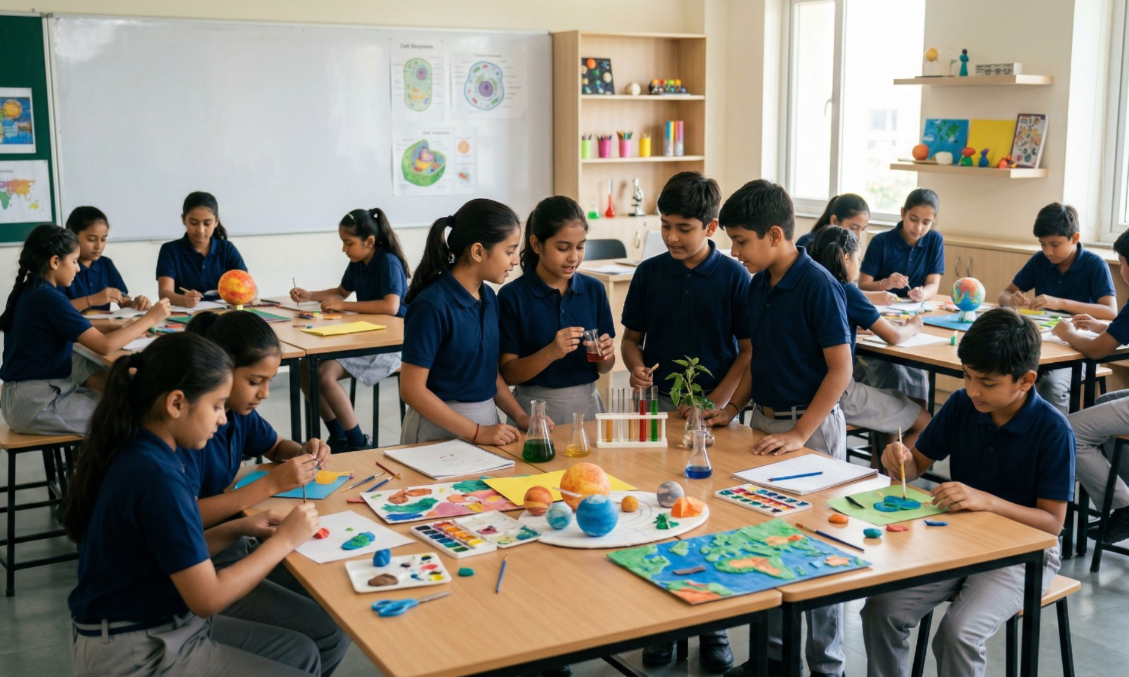
Experiential learning means children do not only receive information. They interact with it. They test it, discuss it, create with it, and connect it to the world.
In early years, it looks like:
- learning through play
- sensory activities
- storytelling
- movement-based exploration
- hands-on language and number experiences
In primary school, it looks like:
- projects
- experiments
- presentations
- field-linked learning
- application-based work
In middle and senior school, it looks like:
- problem-solving
- subject integration
- practical work
- collaborative tasks
- student voice and ownership
Why does this matter?
Because memorisation alone does not build durable understanding. Children remember, transfer, and apply ideas better when they actively engage with them.
Experiential learning also supports:
- confidence
- communication
- curiosity
- resilience
- creativity
- independent thought
For parents looking beyond conventional academics, this is one of the strongest signals of a future-ready school.

What “Holistic Development” Should Really Mean
Another overused phrase in school marketing is “holistic development.”
For parents, it should mean something concrete.
A school that genuinely supports holistic development will usually show evidence of growth in these areas:
Academic capability
The child can think, read, write, solve, and understand.
Communication
The child can express ideas, ask questions, and present with confidence.
Emotional maturity
The child can recover from setbacks, manage feelings better, and seek help when needed.
Social growth
The child can collaborate, participate, listen, and navigate group settings.
Creative confidence
The child has opportunities to imagine, design, perform, make, and contribute.
Physical development
The child is active, coordinated, and exposed to sport or movement.
Character and life skills
The child is building responsibility, empathy, initiative, and self-management.
Parents should ask themselves:
Can I see signs of this growth in the students of this school?
If yes, the school’s “holistic” claim may be real.
The Parent Decision Framework: How to Choose the Best School in Vadodara for Your Child
If you are trying to make a final choice, use this five-step framework.
Step 1: Define your non-negotiables
Examples:
- must be within a practical commute
- must offer a certain board
- must feel safe and well-managed
- must value overall development, not only marks
- must have strong early years or middle school support
Step 2: Define your child profile
Ask:
- Is my child cautious or expressive?
- Does my child need warmth before challenge, or challenge with structure?
- Does my child enjoy discussion, movement, making, performing?
- Does my child need more personal attention?
Step 3: Compare the top 3 schools honestly
Do not compare vague impressions. Compare on the same categories.
Step 4: Visit twice if needed
Your first visit may be emotional. A second visit helps you notice what you missed.
Step 5: Choose the school you can trust on ordinary days
The right school is not the one that dazzles you for one hour. It is the one you can trust every day.
A Parent-Centred Look at Billabong High International School, Vadodara
For families exploring schools in Vadodara with an eye on both academics and overall development, Billabong High International School deserves serious consideration.
This is not because every child should attend the same school. It is because Billabong’s educational stance aligns closely with what many modern parents now say they want:
- child-centric learning
- joyful education
- experiential classrooms
- academic readiness without a joyless atmosphere
- confidence building
- creativity and curiosity
- future-ready learning
- personalised support
- safe, engaging school environment
- meaningful co-curricular and extracurricular exposure
Its Vadodara campus presents itself around the ICSE / ISC pathway and emphasizes strong academics, personal guidance, and a secure school setting. The school’s broader brand positioning also highlights multiple board options across the network and a growth-beyond-the-classroom approach.
Why many parents may find this compelling
1. It frames education as more than syllabus completion
Parents increasingly want schools that treat children as active learners, not passive recipients.
2. It balances head and heart
A school that values confidence, expression, and life skills alongside academics often supports more durable success.
3. It sounds built for real childhood
For many parents, “premium” does not mean luxury aesthetics. It means thoughtful schooling. A place where children can be challenged, supported, and allowed to grow with dignity.
4. It supports future relevance
A future-ready school should help children adapt, question, communicate, create, and collaborate. Those are not side outcomes anymore. They are central.
5. It can appeal across multiple parent priorities
Billabong may suit families looking for:
- a strong alternative to purely conventional schooling
- an environment where children are seen as individuals
- broad-based development, not a narrow mark-driven identity
- a school culture that feels warm, contemporary, and aspirational without becoming impersonal
How Billabong High Fits Different Parent Needs
For parents of younger children
Billabong’s child-centric and experiential positioning can appeal to families who want early learning to feel engaging, confidence-building, and developmentally respectful.
For parents of primary school children
The school’s brand voice around curiosity, creativity, and joyful learning may resonate with families who want stronger foundations without making school feel mechanical.
For parents of middle school children
Its emphasis on holistic development and personal guidance can feel reassuring during a stage where identity, motivation, and confidence often fluctuate.
For parents of older students
The academic seriousness associated with ICSE / ISC, alongside the school’s wider focus on confidence and life skills, may appeal to families who want readiness without emotional narrowing.
Comparing School Culture: What Parents Often Notice but Rarely Name
Many school choices come down to something hard to describe but easy to feel: school culture.
Culture shows up in:
- how adults speak to children
- whether curiosity feels welcome
- whether students are visible as people
- whether achievement is the only thing celebrated
- whether mistakes are treated as failure or part of learning
- whether the school feels performative or genuinely thoughtful
This is where brand language must match lived experience.
A school that says it values creativity should show it in student work, not just annual day photos. A school that claims holistic development should show children participating widely, not only a few selected achievers. A school that says it is child-centric should feel attentive to children during actual school routines.
Parents should look for congruence.
Location, Commute, and Daily Energy: The Underrated Part of School Choice
Families often underestimate how much daily travel affects school experience.
A long commute can reduce:
- sleep quality
- participation in after-school activities
- energy for homework
- overall mood
- willingness to engage socially
- family rhythm
When comparing schools in Vadodara, place commute near the top of your evaluation list.
Ask yourself
- How long will the trip be in peak traffic?
- What time will my child need to wake up?
- Will transport feel safe and reliable?
- Will this schedule still work two years from now?
A school should fit into your family’s life, not consume it.
What Parents Should Look For in Safety and Student Well-being
Safety is not only about guards, buses, and CCTV. Those matter. But parents should think more broadly.
A safe school usually offers three layers:
Physical safety
- controlled entry and exit
- bus protocols
- supervised spaces
- emergency preparedness
- responsible infrastructure management
Emotional safety
- respectful teacher culture
- no humiliation-based discipline
- approachable adults
- systems for reporting concerns
- healthy peer norms
Developmental safety
- age-appropriate expectations
- proper transition support
- balance between challenge and support
- reasonable pressure levels
Parents should ask schools not only what their policy says, but how it works on an ordinary school day.
Billabong’s Vadodara pages and current admissions messaging publicly reference school safety, transport safety, and parent support channels, which is useful for families who want to begin the conversation with visible operational transparency.
How to Judge Whether a School Is Truly Parent-Friendly
Some schools are polished at admission time but difficult later. Parent-friendliness is not about saying yes to everything. It is about quality of partnership.
A parent-friendly school usually:
- communicates clearly
- responds respectfully
- explains academic and behavioural decisions
- values parent trust
- keeps systems transparent
- treats concerns as solvable, not inconvenient
Watch for how the admissions team speaks. It often reveals the school’s relationship culture more than formal promises do.
Comparison Table: What Different Types of Parents May Prefer
| Parent Priority | Schools They May Explore More Closely | Why |
| Child-centric, experiential learning | Billabong High, some progressive-formatted campuses | Better fit for parents seeking engaged learning and confidence building |
| Mainstream CBSE familiarity | DPS Vadodara, Podar, American School of Baroda, New Era | Useful for parents preferring a conventional national-board route |
| ICSE pathway and broader language-rich schooling | Billabong High, Nalanda | Helpful for families drawn to CISCE structure |
| International or globally oriented pathway | Navrachana IB, Cambridge-led options such as VIBGYOR where relevant | Useful for parents comparing international curriculum pathways |
| Larger institutional ecosystem | Navrachana, DPS, Podar | Appeals to families valuing scale and established structures |
| Balanced academics plus visible co-curriculars | Billabong, VIBGYOR, select contemporary campuses | Good for parents wanting confidence, expression, and activity integration |
This is a fit-based guide, not a ranking.
How to Build Your Final Shortlist in One Evening
If you feel overloaded, do this:
Round 1: Remove obvious no-fits
Cross out any school that fails on:
- board mismatch
- impossible commute
- budget mismatch
- age-stage mismatch
Round 2: Keep only 5
Choose the five that still seem viable.
Round 3: Score them
Rate each out of 10 on:
- teaching impression
- child fit
- safety confidence
- communication confidence
- campus energy
- co-curricular depth
- value
Round 4: Revisit the top 3
Speak to the school again. Ask sharper questions.
Round 5: Decide
If two schools feel equally strong, choose the one where your child is more likely to feel known, not just managed.
Key Takeaways for Parents Comparing Schools in Vadodara
- There is no universal number-one school for every child.
- The schools mentioned in this guide are not ranked.
- A useful shortlist starts with board, commute, and child fit.
- Teaching quality matters more than brand noise.
- “Holistic development” should be visible in real student life.
- The best school in Vadodara is the one that supports both your child’s growth and your family’s values.
- Parents should compare schools across academics, wellbeing, communication, safety, culture, and value.
- Billabong High International School is a strong option for families seeking child-centric, experiential, confidence-building education with academic readiness and whole-child development.
- Exact fee comparisons should always be verified directly with each school using the current official fee sheet.
- Visit schools with a framework, not just a feeling.
Conclusion: The Best School Choice Is the One You Can Trust Every Day
Parents researching schools in Vadodara do not need louder marketing. They need better judgement.
The good news is that Vadodara offers several schools worth considering. The challenge is not lack of choice. It is making sense of choice.
A strong decision comes from asking better questions:
- What does my child need now?
- What kind of environment will help them grow?
- Which school offers the right mix of academics, safety, joy, support, and opportunity?
- Which school feels right not just on visiting day, but for the next several years?
If your family is looking for a school that combines academic seriousness with joyful, child-centric, experiential learning, Billabong High International School, Vadodara is a name that deserves a close look as part of your shortlist. It aligns well with the needs of modern parents who want children to be prepared not only for exams, but for life.
Frequently Asked Questions About Schools in Vadodara
1) Which are the best schools in Vadodara for parents to consider in 2026?
Parents commonly consider schools such as Billabong High International School, Nalanda International School, Navrachana International School, Delhi Public School Vadodara, Podar International School, American School of Baroda, New Era Senior Secondary School, and VIBGYOR High. These schools are not being ranked here. They are mentioned because they are among the schools many families explore while shortlisting.
2) How do I choose the best school in Vadodara for my child?
Start with board preference, commute, budget comfort, and your child’s learning style. Then compare teaching quality, student wellbeing, school culture, co-curricular depth, communication systems, and value for money.
3) Which board is better for students in Vadodara: CBSE or ICSE?
Neither board is universally better. CBSE may suit families looking for a widely recognized national curriculum and structured progression. ICSE may appeal to parents who value depth, language development, and broader academic exposure. The right choice depends on your child and the quality of the school delivering the board.
4) Are all top schools in Vadodara highly academic?
Not necessarily. Some schools are more traditionally academic, while others balance academics with experiential learning, arts, sports, life skills, and confidence building. Parents should choose based on the kind of school experience they want for their child.
5) How important is location when comparing schools in Vadodara?
Location matters a great deal. A long commute can affect energy, sleep, mood, attention, and participation. A strong nearby school may be a better long-term fit than a more famous one that creates daily strain.
6) What should parents ask during a school visit?
Ask about teaching methods, classroom engagement, child support systems, discipline philosophy, transport safety, parent communication, co-curricular participation, and how the school supports both struggling and high-performing students.
7) Is Billabong High International School a good option in Vadodara?
Billabong High International School is a strong option for families seeking child-centric, experiential, future-ready education with academic focus and whole-child development. It may especially appeal to parents who want joyful learning, confidence building, creativity, and personalised support alongside academic readiness.
8) How do I compare school fees properly?
Do not look at tuition alone. Compare annual tuition, admission charges, transport, activity fees, material costs, and payment structure. Then weigh those against teaching quality, safety, communication, and developmental opportunities.
9) What makes a school truly parent-friendly?
A parent-friendly school communicates clearly, responds respectfully, explains decisions well, and treats parents as partners. This becomes especially important after admission, when everyday issues and student transitions arise.
10) Should I rely on online rankings and school lists?
Online rankings can help you discover names, but they should not decide the outcome for you. Use them only as a starting point. The final decision should come from school visits, direct questions, child fit, and a thoughtful comparison process.