

Understanding the New Education Policy (NEP) 2020: What Parents Need to Know

In India, the focus on textbooks, exams, and grades is no longer the only aspect of education. The New Education Policy 2020, which attempts to create a more relevant and well-rounded educational system for children, marked an important improvement.
This method encourages how children think, understand, and develop rather than memorisation, which has a direct impact on how schools instruct, evaluate, and support students. By describing the major developments in Indian school teaching in an understandable and straightforward manner, this blog helps parents in maintaining both knowledge and confidence.
The Reason Behind the New Education Policy 2020
The education system followed in India for many years did not fully match the needs of today’s children. Usually, learning was stressful, and creativity was neglected. In order to close this gap, the New Education Policy 2020 was developed, focussing on practical knowledge and life skills.
Also Read: The Importance of Body Language
This policy encourages:
- Learning with curiosity
- Skill development alongside academics
- Emotional and social growth
These goals reflect some of the most important changes in school education India, making learning more meaningful for students.
A New Learning Structure for Growing Minds
NEP 2020 replaces the previous 10+2 framework with a new 5+3+3+4 approach to better reflect how children develop and learn at various ages.
What This Means for Children:
- Learning begins earlier and more gently
- Teaching methods change with age
- Pressure is reduced in early years
This is one of the most practical changes in school education India, as it respects how children learn at different ages.
The Purpose of Early Childhood Education
NEP 2020 clearly promotes the essential importance of early childhood education. Children between the ages of 3 and 6 can now receive programmed education in preschools and Anganwadis.
Learning at this stage focuses on:
- Play and activities
- Language and expression
- Social behaviour
Under NEP 2020 for schools, this early support helps children feel confident and ready for formal schooling later.
Education in Languages You Know
When they understand what is being taught, children learn the most successfully. For this reason, NEP 2020 for schools encourages early childhood instruction in the mother tongue or regional language.
This approach:
- Improves comprehension
- Builds confidence
- Reduces learning stress
English continues to be taught, but understanding comes first. This is a thoughtful step among the many changes in school education India.
Also Read: Exploring Careers in Event Management
Real Understanding from Routine Learning
NEP 2020 enables students to study at a more consistent pace as well as understand subjects better by reducing the syllabus load. Students spend more time understanding key concepts instead of rushing through chapters.
This method helps children:
- Think clearly
- Connect concepts
- Apply knowledge in daily life
Such changes in school education India encourage long-term learning rather than short-term exam preparation.
A Healthier Approach to Exams and Assessment
Exams are no longer the only way to judge a child’s progress. Under NEP 2020 for schools, assessment becomes more continuous and supportive.
New assessment methods include:
- Regular classroom activities
- Project-based evaluation
- Feedback on improvement
This system supports learning without fear and reflects meaningful changes in school education India.
What Impact Will NEP 2020 Have on a Child’s Regular Classroom Experience?
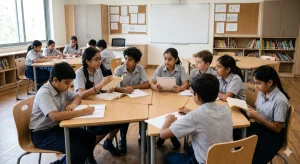
In the classroom, participation and discussion will take place over one-way instruction. Teachers will use projects, activities, stories, and examples to explain subjects. Students will be free to express their opinions and ask questions.
Role-playing, group projects, and practical exercises will help in learning. Every session will be planned for better understanding rather than just completing the curriculum. In the classroom, there will be better support and less burden. Children will receive regular feedback to help them improve gradually.
Freedom to Select Interests and Subjects
In the past, students’ options were restricted by fixed topic streams. These restrictions have been removed under the New Education Policy 2020, allowing students to choose from a variety of interests.
Students are now able to:
- Combine arts and science subjects
- Discover strengths over time
- Make informed career decisions
This flexibility under NEP 2020 for schools helps students grow with confidence.
Practical Skills as Part of School Life
Skill-based education is now a key part of schooling. The policy introduces vocational learning from middle school onwards.
Students are exposed to:
- Digital tools
- Financial basics
- Creative and technical skills
These changes in school education India prepare students for real-life challenges, not just exams.
How Children with Various Learning Needs Are Supported by NEP 2020
The New Education Policy 2020 recognises that each kid learns differently. Schools are expected to provide children with a wide range of learning opportunities and skills. Children with specific learning needs receive targeted attention and guidance.
Different learning capacities are accommodated by modifying teaching techniques. Dedicated teachers provide support to students in need. While creating specific learning plans, a student’s needs are taken into account. The inclusion policy under NEP 2020 for schools reflects improvements in Indian education and ensures that every child feels supported.
NEP 2020 on School Governance and Accountability
Strong systems are essential for high-quality education. The goal of the New Education Policy 2020 is to improve school governance by increasing supervision and awareness.
Key improvements include:
- Clear performance standards
- Regular school reviews
- Accountability in management
These steps under NEP 2020 for schools help parents trust the system and understand how schools maintain quality, reflecting responsible changes in school education India.
Involvement of Parents in the NEP 2020 Framework
In their child’s educational path, parents are no longer just observers. Parents are encouraged to take an active role in their children’s education and development under the New Education Policy 2020.
Parents can:
- Support learning at home
- Communicate with teachers
- Encourage skills and values
This shared responsibility under NEP 2020 for schools strengthens the learning environment and supports positive changes in school education India.
Role of Teachers in the New Learning System
Teachers are central to the success of the New Education Policy 2020. The policy focuses on regular teacher training and modern teaching methods.
Teachers are guided to:
- Encourage discussion
- Support individual learning needs
- Act as mentors
This approach under NEP 2020 for schools creates stronger classrooms and supports lasting changes in school education India.
NEP 2020’s Long-Term Effects on Higher Education and Careers
The New Education Policy 2020 has an impact outside of the classroom. It gives students more skills and self-assurance as they move into higher education and the work life.
Long-term results consist of:
- Better career clarity
- Skill-based job readiness
- Lifelong learning habits
The results above show how NEP 2020 for schools influences future achievement and strengthens the general changes in Indian education.
Conclusion
The New Education Policy 2020 introduces intentional and much-needed change in Indian education. By prioritising understanding, broad-based abilities, and adaptability, it creates a beneficial learning environment for all children. Parents are able to help their children through these changes in Indian education by staying up to date with NEP 2020 for schools, ensuring that they develop not only academically but also as capable and self-assured individuals.
At Billabong High International School, we provide a learning environment shaped to support curiosity, skills, and overall development. Get in touch with us right now to find out more about our curriculum!
Also Read: A Guide to Understanding Cybersecurity